Quick Answer
A box of flooring typically weighs 20-60 pounds, depending on the material and how many square feet it holds. Laminate boxes usually weigh about 25-40 lb, luxury vinyl plank (LVP) about 25-50 lb, engineered hardwood about 30-50 lb, solid hardwood about 40-60 lb, and porcelain tile boxes often 50-70 lb. The exact weight is printed on the box label or the product spec sheet.
Key Takeaways
- Most flooring boxes hold about 15-30 square feet, so box weight depends on both coverage and material density.
- Rigid-core vinyl (SPC) is much heavier per square foot than thin glue-down vinyl.
- Tile and solid hardwood are the heaviest common flooring types per box.
- Multiply pounds per square foot by your total square footage to plan your truck load.
- Check your vehicle’s payload rating before loading more than a few hundred pounds.
Knowing what a box of flooring weighs helps you plan pickup, decide whether you need delivery, and avoid overloading your car or your back. Weights vary more than people expect: two boxes that look identical can differ by 20 pounds. Below are typical ranges for every common flooring type, a simple way to estimate your total load, and safe handling tips.
How Much Does a Box of Flooring Weigh by Type?
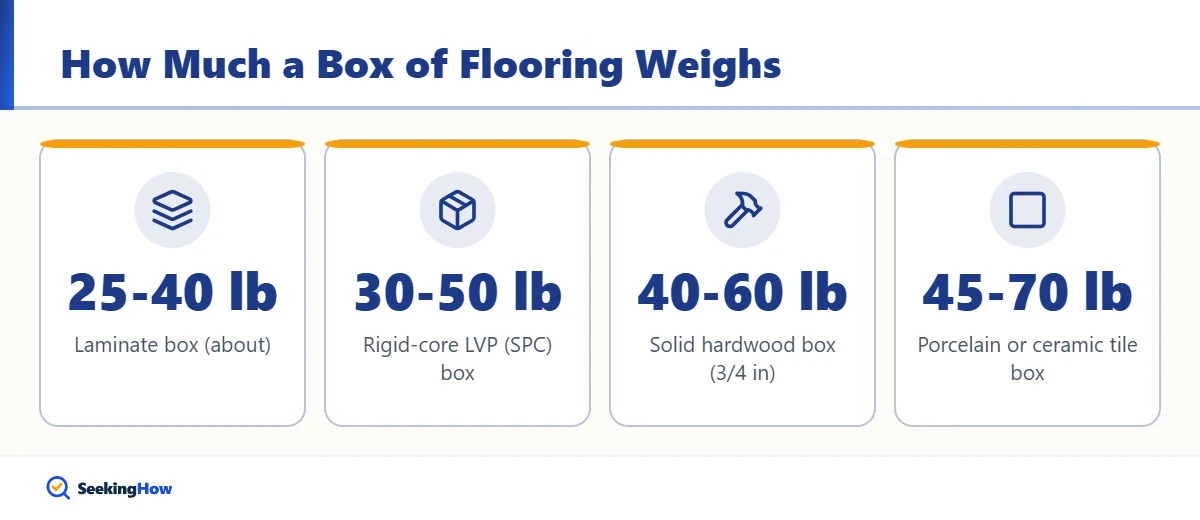
The table shows typical ranges for standard boxes from major brands. Use it for planning, then confirm with the label on your specific product.
| Flooring type | Typical sq ft per box | Approx. lb per sq ft | Typical box weight |
|---|---|---|---|
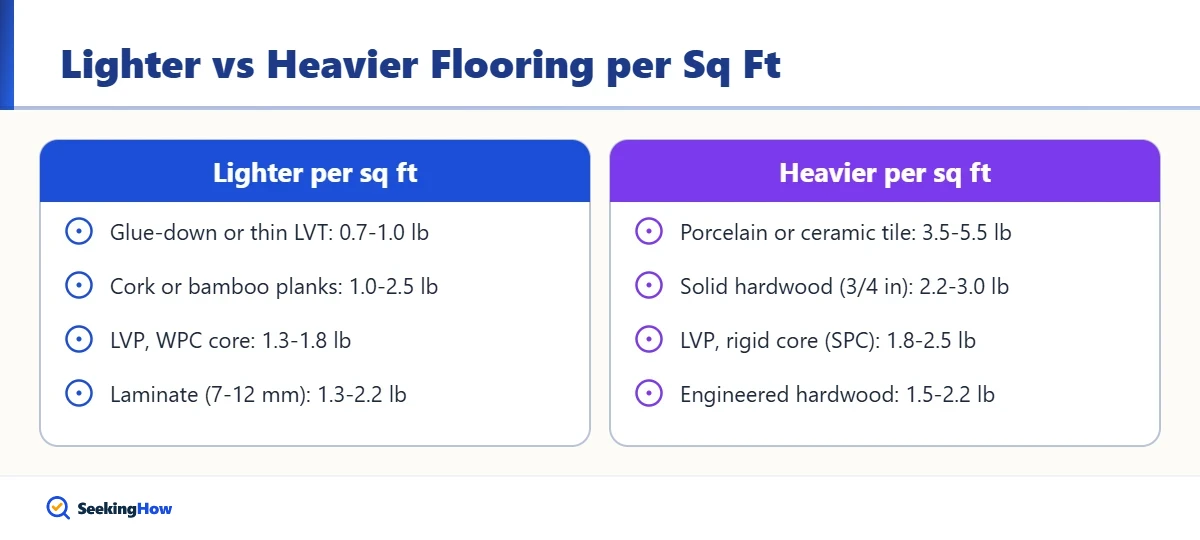
| Laminate (7-12 mm) | 15-25 | 1.3-2.2 | 25-40 lb |
| Luxury vinyl plank, rigid core (SPC) | 15-25 | 1.8-2.5 | 30-50 lb |
| Luxury vinyl plank, WPC | 18-25 | 1.3-1.8 | 25-40 lb |
| Glue-down or thin LVT (2-3 mm) | 30-45 | 0.7-1.0 | 25-40 lb |
| Engineered hardwood | 18-30 | 1.5-2.2 | 30-50 lb |
| Solid hardwood (3/4 in) | 18-25 | 2.2-3.0 | 40-60 lb |
| Porcelain or ceramic tile | 10-16 | 3.5-5.5 | 45-70 lb |
| Cork or bamboo planks | 18-25 | 1.0-2.5 | 20-50 lb |
Ranges are approximate and vary by thickness, species, wear layer and manufacturer.
Why Do Flooring Box Weights Vary So Much?
Three factors drive most of the difference:
- Density of the core: SPC vinyl uses a stone-polymer core that is heavy and rigid; WPC and HDF laminate cores are lighter.
- Thickness: a 12 mm laminate weighs noticeably more per square foot than a 7 mm one; 3/4-inch solid oak is heavier than 3/8-inch engineered oak.
- Coverage per box: manufacturers set box sizes partly so a carton stays liftable, which is why heavy tile boxes often hold only 10-16 square feet.
Attached underlayment pads add a little weight, and wood species matters too: hickory and maple are denser than many oaks.
How Do You Calculate the Total Weight of Your Flooring?
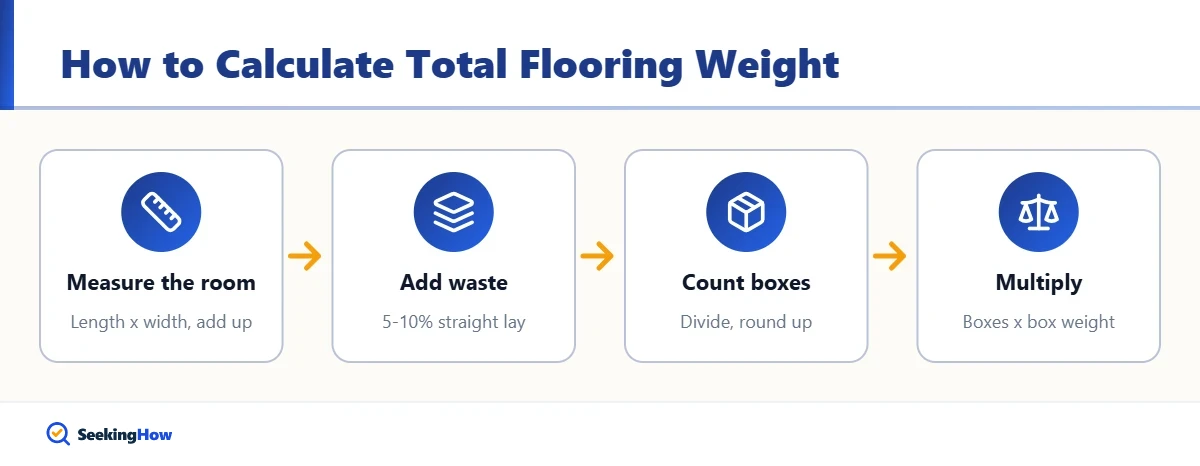
You only need two numbers: your total square footage (including waste) and the weight per box or per square foot.
- Measure the room: length times width for each area, then add them together.
- Add waste: about 5-10% for straight lay, 10-15% for diagonal or herringbone patterns.
- Find the box count: divide total square feet by square feet per box and round up.
- Multiply: box count times box weight gives your total load.
Example: a 12 x 15 ft bedroom is 180 sq ft. Adding 10% waste gives 198 sq ft. With rigid-core LVP at 23 sq ft per box, you need 9 boxes. At about 45 lb each, that is roughly 405 lb of flooring.
| Project size | Laminate (about 1.7 lb/sq ft) | SPC vinyl (about 2.2 lb/sq ft) | Porcelain tile (about 4.5 lb/sq ft) |
|---|---|---|---|
| 200 sq ft | About 340 lb | About 440 lb | About 900 lb |
| 500 sq ft | About 850 lb | About 1,100 lb | About 2,250 lb |
| 1,000 sq ft | About 1,700 lb | About 2,200 lb | About 4,500 lb |
Tip: Remember to add the weight of underlayment, transition strips, adhesive, thinset or grout. Thinset and grout bags often weigh 25-50 lb each.
Can Your Car or Truck Carry the Flooring?
Every vehicle has a payload rating, the maximum combined weight of passengers and cargo. You will find it on the Tire and Loading Information sticker on the driver’s door jamb or in the owner’s manual.
- Sedans and small SUVs: payload is often roughly 800-1,200 lb including people, and trunk space limits you to a handful of boxes.
- Midsize and full-size pickups: payloads commonly fall around 1,000-2,500 lb depending on configuration.
- Utility trailers: check both the trailer’s rating and your vehicle’s towing capacity.
Lay boxes flat, spread the weight evenly over the axle, and strap them down. For loads over your payload rating, use store delivery or a rental truck. A full pallet of flooring can easily weigh 1,500-3,000 lb.
How Do You Lift and Store Flooring Boxes Safely?
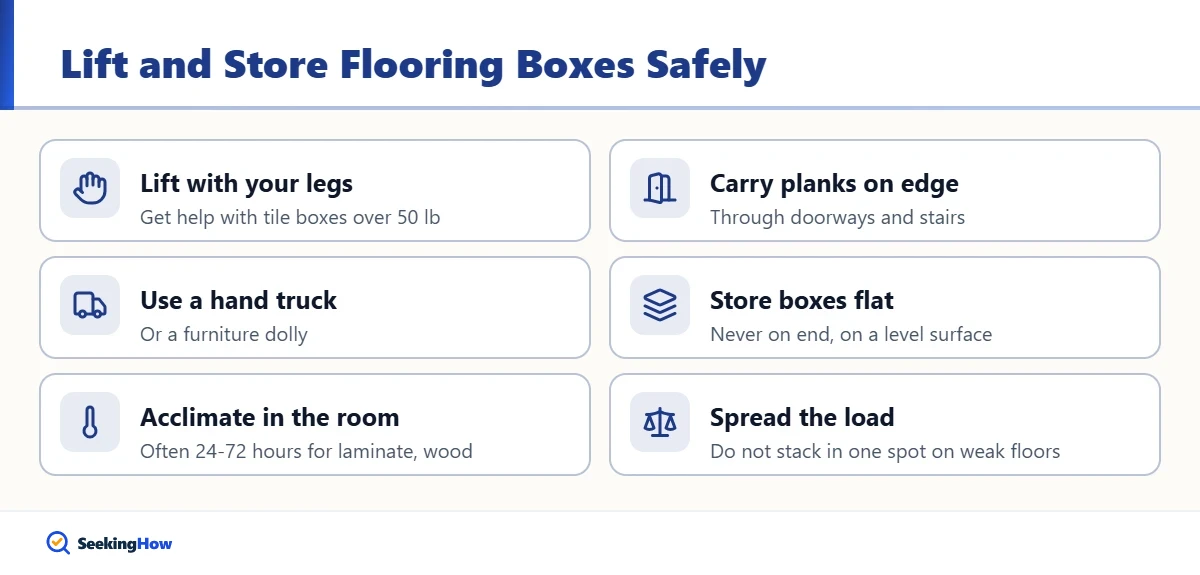
- Lift with your legs, keep the box close to your body, and avoid twisting; get help with tile boxes over 50 lb.
- Carry long plank boxes on edge through doorways and stairs rather than flat.
- Use a hand truck or furniture dolly for multiple boxes.
- Store boxes flat on a level surface, never on end, to prevent warping or broken locking edges.
- Acclimate the flooring in the room where it will be installed; many manufacturers specify about 24-72 hours for laminate and wood, but follow your product’s instructions.
- Do not stack heavy boxes in a single spot on a weak floor, porch or mezzanine; spread them out.
Safety: If you are storing a large tile order on an upper floor, deck or raised structure, spread the load across joists or get advice from a contractor or structural engineer. Our guide on building an addition on piers explains why floor framing load limits matter.
Does Heavier Flooring Mean Better Quality?
Not necessarily. Weight reflects material and thickness, not overall quality. A heavy SPC plank is very dimensionally stable and resists dents, but a lighter WPC plank can feel warmer and quieter underfoot. Thicker laminate often sounds more solid, yet wear rating (AC rating) matters more for durability. Compare the wear layer, warranty and core type rather than box weight alone.
What Should You Plan for After Delivery?
Once your boxes arrive, inspect each one for crushed corners and confirm the same production run or dye lot on every carton so color matches. Then plan the finishing details: our guide to installing baseboard molding on an uneven floor helps you trim out the room, and if you are mixing hard floors with rugs, see how to keep carpet edges from fraying. For garages, interlocking tiles are a lighter alternative; see how to cut RaceDeck tiles.
Frequently Asked Questions
How much does a box of laminate flooring weigh?
A standard box of laminate flooring usually weighs about 25 to 40 pounds. Thinner 7 to 8 mm laminate sits at the low end, while 12 mm boards with attached pads are heavier. Boxes typically cover 15 to 25 square feet, and the exact weight is printed on the carton.
How much does a box of vinyl plank flooring weigh?
Rigid-core SPC vinyl plank boxes typically weigh about 30 to 50 pounds, while lighter WPC planks are often 25 to 40 pounds. Thin glue-down vinyl boxes can hold more square feet at similar weights. Check the label, as core density varies by brand.
How many boxes of flooring fit in a pickup truck?
It depends on the payload, not just bed space. A truck with a 1,500 pound payload and two adult passengers might safely carry around 25 to 30 laminate boxes but far fewer tile boxes. Check the door jamb payload sticker and subtract passenger weight first.
How much does a pallet of flooring weigh?
A full pallet of flooring commonly weighs roughly 1,500 to 3,000 pounds, depending on the material and box count. Tile pallets are usually the heaviest. Most cars and many pickups cannot safely carry a full pallet, so use store delivery or a rental truck.