Quick Answer
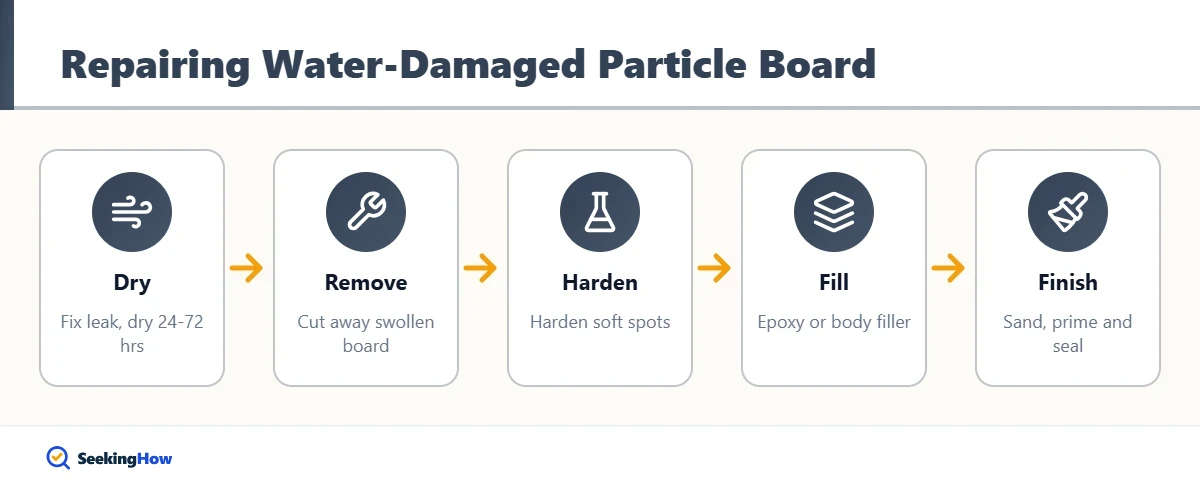
To repair particle board water damage, dry the piece completely for 24-72 hours, cut or sand away swollen material, harden soft areas with a penetrating wood hardener, fill with two-part epoxy or polyester filler, sand smooth, then prime with a shellac or oil-based primer and paint. Badly crumbled panels should be replaced instead.
Key Takeaways
- Swelling in particle board is permanent; drying stops further damage but won’t shrink it back.
- Wood hardener soaks into soft, crumbly fibers and binds them so filler has something solid to grip.
- Use waterproof two-part fillers, not water-based wood putty, on particle board.
- Seal every raw edge afterward; exposed edges are where water gets in.
- If the panel sags, crumbles or holds screws loosely, replacing it is safer than patching.
Particle board (and its cousin, MDF) is made of wood chips or fibers bonded with resin, then covered with laminate, veneer or paint. When water gets through the surface, the fibers absorb it and expand, leaving bubbles, puffed edges and soft spots. You can often make a solid repair if you act before the board starts falling apart.
How Do You Know How Bad the Damage Is?
Press on the area with a screwdriver tip and look at the edges. The board’s condition decides whether to repair or replace it.
| Damage level | What you see | Best approach |
|---|---|---|
| Minor | Slight edge swelling, laminate intact, board firm | Dry, sand flush, seal edges |
| Moderate | Raised bubbles, soft spots, peeling veneer | Dry, remove swollen material, harden, fill, refinish |
| Severe | Crumbling, sagging, screws pulling out, mold | Replace the panel or piece |
What Do You Need?
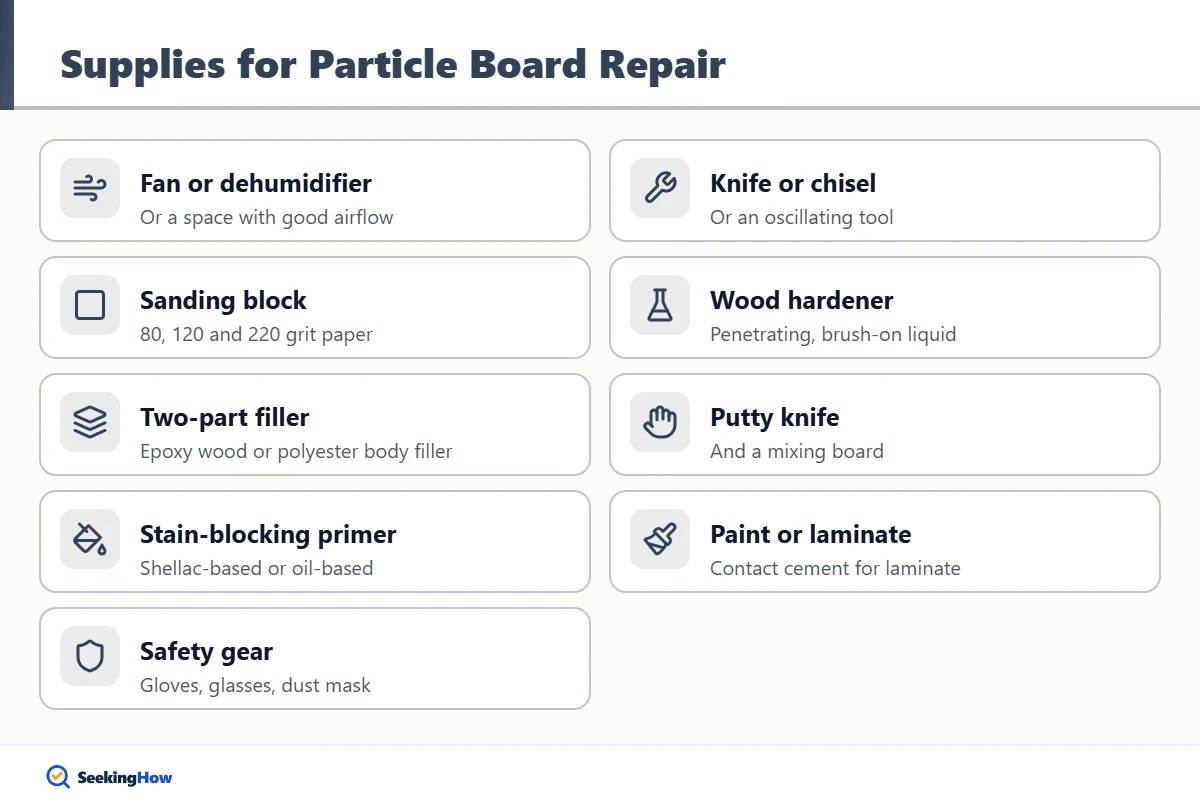
- Fan, dehumidifier or space with good airflow
- Utility knife, chisel or oscillating tool
- Sanding block and sandpaper (80, 120 and 220 grit)
- Penetrating wood hardener (liquid, brush-on)
- Two-part epoxy wood filler or polyester body filler
- Putty knife and mixing board
- Shellac-based or oil-based stain-blocking primer
- Paint, or contact cement and laminate/veneer for laminated pieces
- Gloves, safety glasses and a dust mask or respirator
How Do You Repair Particle Board Water Damage Step by Step?
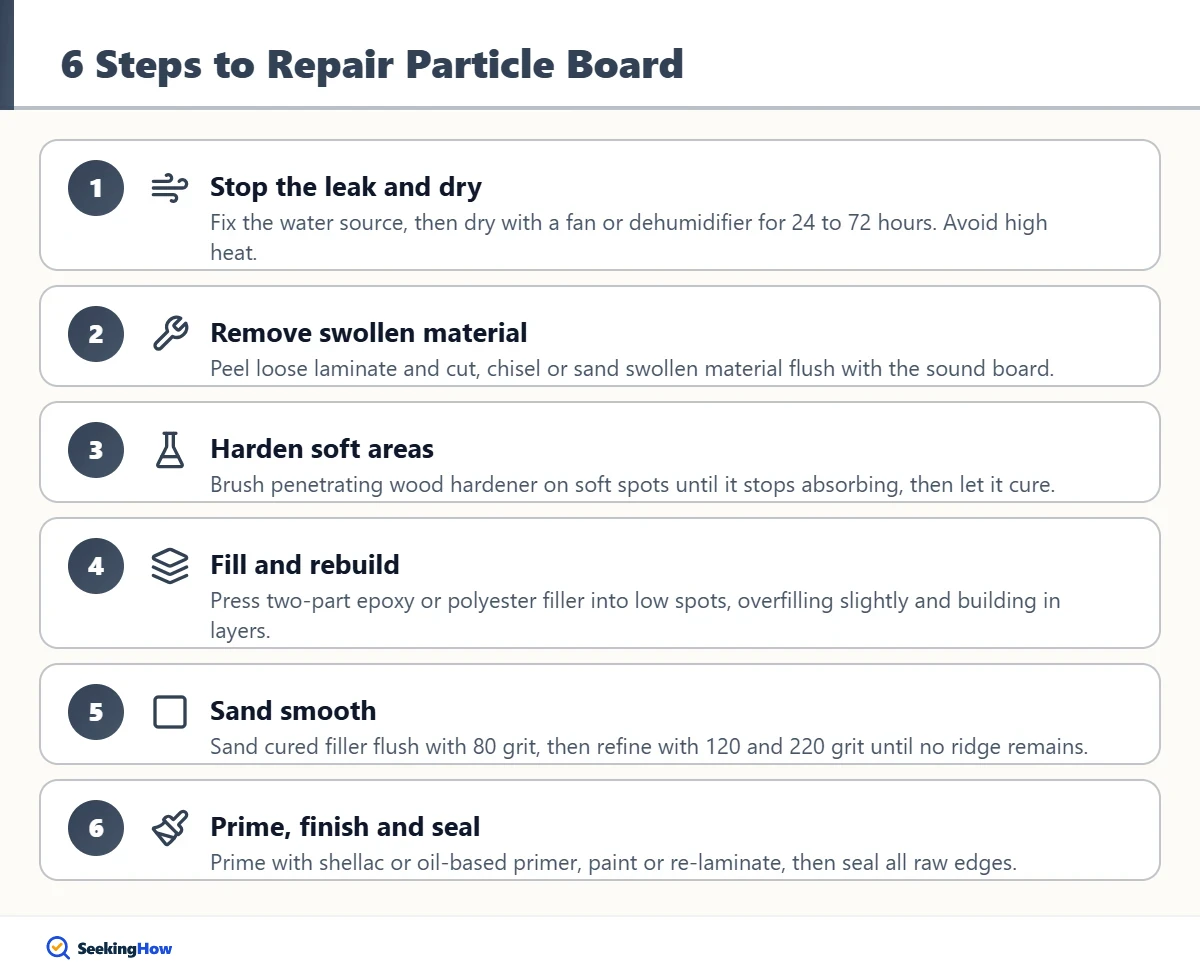
Step 1: Stop the Leak and Dry the Board
Find and fix the water source first, whether it is a dripping sink trap, a leaking dishwasher or a wet floor. Remove items from the cabinet, open doors, and dry the area with a fan or dehumidifier for 24-72 hours until the board feels completely dry and firm. Don’t use high heat, which can crack the surface and warp the board.
Step 2: Remove Swollen and Loose Material
Peel back any loose laminate or veneer. Cut, chisel or sand away the swollen, puffy material until the surface is flush with the undamaged board around it. If the surface is only slightly raised, sanding with 80 grit may be enough.
Step 3: Harden Soft Areas
Brush penetrating wood hardener onto soft or crumbly spots and let it soak in. Apply additional coats until the area stops absorbing, then let it cure according to the label, often a few hours. The cured hardener binds loose fibers into a firm base.
Step 4: Fill and Rebuild
Mix a small batch of two-part epoxy or polyester filler and press it into low spots and damaged edges with a putty knife. Overfill slightly, and build deep areas in layers. For broken corners, a strip of tape can act as a form while the filler sets.
Step 5: Sand Smooth
Once cured, sand the filler flush with 80 grit, then refine with 120 and 220 grit. Run your hand across the repair; you should not feel any ridge. Wipe off dust before finishing.
Step 6: Prime, Finish and Seal
Prime the repair and surrounding board with a shellac-based or oil-based primer, which seals the surface and keeps the fibers from swelling again. Paint to match, or glue down new laminate or veneer with contact cement. Finally, seal all raw edges, especially bottom edges and cutouts around plumbing.
Safety: Two-part fillers and hardeners release fumes, so work in a ventilated area and wear gloves and eye protection. Particle board dust is fine and irritating; wear a dust mask or respirator when sanding. If you see or smell mold, wear an N95 respirator and see the mold section below.
How Do You Fix Swollen Particle Board Under a Sink?
Sink base cabinets take the most water damage because of slow leaks at the trap, supply lines and faucet. After fixing the leak and drying the cabinet, you have three options for the floor panel.
- Patch it: follow the steps above for small swollen areas.
- Overlay it: cut a piece of 1/4 inch plywood or a cabinet liner to fit over the damaged floor and seal it with polyurethane. This hides the damage and adds a protective layer.
- Replace it: if the bottom is soft or sagging, cut it out and screw in a new piece of 1/2 inch or 3/4 inch plywood supported by cleats on the cabinet sides.
A waterproof sink mat or tray under the trap catches future drips. If you suspect a hidden leak behind walls or underground, our guide on how to tell if you have a water leak underground explains the warning signs.
How Do You Repair Water-Damaged Particle Board Furniture?
Flat-pack dressers, desks and bed frames often get damaged at the bottom edge from mopping or spills. Loose joints are common, because swollen board can’t hold cam locks and screws. Fill stripped screw holes with epoxy, let it cure, then drill new pilot holes. If a bolt head has stripped while you were disassembling the piece, see how to remove a stripped Allen screw.
For particle board slats or bed supports that have softened, don’t patch; replace them with solid wood, as in our guide on fixing a broken bed slat.
What Mistakes Should You Avoid?
- Trying to press the swelling back down: clamping or ironing does not reverse swollen fibers and can crack the surface.
- Using water-based wood putty: it can add moisture and won’t bond well to wet-damaged fibers.
- Repairing before the board is dry: trapped moisture leads to mold and failed filler.
- Skipping primer: latex paint directly on particle board can raise fibers and absorb moisture.
- Patching structural parts: shelves, cabinet floors and bed supports that carry weight should be replaced if soft.
What If There Is Mold?
Particle board that stayed wet for more than a day or two can grow mold, which shows up as black, green or white fuzzy spots or a musty smell. Because particle board is porous, mold can grow inside it, and the EPA advises that porous materials with mold often need to be thrown away. Small surface spots on otherwise solid board can be cleaned, but moldy, soft panels should be removed and replaced. For mold covering a large area, roughly more than 10 square feet, consider a professional remediation company.
How Can You Prevent Particle Board Water Damage?
- Seal raw edges and cutouts with paint, polyurethane or edge banding.
- Use waterproof mats under sinks and plants.
- Wipe spills immediately, especially on laminated tops where seams meet.
- Keep furniture off damp basement floors with plastic furniture glides or risers.
- Check under sinks every few months for drips.
When Should You Replace Instead of Repair?
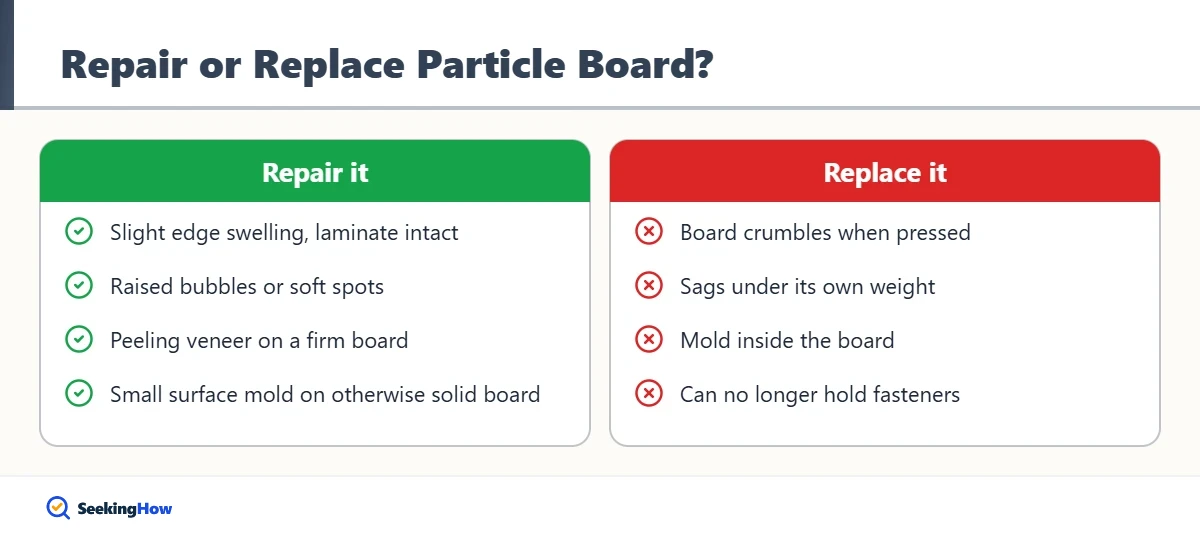
Replace the piece if the board crumbles when pressed, sags under its own weight, has mold inside, or can no longer hold fasteners. Cheap flat-pack furniture often costs less to replace than to repair properly. For built-in cabinets, a cabinet maker or handyman can replace individual panels or floors without replacing the whole unit.
Frequently Asked Questions
Can swollen particle board go back to normal?
No. Once the wood chips absorb water and expand, the resin bonds break and the board stays swollen even after drying. You need to sand or cut away the raised material and rebuild the surface with a waterproof filler, or replace the panel.
What is the best filler for particle board?
Two-part epoxy wood filler or polyester body filler works best because both cure hard, resist moisture and bond to hardened fibers. Water-based wood putty is a poor choice because it shrinks, absorbs moisture and does not grip damaged particle board well.
How long does water-damaged particle board take to dry?
Usually 24 to 72 hours with good airflow from a fan or dehumidifier, depending on how wet it got and the humidity. The board should feel completely dry and firm before you apply hardener or filler. Avoid high heat, which can warp or crack it.
Can I use wood glue to fix water-damaged particle board?
Wood glue can reattach loose laminate or veneer to a dry, firm surface, but it will not rebuild crumbled or swollen board. For soft fibers use a penetrating wood hardener, and for missing material use a two-part filler.
Is water-damaged particle board dangerous?
The board itself is not dangerous, but particle board that stayed wet can grow mold, and soft structural parts like shelves or cabinet floors may fail under weight. Replace moldy or crumbling pieces and wear a mask when sanding.