Quick Answer
To take out a flat back nose stud, wash your hands, then hold the flat disc inside your nostril steady with one finger. For a threadless (push-pin) stud, pull the decorative top straight out. For an internally threaded stud, twist the top counterclockwise until it unscrews. Slide the post out from inside. It takes under a minute; never force it, and wait until the piercing is healed.
Key Takeaways
- Flat back nose studs come in two main types: threadless (push-pin) and internally threaded. Identify yours first.
- Always stabilize the flat back inside the nostril so you do not twist or tug the healing tissue.
- Threadless tops pull straight out; threaded tops unscrew counterclockwise (“lefty-loosey”).
- Nostril piercings commonly take about 4-6 months or longer to heal; avoid removing jewelry before then.
- If the stud is stuck, embedded or the area is swollen, see a professional piercer rather than forcing it.
Flat back nose studs, also called labret-style studs, are popular because the disc sits flush inside the nostril and will not snag on tissues or poke your nose. That same flush design makes them confusing to remove the first time. This guide shows you how to tell which type you have, the exact removal steps, and what to do if it will not budge.
What Type of Flat Back Nose Stud Do You Have?
Look at your purchase details or ask your piercer. If you are not sure, the feel of the top usually tells you. There are two common designs, plus a few less common ones.
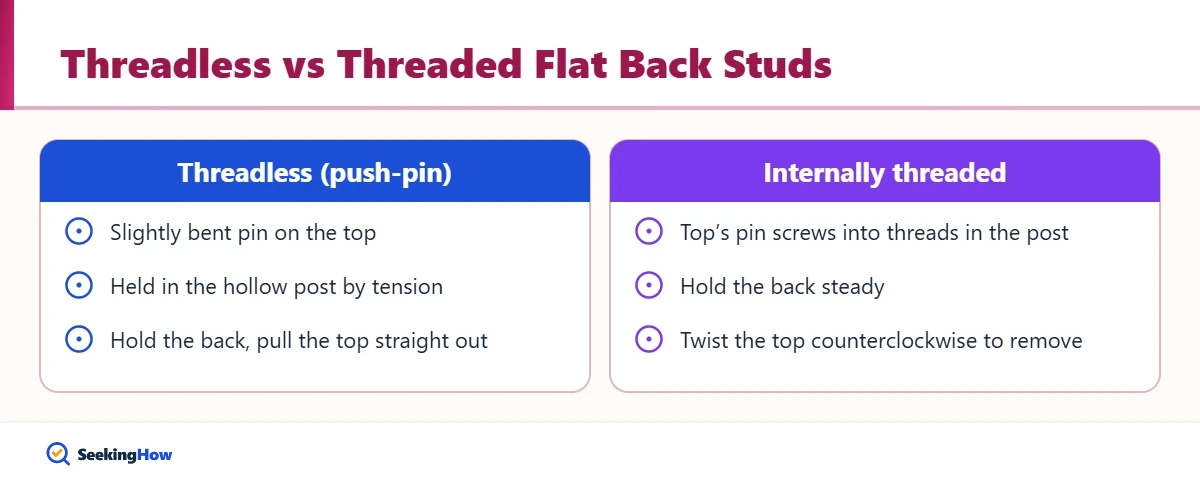
| Type | How it holds | How to remove |
|---|---|---|
| Threadless (push-pin) | A slightly bent pin on the top presses into the hollow post, held by tension | Hold the back, pull the top straight out |
| Internally threaded | The top’s threaded pin screws into threads inside the post | Hold the back, twist the top counterclockwise |
| Externally threaded (less common, lower quality) | Threads are on the post itself | Unscrew counterclockwise; threads may scrape the channel |
| One-piece flat back | Top and post are fused | Cannot be taken apart; have a piercer remove or cut it |
Most implant-grade titanium jewelry from professional studios is threadless or internally threaded. If the top looks like it has no seam at all, it may be a one-piece stud.
What Do You Need Before You Start?
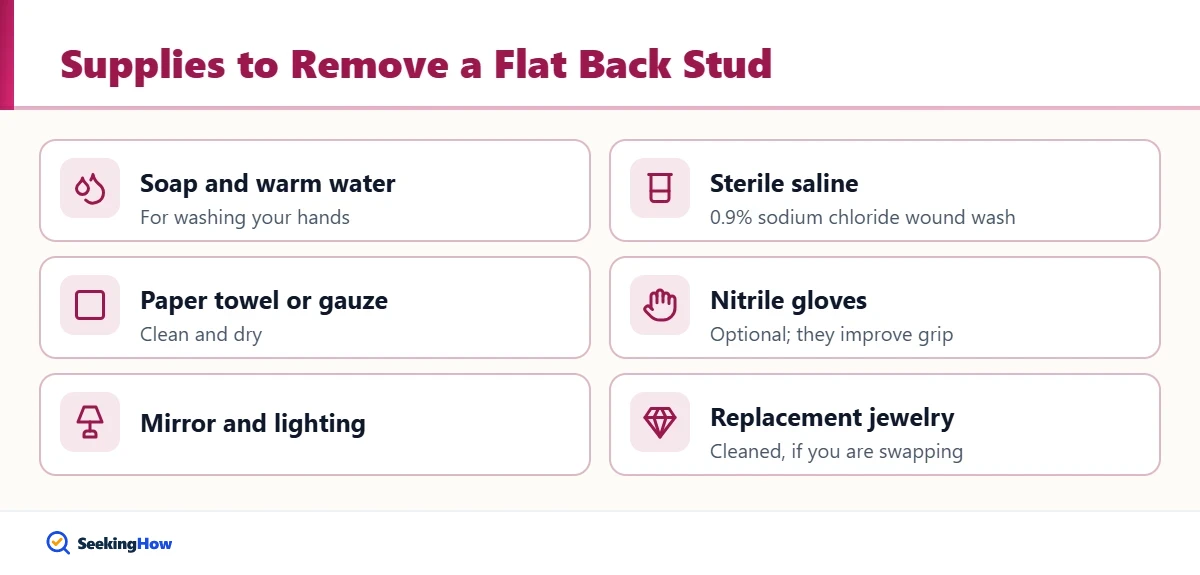
- Soap and warm water for your hands
- Sterile saline wound wash (0.9% sodium chloride), sold at pharmacies
- Clean, dry paper towel or gauze
- Disposable nitrile gloves (optional, they improve grip)
- A mirror and good lighting
- Your replacement jewelry, cleaned, if you are swapping
How Do You Take Out a Flat Back Nose Stud?
Work slowly in front of a mirror. Your nose may be slightly tender afterward, which is normal.
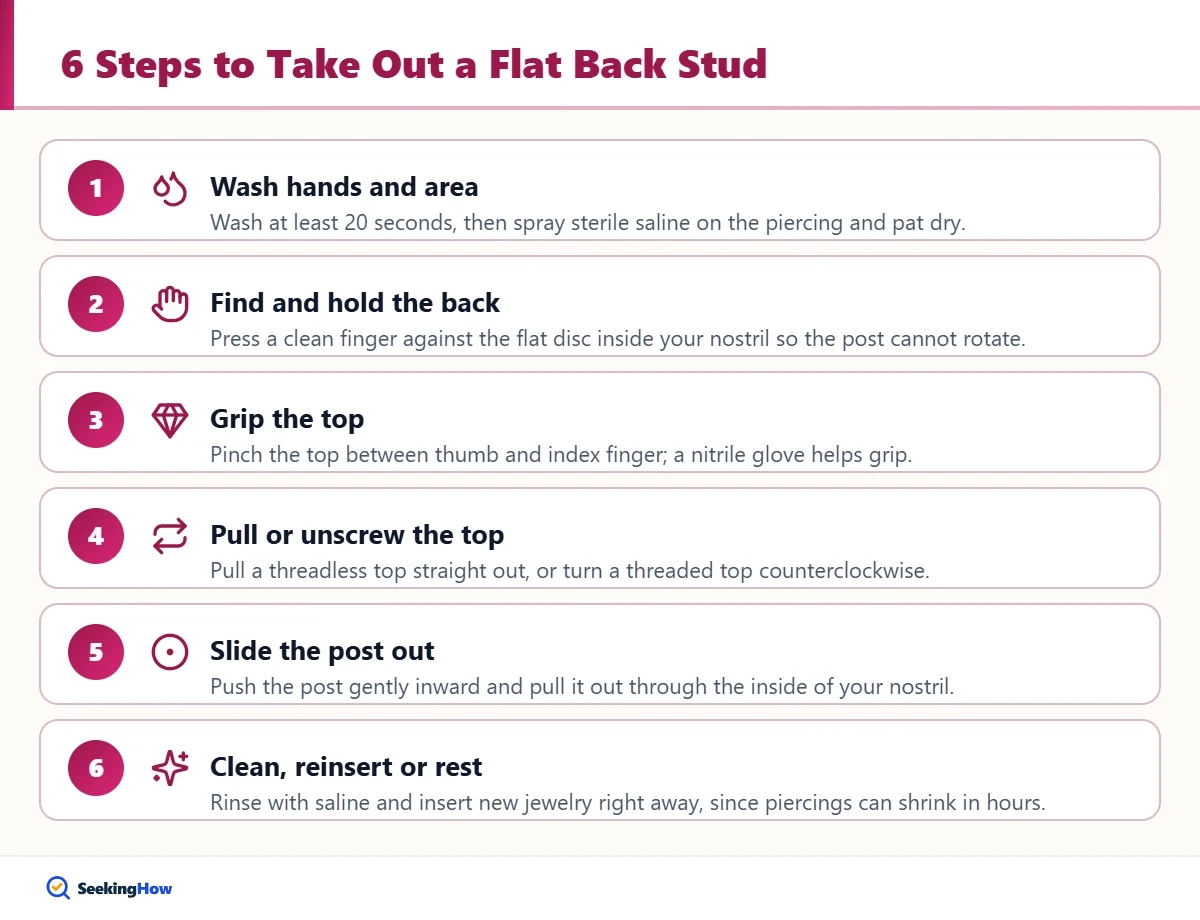
Step 1: Wash Your Hands and the Area
Wash your hands with soap and water for at least 20 seconds and dry them well. Spray or dab sterile saline on the outside and inside of the piercing to loosen any dried discharge, then pat dry. Dry fingers grip the tiny parts far better.
Step 2: Find and Hold the Flat Back
Place a clean finger or thumb inside your nostril and press gently against the flat disc. Hold it firmly against the inside of your nose so the post cannot rotate. This is the most important step: it keeps you from pulling or twisting the piercing channel.
Step 3: Grip the Top
With your other hand, pinch the decorative top between your thumb and index finger. Wearing a nitrile glove or using a clean piece of rubber shelf liner helps if the top is small and smooth.
Step 4: Pull or Unscrew the Top
For a threadless stud, pull the top straight out, away from your face. Some piercers suggest a gentle wiggle while pulling. For an internally threaded stud, turn the top counterclockwise as you look at it in the mirror until it comes free. Do not bend the pin of a threadless top.
Step 5: Slide the Post Out From Inside
Once the top is off, push the post gently inward and pull it out through the inside of your nostril by the flat back. Keep the pieces on a clean paper towel; they are tiny and easy to lose down a drain, so close the sink stopper first.
Step 6: Clean and Reinsert or Let It Rest
Rinse the area with saline. If you are inserting new jewelry, do it right away, since nostril piercings can start to shrink within hours. Insert the new post from inside the nostril, then attach the top from the outside.
Tip: Close the bathroom sink drain or work over a towel. Nose stud tops are often 2-3 mm wide and almost impossible to find once dropped.
What If Your Nose Stud Will Not Come Out?
- Threadless top is too tight: try a firmer grip with a glove and a straight pull, not a twist. Tight tension is normal for a secure fit.
- Threaded top will not turn: make sure you are holding the back still. Dried discharge can glue threads; soak with warm saline for a few minutes and try again.
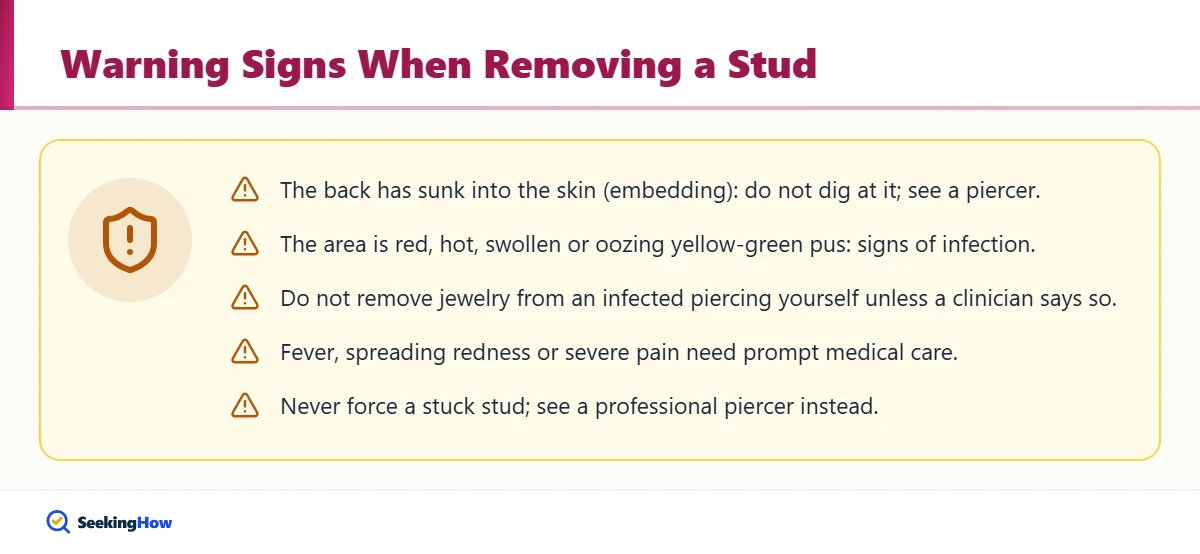
- Back has sunk into the skin: this is called embedding and usually happens when the post is too short during swelling. Do not dig at it.
- Area is red, hot, swollen or oozing yellow-green pus: these can be signs of infection.
Safety: If jewelry is embedded or you suspect an infection, see a professional piercer or your doctor. Do not remove jewelry from an infected piercing on your own unless a clinician tells you to, because closing the hole can trap infection under the skin. Fever, spreading redness or severe pain need prompt medical care.
How Long Should You Wait Before Changing a Nose Stud?
Nostril piercings commonly take about 4-6 months to heal and sometimes longer. Many piercers recommend leaving the initial jewelry in place until you are fully healed and then returning to the studio for your first change, since they may also downsize the post once swelling settles. Removing jewelry too early can irritate the channel or let it close quickly.
How Do You Choose a Replacement Flat Back Stud?
- Material: implant-grade titanium (ASTM F136), niobium or solid 14k-18k gold are the common body-safe choices. Avoid mystery metals and plated jewelry, which may contain nickel. If nickel bothers you, our guide on cleaning nickel silver explains what that alloy actually is.
- Gauge: nose studs are often 18g or 20g. Match your current size unless your piercer advises otherwise.
- Post length: healed nostrils often take about 6 mm, but anatomy varies. Too short can embed; too long snags.
- Style: threadless studs are easy to swap tops on; threaded studs are very secure.
How Do You Clean Your Nose Stud Jewelry?
Soak titanium or gold studs in warm water with a drop of mild, fragrance-free soap, scrub gently with a soft toothbrush, rinse well and dry. Avoid alcohol and hydrogen peroxide on a healing piercing because they can irritate tissue. Gemstone tops need gentler handling; our guide to cleaning tanzanite rings covers how to care for softer stones.
What Mistakes Should You Avoid?
- Twisting a threadless top, which bends the pin and loosens the fit.
- Pulling the stud out from the outside without holding the flat back.
- Using dirty hands or fingernails to pry at the disc.
- Leaving the piercing empty for hours when you want to keep it.
- Forcing jewelry back into a hole that has started to close; a piercer can use a taper safely.
Frequently Asked Questions
Do flat back nose studs unscrew?
Some do and some do not. Internally threaded flat back studs unscrew by turning the top counterclockwise while you hold the back still. Threadless or push-pin studs do not unscrew; the top is held by tension and pulls straight out. Ask your piercer which type you have.
Which way do you turn a nose stud to unscrew it?
Turn the top counterclockwise, or to the left, as you look at it in a mirror, while holding the flat back still inside your nostril. Turning clockwise tightens it. If it will not move, soak the area with warm saline to loosen dried discharge and try again.
Can I take my nose stud out after 2 months?
It is usually too early. Nostril piercings commonly take about 4 to 6 months or longer to heal, and removing jewelry before then can irritate the channel or let it close. If you need a change sooner, have a professional piercer do it.
How fast does a nose piercing close?
A new or healing nose piercing can begin to shrink within hours of removing jewelry. Fully healed, older piercings may stay open longer, but this varies widely. If you want to keep the hole, insert replacement jewelry right away or use a clear retainer.