Quick Answer
To fix a broken bed slat, take the weight off the frame, then either glue and clamp a clean crack, “sister” a new 1×4 board alongside the break with wood glue and 1-1/4 inch screws, or replace the slat with a new board cut to length. Most fixes take 30-60 minutes and cost under $20 in lumber, glue and screws.
Key Takeaways
- A clean crack along the grain can be glued and clamped; a slat snapped across the grain needs sistering or replacement.
- Replacement slats are usually 1×3 or 1×4 pine (actual size 3/4 inch thick by 2-1/2 or 3-1/2 inches wide) cut to the frame’s inside width.
- Wood glue needs about 24 hours to fully cure before you sleep on the repair.
- Repeated breaks usually mean the slats are too far apart or the frame needs a center support leg.
Bed slats break for predictable reasons: a knot in the wood, too much gap between slats, a missing center support, or someone jumping on the bed. The good news is that a slat is one of the simplest parts of any bed to repair. This guide walks you through choosing the right fix, doing it properly and stopping it from happening again.
Why Do Bed Slats Break?
Most slats fail at their weakest point, which is usually the middle of the span or a knot in the board. Pine and other softwoods are common in budget frames, and a 3/4 inch thick softwood board spanning 60 inches or more flexes noticeably under a queen or king mattress.
- Too much span: wide beds without a center rail force each slat to carry the load over its full length.
- Wide gaps: slats spaced more than about 3 inches apart concentrate weight on fewer boards, and many mattress makers require gaps of 3 inches or less for warranty coverage.
- Wood defects: knots, short grain and checks (small splits) are natural weak spots.
- Point loads: kneeling, standing or jumping on the mattress puts far more force on one or two slats than lying down.
- Loose fit: slats that slide in their ledges can fall off or crack where they rest on the rail.
What Do You Need to Fix a Broken Bed Slat?
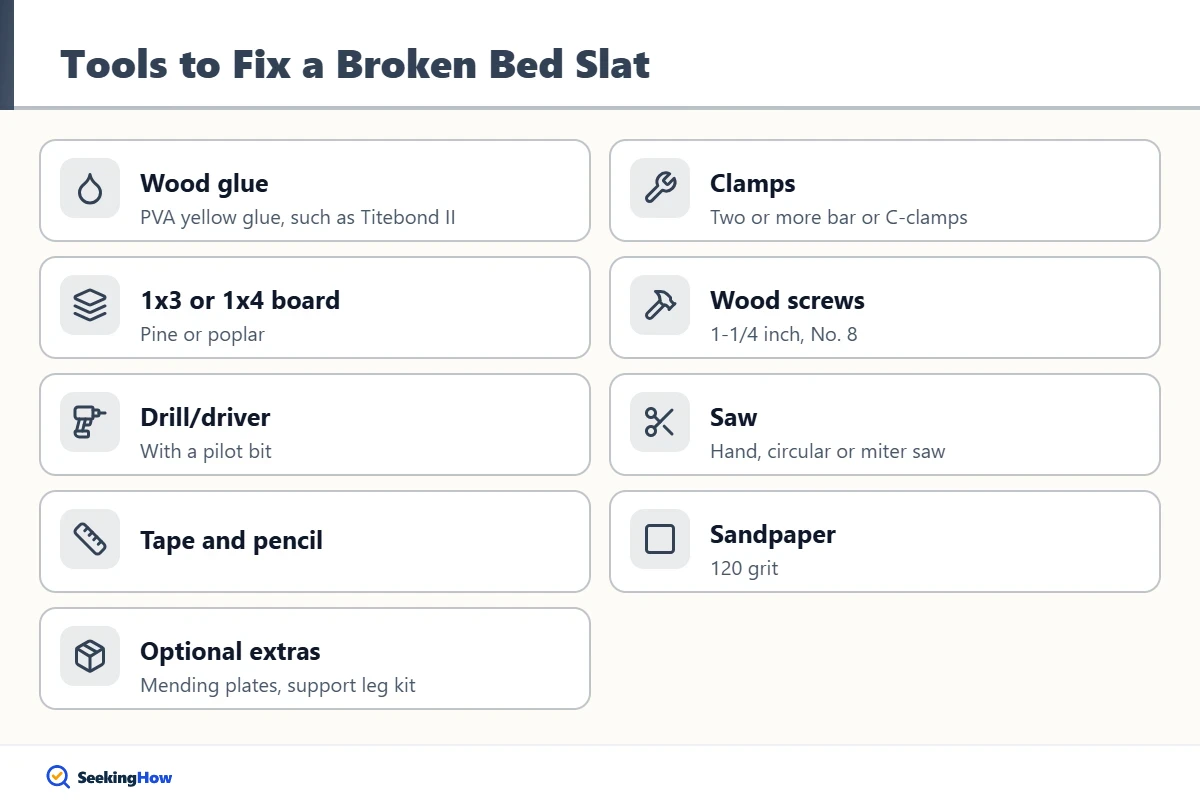
Gather everything before you strip the bed so the frame isn’t out of use longer than necessary. You won’t need every item; the list depends on the method you choose below.
- Wood glue (a PVA glue such as Titebond II or a similar yellow wood glue)
- Two or more bar clamps or C-clamps
- A 1×3 or 1×4 pine or poplar board for sistering or replacement
- 1-1/4 inch wood screws (No. 8 is a good size)
- Drill/driver with a pilot bit
- Handsaw, circular saw or miter saw
- Tape measure and pencil
- Sandpaper (120 grit)
- Optional: flat steel mending plates, a center support leg kit, or a bunkie board
Which Repair Method Should You Use?
Look closely at the break before you buy anything. The direction and size of the crack tells you whether glue alone will hold or whether the slat needs reinforcement.
| Type of damage | Best fix | Time | Strength |
|---|---|---|---|
| Split along the grain, pieces still attached | Glue and clamp | 20 min + 24 hr cure | Good for light cracks |
| Snapped across the grain | Sister a new board alongside | 30-45 min | Very strong |
| Splintered, rotten or multiple breaks | Replace the slat | 30-60 min | Like new |
| Cracked at the end where it sits on the rail | Metal mending plate or replacement | 20 min | Good |
| Several slats breaking over time | Add center support or bunkie board | 1-2 hr | Fixes the root cause |
How Do You Fix a Broken Bed Slat Step by Step?
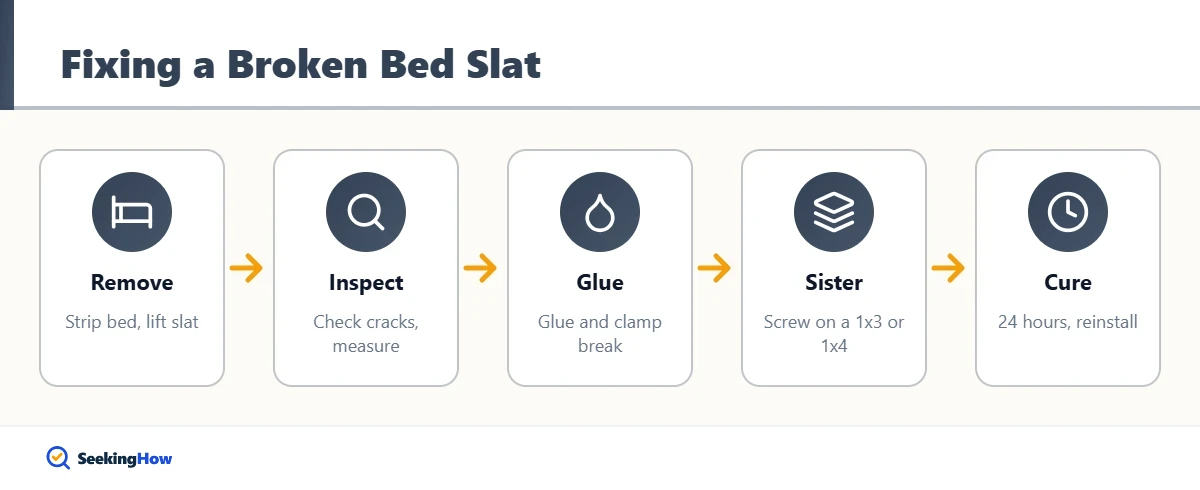
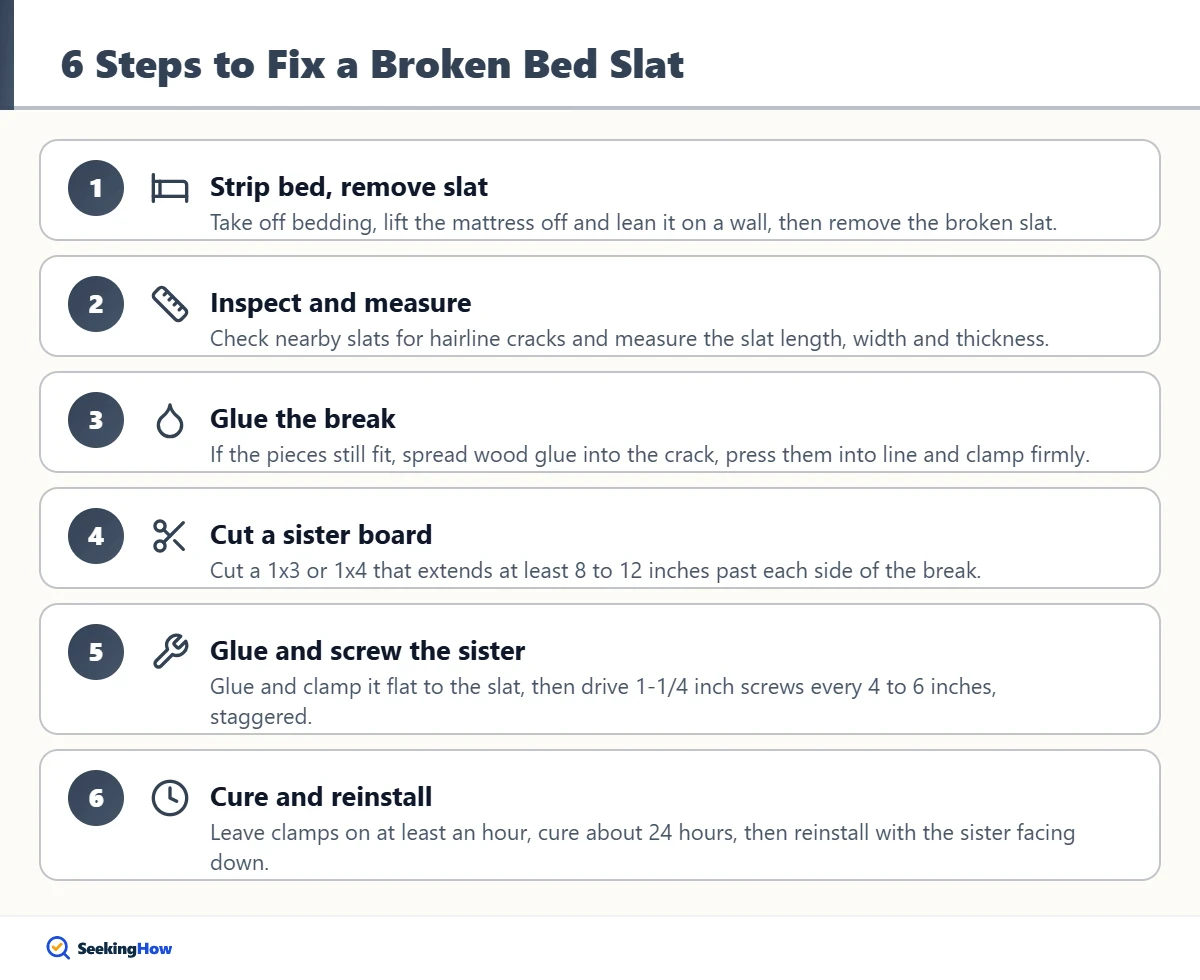
The steps below cover the most reliable all-purpose method: gluing the break and sistering a new board alongside it. If you decide to replace the slat entirely, follow Steps 1, 2 and 6 and swap Steps 3-5 for the replacement instructions in the next section.
Step 1: Strip the Bed and Remove the Slat
Take off the bedding and lift the mattress off the frame; lean it against a wall rather than dragging it. Unscrew or lift out the broken slat. Many slats sit loose on a ledge or are held by plastic caps, while others are screwed to the side rails.
Step 2: Inspect and Measure
Check the break and the neighboring slats for hairline cracks you might have missed. Measure the slat’s full length, width and thickness, and note the gap between slats. Write these down so your new board matches.
Step 3: Glue the Break
If the pieces still fit together, spread wood glue into the crack, press the pieces back into line and clamp them firmly. Wipe away squeeze-out with a damp cloth. If the slat has splintered badly, skip the glue and go straight to sistering.
Step 4: Cut a Sister Board
Cut a piece of 1×3 or 1×4 that extends at least 8-12 inches past each side of the break. For a break near the middle of a long slat, many people simply cut a sister the full length of the slat, which adds the most stiffness.
Step 5: Glue and Screw the Sister in Place
Spread glue on the face of the sister board, clamp it flat against the slat and drive 1-1/4 inch screws every 4-6 inches, staggered so you don’t split the wood. Drill pilot holes first, and make sure screw tips don’t poke through the other side where they could snag the mattress.
Step 6: Let It Cure and Reinstall
Leave the clamps on for at least an hour and let the glue cure for about 24 hours before putting full weight on it. Sand any rough edges, reinstall the slat with the sister board facing down, and put the mattress back.
How Do You Replace a Bed Slat Completely?
Replacement is the cleanest fix when a slat is splintered, warped or broken in more than one place. Home centers sell 1×3 and 1×4 pine boards in 6 and 8 foot lengths, and many will make simple cuts for you.
- Use the old slat as a template, or measure the inside distance between the side-rail ledges and subtract about 1/4 inch so the slat drops in easily.
- Choose a straight board with few knots; sight down its length to check for bowing.
- Cut to length and sand the ends and edges so they won’t snag fabric.
- If the original slats had end caps, holes or brackets, transfer or replicate them.
- Set the new slat in place and screw it down if the originals were screwed.
Tip: Poplar and select-grade pine cost a little more than common board, but they have fewer knots and make noticeably stiffer slats. If your bed uses curved (sprung) slats, buy manufacturer replacements, because a flat board won’t match the height of the others.
What About Quick or Temporary Fixes?
If you need the bed usable tonight, these stopgaps work until you can make a proper repair.
- Mending plates: screw flat steel mending plates across the underside of the break. They’re fast but less stiff than a wood sister.
- Plywood strip: a strip of 1/2 inch plywood screwed under the break spreads the load over a wider area.
- Borrowed slat: move a slat from the foot end to the middle, where the most weight sits, and leave a slightly bigger gap at the foot temporarily.
- Bunkie board: a thin, fabric-covered platform laid over the slats bridges a weak spot and spreads weight across all of them.
If you’re building or upgrading a foundation, our guide on making a box spring out of plywood shows how to create a solid platform that ends slat problems for good.
What Are the Most Common Mistakes When Fixing Bed Slats?
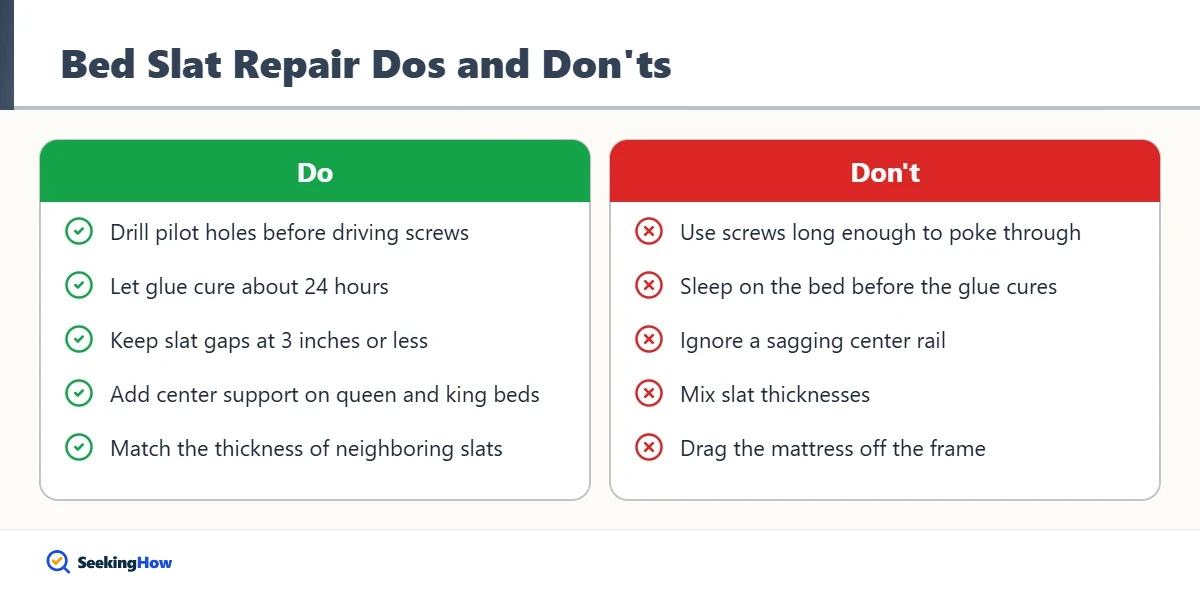
- Skipping pilot holes: screws driven near the edge of a 3/4 inch board split it easily.
- Using screws that are too long: anything that pokes through can tear the mattress cover.
- Sleeping on it too soon: glue joints reach full strength only after curing, typically around 24 hours.
- Ignoring the cause: if the center rail is sagging or a support leg is missing, new slats will break again.
- Mixing thicknesses: a slat that sits higher or lower than its neighbors creates a ridge or dip you will feel.
How Can You Stop Bed Slats From Breaking Again?
Prevention is mostly about spreading the load. For queen and king beds, a center rail supported by at least one leg to the floor makes the biggest difference. Center support kits with adjustable legs are inexpensive and screw to the existing center rail.
Keep slat gaps at 3 inches or less, especially under memory foam or hybrid mattresses, which need even support. If the slats slide around, screw each one to the ledge or add a strip of non-slip rubber; the same principle is behind our tips on stopping couch cushions from sliding.
Finally, check the frame’s hardware once or twice a year. Loose bolts let the frame rack, which twists the slats and loosens their seating. If a bolt head is stripped and won’t turn, see our guide to removing a stripped Allen screw, since many flat-pack beds use hex bolts.
When Should You Replace the Whole Frame Instead?
Slats are cheap to fix, but some damage isn’t worth chasing. Consider a new frame or foundation if the side rails are cracked, the ledges that hold the slats are splitting off, the joints keep loosening even after tightening, or the frame is particle board that has swollen or crumbled. A cracked side rail carries the weight of every slat, so repairing it safely is a bigger job than replacing a single board.
Frequently Asked Questions
Can I use a 2×4 as a bed slat?
You can, but a 2×4 is 1-1/2 inches thick, twice the height of a standard 3/4 inch slat, so it will sit higher than the others and create a ridge. Either replace all the slats with matching boards or rip the 2×4 down to the same thickness as your existing slats.
How far apart should bed slats be?
Most mattress manufacturers recommend slat gaps of about 3 inches or less, and some memory foam brands specify even less. Wider gaps let foam sag between boards and put more weight on each slat, which makes breaks more likely. Check your mattress warranty for its exact requirement.
Is it safe to sleep on a bed with one broken slat?
For a night or two it is usually fine if you move the broken slat away from the center or remove it and shift the others to close the gap. Leaving a large gap can damage your mattress and overload neighboring slats, so make a proper repair soon.
What wood is best for replacement bed slats?
Straight, knot-free pine or poplar in 1×3 or 1×4 size works well for most beds. Poplar is slightly harder and stiffer. Avoid boards with large knots near the middle, and sight down the board before buying to make sure it is not bowed or twisted.
Does wood glue alone fix a broken bed slat?
Wood glue works well for a crack that runs along the grain when the pieces fit tightly. For a slat snapped across the grain, glue alone is not strong enough because end grain bonds poorly, so add a sister board or replace the slat.