
Quick Answer
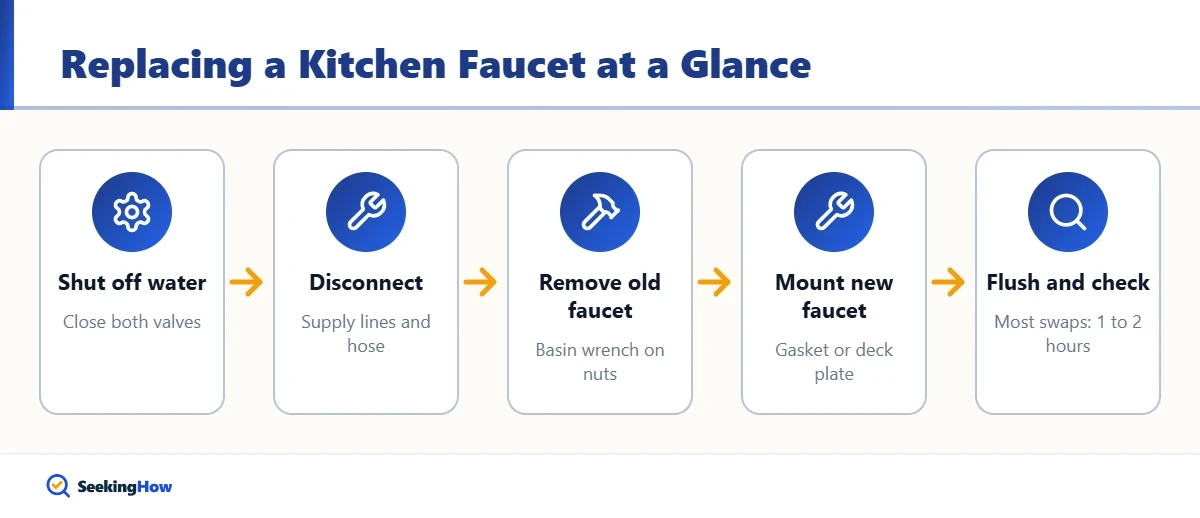
To replace a kitchen faucet, shut off the hot and cold valves under the sink, open the faucet to release pressure, disconnect the supply lines and sprayer hose, and remove the mounting nuts with a basin wrench. Clean the sink deck, mount the new faucet with its gasket, connect the pull-down hose and new braided supply lines, then flush and check for leaks. Most swaps take 1 to 2 hours.
Key Takeaways
- Count the holes in your sink or countertop before you buy; your new faucet (with or without a deck plate) must match.
- A basin wrench is the one specialty tool that makes removing old mounting nuts under the sink much easier.
- Replace the supply lines with new braided stainless lines at the same time; old lines are a common leak point.
- Flush the new faucet by running water with the aerator removed so debris does not clog the cartridge or spray head.
Replacing a kitchen faucet is one of the most approachable plumbing upgrades. Most modern faucets come with flexible connections and quick-connect sprayer hoses, so you rarely need to cut or solder anything. This guide walks through planning, removal and installation, plus fixes for the common snags that slow people down.
What Do You Need to Replace a Kitchen Faucet?
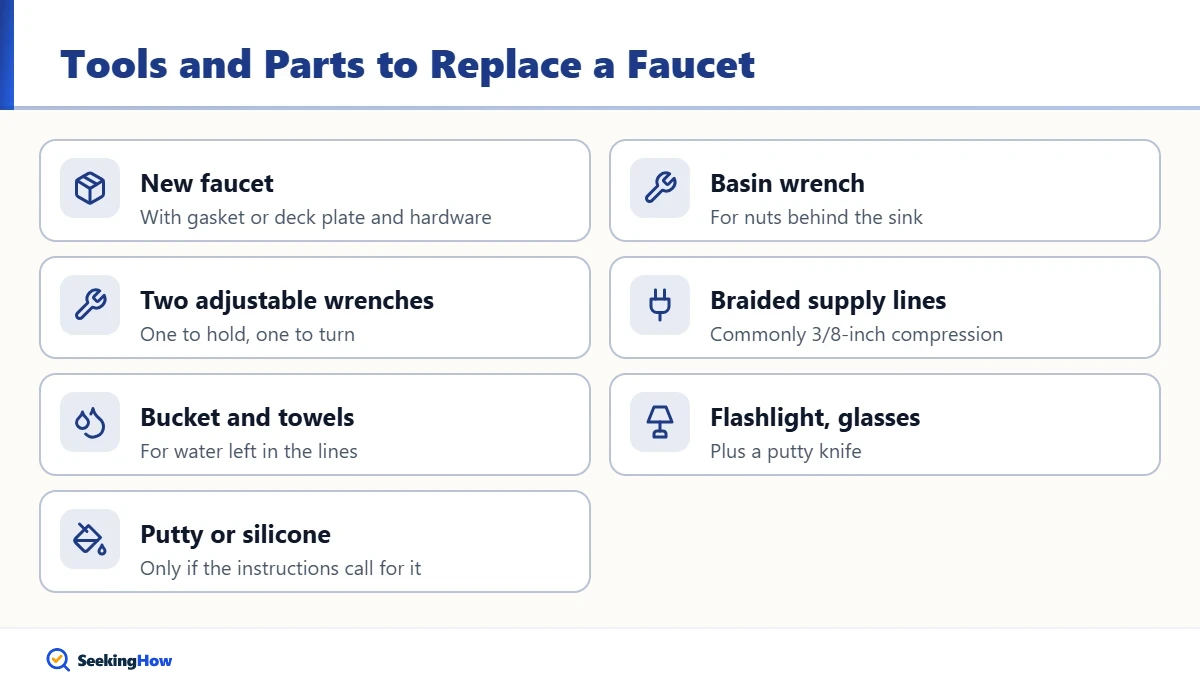
- New faucet: with its gasket or deck plate, mounting hardware and instructions.
- Basin wrench: a long-handled wrench with a swiveling jaw for nuts behind the sink.
- Adjustable wrenches: two, one to hold fittings and one to turn.
- New supply lines: braided stainless lines sized to your valves, commonly 3/8-inch compression on the valve side.
- Bucket and towels: for water left in the lines.
- Flashlight or headlamp, safety glasses and a putty knife.
- Plumber’s putty or silicone: only if the faucet instructions call for it.
How Do You Choose the Right Replacement Faucet?
Look under the sink and on the deck to count mounting holes. Many kitchen sinks have one, three or four holes. A single-hole faucet can cover a three-hole sink with a deck plate, while a fourth hole is often used for a soap dispenser, side sprayer or filtered water faucet.
| Faucet style | Holes needed | Pros | Considerations |
|---|---|---|---|
| Single-handle pull-down | 1 (or 3 with deck plate) | Tall arc, easy to fill pots | Needs space above for the spout |
| Single-handle pull-out | 1 (or 3 with deck plate) | Compact; good under low cabinets | Shorter reach than pull-down |
| Two-handle with side sprayer | 3 to 4 | Traditional look; separate temp control | More connections to make |
| Touch or touchless | 1 | Hands-free on and off | Needs batteries or an outlet |
| Commercial-style spring spout | 1 | Powerful spray, large sinks | Tall; check cabinet clearance |
Also check the distance from the faucet to any window or backsplash, and whether the handle will swing freely. If you plan to add a dishwasher or water filter at the same time, see how long it takes to install a dishwasher to plan your day.
How Do You Replace a Kitchen Faucet Step by Step?
Step 1: Clear the Cabinet and Turn Off the Water
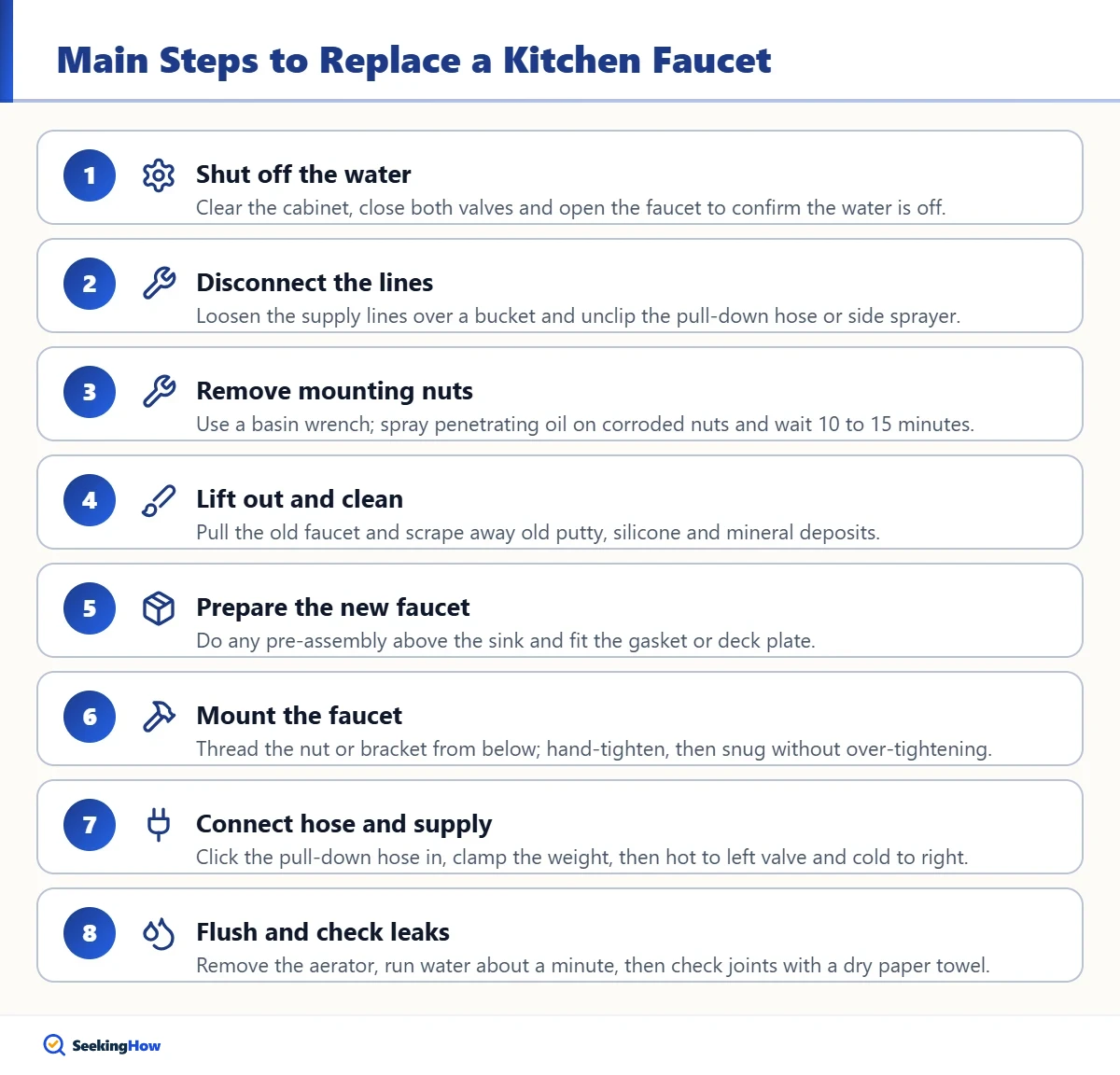
Empty the sink cabinet and lay down a towel. Turn the hot and cold shutoff valves clockwise until they stop, or turn a quarter-turn valve so the handle is perpendicular to the pipe. Open the faucet to confirm the water is off; if a valve will not close, shut off the main.
Step 2: Disconnect the Supply Lines
Set a bucket under the valves. Using one wrench to steady the valve body, loosen the compression nuts where the supply lines attach to the valves and let the lines drain. If you have a dishwasher or filter tee on the hot line, note how it connects before taking it apart.
Step 3: Disconnect the Sprayer or Pull-Down Hose
Squeeze or pull the clip on a quick-connect fitting to release a pull-down hose, and remove the hose weight. For an older side sprayer, unscrew the hose from the faucet body. Take a photo before you disconnect so you know how everything was routed.
Step 4: Remove the Mounting Nuts
Reach behind the sink with a basin wrench and turn the mounting nuts counterclockwise. Some faucets use a single large nut or a mounting bracket with screws. Spray penetrating oil on corroded nuts and wait 10 to 15 minutes; if they will not move, carefully cut them with a hacksaw blade or oscillating tool.
Step 5: Lift Out the Old Faucet and Clean the Deck
Pull the old faucet straight up, feeding hoses through the holes. Scrape away old putty, silicone and mineral deposits with a plastic putty knife, then clean with a mild cleaner or a little vinegar. A clean, dry surface helps the new gasket seal.
Step 6: Prepare the New Faucet
Unpack the faucet and read its instructions. Attach any pre-assembly the manual calls for, such as threading the supply lines into the faucet body before mounting, which is much easier above the sink. Fit the gasket or deck plate, or apply putty or silicone only if the instructions call for it.
Step 7: Mount the Faucet
Feed the hoses and supply lines through the hole and set the faucet on the deck, facing forward. Have a helper hold it straight from above while you thread the mounting nut or bracket from below. Tighten firmly by hand, then snug it with the supplied tool or a basin wrench without over-tightening.
Step 8: Connect the Pull-Down Hose
Route the spray hose down and connect it to the faucet outlet with the quick-connect fitting until it clicks, then tug gently to confirm. Clamp the weight onto the hose at the position marked in the instructions so the spray head retracts fully.
Step 9: Connect the Water Supply
Attach the hot line to the left valve and cold to the right, as is standard. Tighten each compression nut by hand, then about a quarter to a half turn with a wrench. Do not use thread tape on compression fittings unless the manufacturer says to.
Step 10: Flush the Lines and Check for Leaks
Remove the aerator or spray head as the instructions direct, open the shutoff valves slowly and run hot and cold water for about a minute to flush debris. Reinstall the aerator, then run the faucet and check every connection with a dry paper towel. Tighten any weeping fitting slightly and check again after a few hours.
How Long Does It Take to Replace a Kitchen Faucet?
A straightforward swap with accessible shutoff valves typically takes 1 to 2 hours for a DIYer. Allow longer if the old mounting nuts are corroded, the shutoff valves leak or will not close, or you are converting from a three-hole to a single-hole faucet. A professional plumber can often finish in about an hour.
Tip: Old multi-turn shutoff valves sometimes leak at the stem when you turn them after years of sitting. Have towels ready, and consider replacing them with quarter-turn valves while the faucet is out.
What Are Common Problems When Replacing a Faucet?
- Nuts that will not budge: use penetrating oil, a basin wrench with a long handle, or cut the nut. Protect the sink with a towel.
- Not enough room to work: remove the garbage disposal or drain trap temporarily if necessary, and use a headlamp.
- Leak at the supply connection: the nut is under- or over-tightened, or the line is the wrong size. Replace the line if the ferrule is damaged.
- Spray head does not retract: reposition the weight or check that the hose is not catching on items in the cabinet.
- Low flow after install: debris in the aerator or cartridge screen; remove and rinse it.
Safety: Wear safety glasses when working under the sink, since debris and water can fall in your eyes. If the shutoff valves are corroded, will not close, or you see a leaking or cracked pipe, stop and call a licensed plumber rather than forcing parts. A leaking PVC drain joint is a separate repair; see fixing a leaking PVC joint without cutting.
Should You Repair or Replace Your Kitchen Faucet?
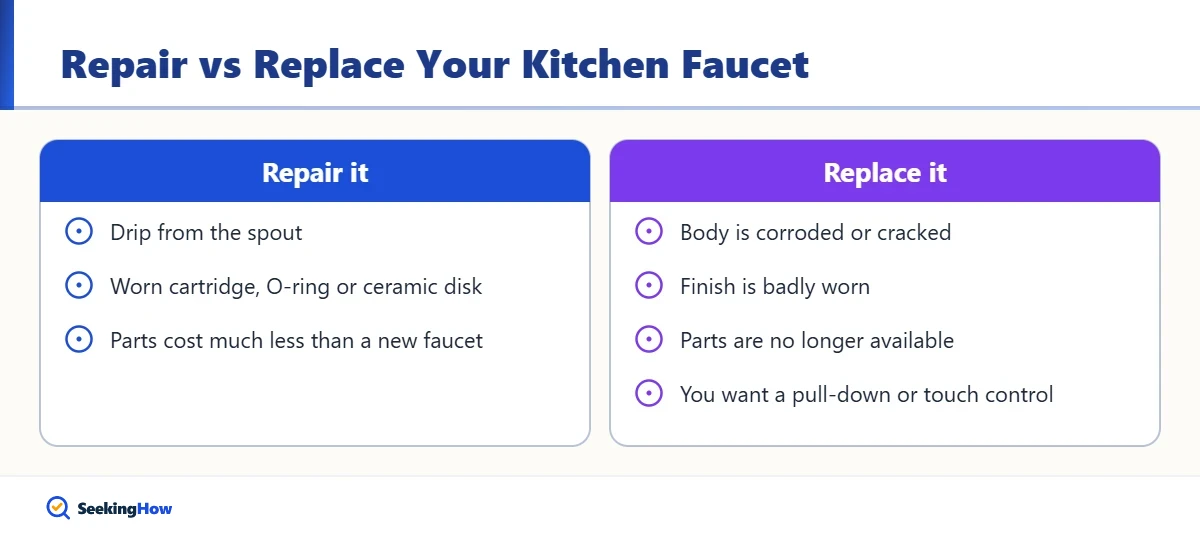
A drip from the spout is often a worn cartridge, O-ring or ceramic disk that can be replaced for much less than a new faucet. Replace the whole faucet if the body is corroded or cracked, the finish is badly worn, parts are no longer available, or you want features like a pull-down sprayer or touch control.
Once the new faucet is in, keep it performing well by cleaning the aerator every few months in hard-water areas. If you connect a garden hose or portable appliance to the tap, see how to connect a hose to a kitchen tap, and if you use an under-sink filter, our guide on changing a drinking water filter covers the cartridge swap.
Frequently Asked Questions
Can I replace a kitchen faucet myself?
Yes. Most homeowners can replace a kitchen faucet with basic tools and a basin wrench, since modern faucets use flexible supply lines and quick-connect hoses. Call a licensed plumber if the shutoff valves do not work, pipes are corroded, or you need to move or add plumbing.
Do I need plumber putty for a kitchen faucet?
Usually not. Most new kitchen faucets include a rubber or foam gasket or deck plate that seals against the sink. Some manufacturers call for putty or silicone in certain installs, and stone countertops can stain from some putties, so follow the faucet instructions.
What size are kitchen faucet supply lines?
The valve end is most often a 3/8-inch compression connection in US homes, and the faucet end varies by model, commonly 1/2-inch or 3/8-inch. Many faucets include attached lines. Take the old line or valve size to the store, and choose braided stainless lines.
Why is my new faucet leaking under the sink?
Check each connection with a dry paper towel. Leaks usually come from a supply nut that is too loose or overtightened, a missing washer, a cross-threaded fitting, or a quick-connect hose not fully clicked in. Tighten gently, reseat the hose, or replace a damaged supply line.
How do I remove a stuck kitchen faucet nut?
Spray penetrating oil on the nut, wait 10 to 15 minutes, and use a basin wrench with steady pressure. A faucet nut removal tool can help with plastic nuts. If it still will not turn, carefully cut the nut with a hacksaw blade or oscillating tool, protecting the sink.