Quick Answer
A Whirlpool ice maker usually stops working because it is switched off, the wire shut-off arm is raised, the water supply or filter is restricted, the fill tube is frozen, or the freezer is warmer than about 0°F. Turn the ice maker on, lower the arm, replace an old filter, thaw the fill tube and give it 24 hours to produce ice.
Key Takeaways
- Check the simple things first: the on/off switch or control-panel setting, the shut-off arm and the ice bin position.
- A clogged water filter or kinked supply line is one of the most common reasons for small or no ice.
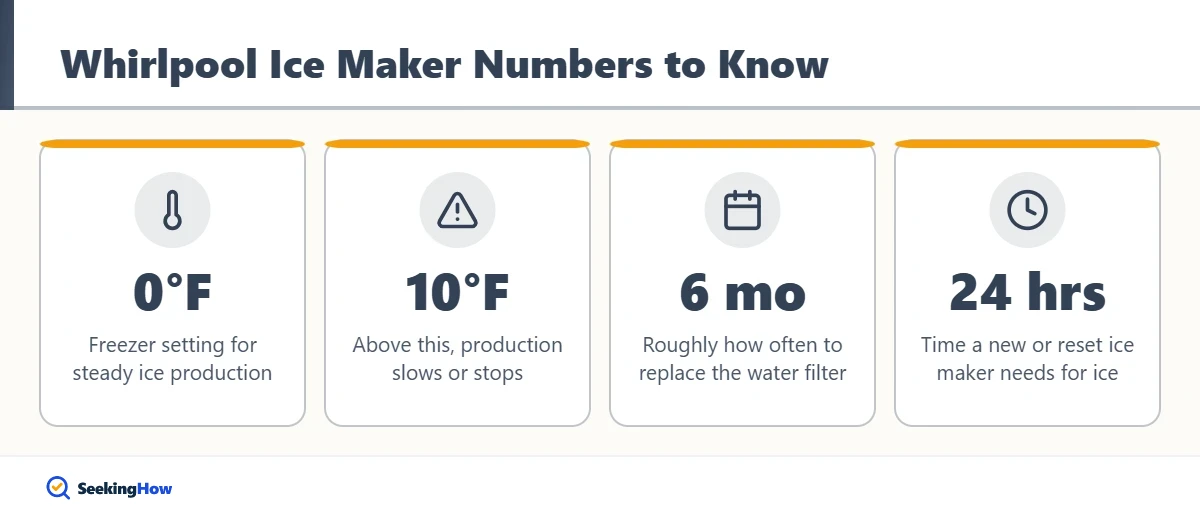
- The freezer should be at about 0°F (-18°C) for steady ice production.
- A frozen fill tube can be thawed with a hair dryer on low or warm water in a turkey baster.
- A failed water inlet valve, ice maker module or control board needs a replacement part or technician.
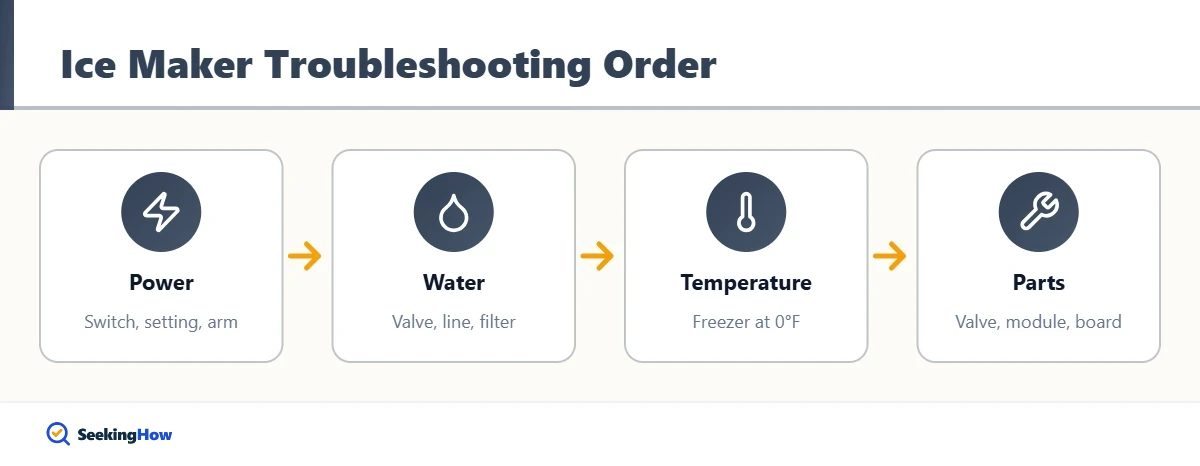
Whirlpool makes several ice maker designs, including the classic crescent-cube unit with a wire arm, door-mounted ice makers on French-door models, and in-freezer units with a paddle sensor. The troubleshooting logic is the same for all of them: power, water, temperature, then parts. Work through the checks below in order.
Why Is My Whirlpool Ice Maker Not Working?
The ice maker is turned off
Many Whirlpool refrigerators have an ice maker switch on the unit itself or an Ice Maker or Ice Off option on the dispenser control panel. A lock or Ice Off setting may have been pressed by accident. Some models also have a feeler arm that, when raised, stops production.
The shut-off arm or sensor is blocked
On units with a wire arm, ice production stops when the arm is up. A cube stuck under the arm, or a misplaced bin, can hold it in the full position. Paddle-style and optical sensors can be fooled by frost or a bin that is not pushed all the way in.
Water supply problems
The ice maker needs steady water pressure. A partially closed house valve, a kinked line behind the fridge, or a clogged filter will reduce flow, giving small, hollow or no cubes. Whirlpool generally recommends replacing the water filter about every six months.
Frozen fill tube
Low water pressure or a leaking inlet valve can let water drip slowly into the fill tube, where it freezes and blocks it. You may see ice in the tube opening at the back of the ice maker.
Freezer too warm
The ice maker’s thermostat waits until the mold is cold enough before it ejects cubes. If the freezer is above about 10°F, production slows or stops. Overpacked freezers, blocked vents and dirty condenser coils all raise the temperature.
Failed parts
If water reaches the fridge but not the ice maker, the water inlet valve may be faulty. If the mold fills and freezes but never ejects, the ice maker module or its motor may have failed. Electronic control issues show up on some models as error codes.
Quick Symptom Guide
| Symptom | Likely cause | First fix |
|---|---|---|
| No ice at all | Ice maker off, arm raised, water shut off | Turn on, lower arm, open valve |
| Small or hollow cubes | Clogged filter or low water pressure | Replace filter, check line for kinks |
| Ice in the fill tube | Frozen fill tube | Thaw tube, check inlet valve |
| Mold full but no ejection | Freezer too warm or failed module | Set freezer to 0°F, reset unit |
| Ice clumps in bin | Infrequent use or temperature swings | Empty bin, check door seal |
| Dispenser works for water, not ice | Jammed auger or ice chute | Clear clumps, thaw chute |
How To Fix a Whirlpool Ice Maker That Is Not Making Ice
Step 1: Confirm the ice maker is on
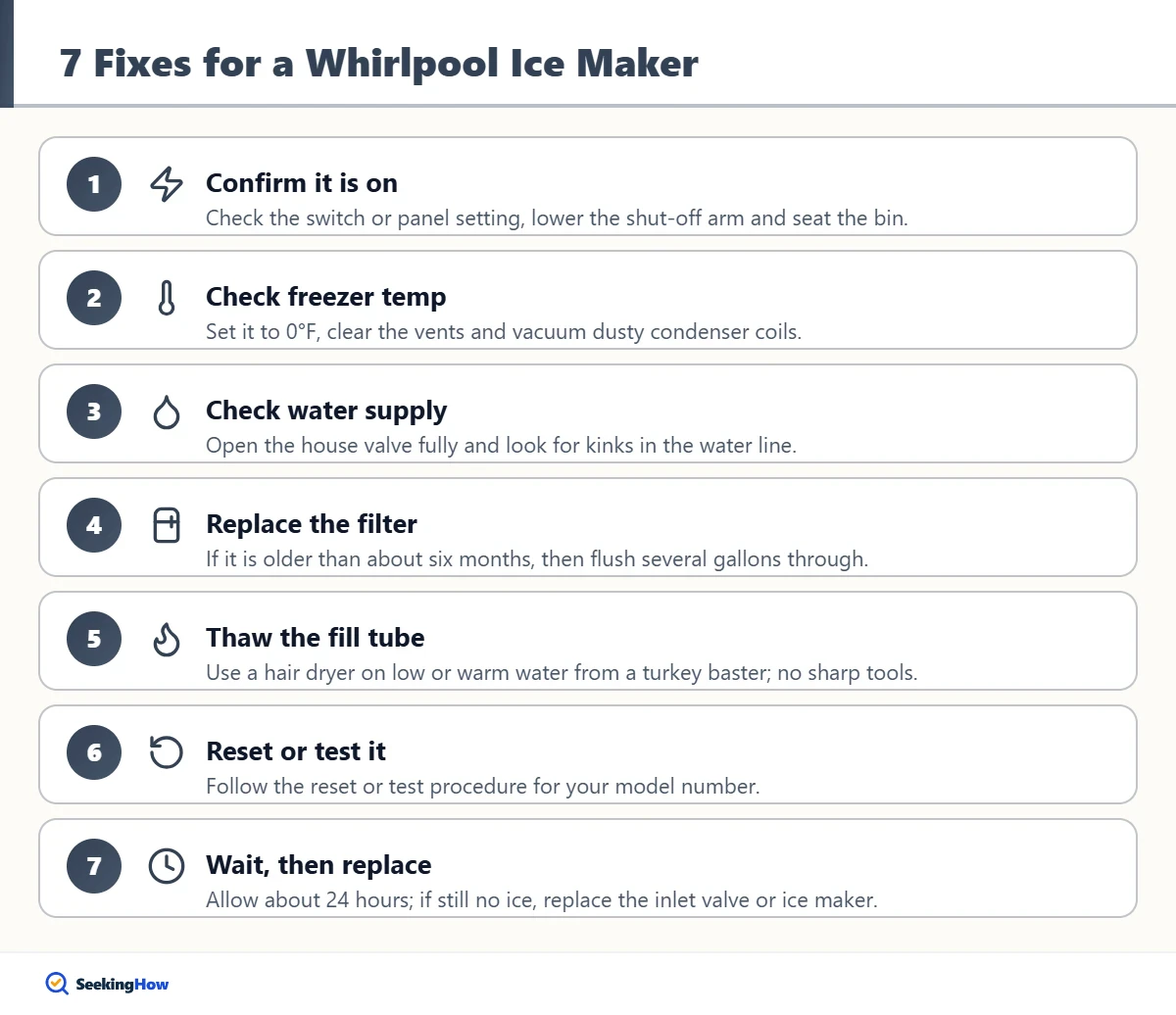
Find the ice maker switch or the ice setting on the control panel and make sure it is on and the control lock is off. Lower the wire shut-off arm if your model has one. Push the ice bin fully into place so the sensor reads it correctly.
Step 2: Check the freezer temperature
Set the freezer to 0°F (-18°C) and verify it with an appliance thermometer after several hours. Clear food away from vents and make sure the freezer door closes fully. Vacuum dusty condenser coils at the bottom or back of the fridge to restore cooling.
Step 3: Check the water supply
Make sure the household shut-off valve to the fridge is fully open. Pull the refrigerator out gently and look for kinks or crushed sections in the water line. Dispense water from the door, if you have one, to confirm water is reaching the fridge.
Step 4: Replace the water filter
If the filter is older than about six months or water flow is slow, replace it with a filter that matches your model. After installing, dispense several gallons of water to flush air and carbon fines from the system, as the filter instructions direct. Air in the line can delay ice production after a filter change.
Step 5: Thaw a frozen fill tube
Unplug the fridge or turn off the ice maker and look at the fill tube where water enters the mold. Melt any ice with a hair dryer on low held several inches away, or squirt warm water from a turkey baster. Never use a sharp tool on the tube or mold.
Step 6: Reset or test the ice maker
Many Whirlpool ice makers can be reset or tested by turning them off and on, or by pressing a test button or holding a control combination listed in the use-and-care guide. A test cycle should rotate the ejector and call for water. Look up your exact model number on the label inside the fridge for the right procedure.
Step 7: Wait 24 hours, then replace failed parts
New or reset ice makers can take about 24 hours to produce the first batch, and it may take a few days to fill the bin. If there is still no ice, test or replace the water inlet valve or ice maker assembly using parts matched to your model number, or book Whirlpool service.
Tip: Throw out the first few batches of ice after a filter change, a new installation or a long period without use. They can taste stale or contain carbon fines from the filter.
How Do You Keep a Whirlpool Ice Maker Working Well?
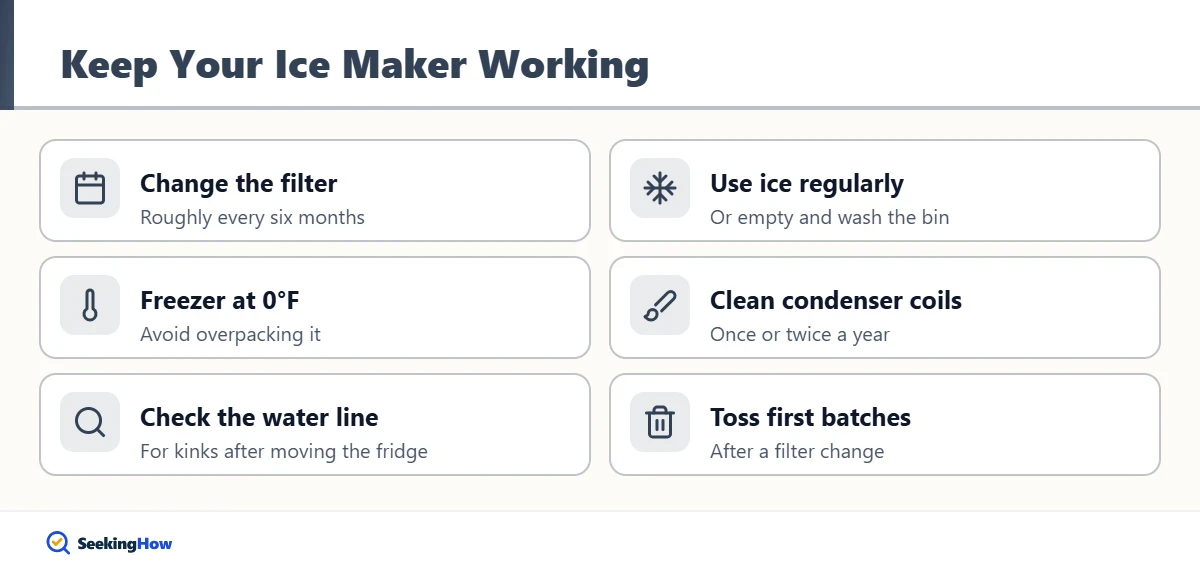
- Replace the water filter on schedule, roughly every six months.
- Use ice regularly, or empty and wash the bin every few weeks so cubes do not clump.
- Keep the freezer at 0°F and avoid overpacking it.
- Clean condenser coils once or twice a year.
- Check the water line for kinks whenever you move the refrigerator.
Hard water can leave scale in ice and dispensers over time. A mild vinegar wipe-down of the bin, rinsed well, helps; our guide to everyday vinegar uses explains safe dilutions. If your fridge is also pooling water inside, read our guide on why a fridge leaks water inside.
When Should You Call Whirlpool Service or a Technician?
Call for service if water reaches the dispenser but not the ice maker after the steps above, if the ice maker shows an error code, or if the freezer will not reach 0°F. These point to an inlet valve, control board, sealed-system or defrost problem. If the fridge is under warranty, use Whirlpool’s official support channels before buying parts, because DIY repairs may affect coverage.
Safety: Unplug the refrigerator before removing the ice maker or touching wiring, and shut off the water supply before disconnecting any line. Keep fingers away from the ejector arms and auger.
Frequently Asked Questions
How do I reset my Whirlpool ice maker?
Reset methods vary by model. Many units reset by turning the ice maker off and on or by unplugging the fridge for a few minutes. Some have a test button or a control-panel combination. Find the exact steps in the use-and-care guide for your model number.
How long does it take a Whirlpool ice maker to make ice?
After installation, a reset or a filter change, expect roughly 24 hours before the first batch drops, and a few days to fill the bin. Production depends on freezer temperature, water pressure and how often you use ice.
Why is my Whirlpool ice maker making small cubes?
Small or hollow cubes usually mean low water flow. A clogged water filter, a partially closed supply valve or a kinked water line are the common causes. Replace the filter, open the valve fully and straighten the line, then check the next batches.
Can a bad water filter stop the ice maker?
Yes. A clogged or incorrectly installed filter restricts water flow and can stop ice production or cause small cubes. Some models also stop dispensing with no filter or a bypass plug installed incorrectly. Install a compatible filter and flush it.
Why is water working but no ice coming out?
If water dispenses but there is no ice, the ice maker may be off, the arm raised, the fill tube frozen or the freezer too warm. If those check out, the ice maker side of the inlet valve or the ice maker module may have failed.