
Quick Answer
To cut RaceDeck tiles, measure each gap, subtract about 1/4 inch for expansion, mark the line with a fine-tip marker and a square, and cut with a circular saw, table saw, or miter saw fitted with a fine-tooth carbide blade. Use a jigsaw for curves and notches. Clamp the tile, cut slowly, and deburr the edge with a utility knife.
Key Takeaways
- RaceDeck tiles are rigid polypropylene, so they cut cleanly with ordinary woodworking saws and a fine-tooth blade.
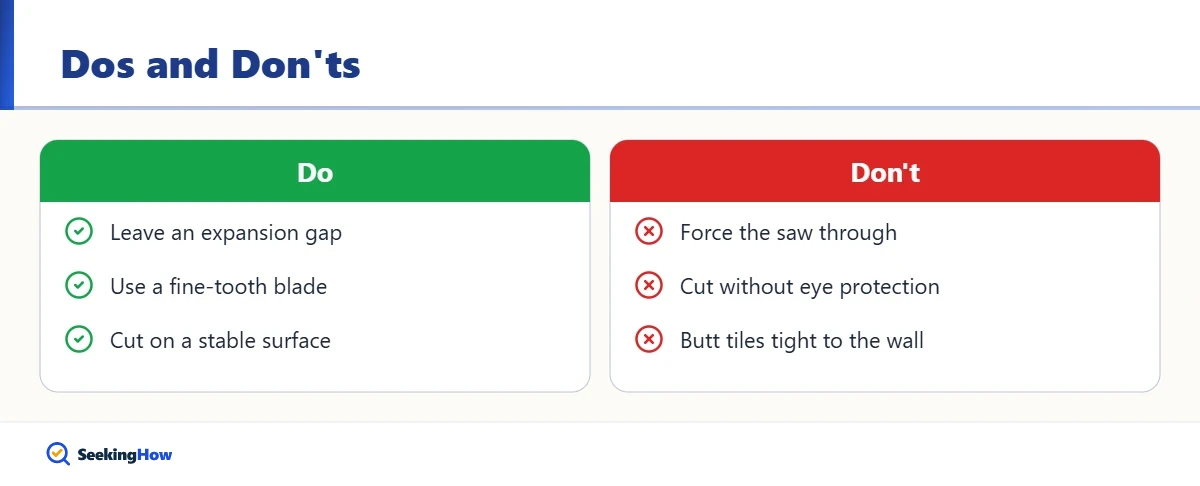
- Leave a small expansion gap at walls; plastic floor tiles grow and shrink with temperature.
- Plan your layout from the most visible edge (usually the garage door) so cut tiles land along back walls and under cabinets.
- Keep the correct interlocking edge (loops or tabs) on the cut tile so it still connects to its neighbors.
- Wear eye and ear protection; plastic chips fly and blades can grab thin pieces.
Most of a RaceDeck garage floor goes down as full tiles that simply snap together. The cut tiles are where an install looks either professional or patched, especially along walls, around posts, and at the door threshold. Here is how to measure, mark, and cut them cleanly.
What Are RaceDeck Tiles Made Of?
RaceDeck tiles are modular interlocking garage floor tiles made from high-impact copolymer polypropylene. Most lines are 12 x 12 inch squares that connect with a loop-and-pin or tab-style edge, with patterns such as diamond plate, coin, and perforated free-flow designs. Check the exact thickness and edge type of your line in its installation guide.
Because polypropylene is tough but not brittle, it cuts like a dense plastic or soft wood. It does not shatter like ceramic, but it can melt and leave a gummy edge if your blade is dull or you push too hard.
What Tools Do You Need To Cut RaceDeck Tiles?
You likely already own the right saw. What matters most is the blade and how you support the tile.
| Tool | Best for | Blade tip | Notes |
|---|---|---|---|
| Circular saw | Long straight cuts along walls | Fine-tooth carbide, 40T or more for 7-1/4 in | Clamp the tile and use a straightedge guide |
| Table saw | Many repeat rip cuts of the same width | Fine-tooth carbide crosscut or plywood blade | Use a push stick; never cut tiny pieces freehand |
| Miter saw | Fast, square crosscuts | 60T or finer carbide | Tile must sit flat against the fence |
| Jigsaw | Curves, notches, cutouts for posts and drains | Fine-tooth blade for plastic or laminate | Slow speed reduces melting |
| Oscillating multi-tool | Small notches and touch-up cuts | Bi-metal plunge blade | Slow but precise |
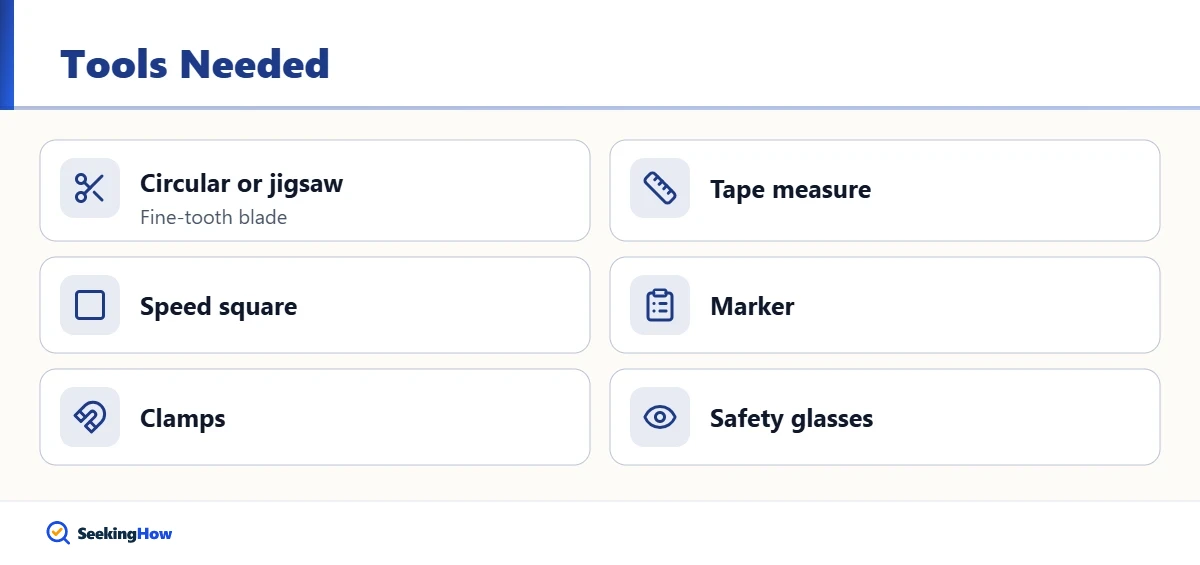
You also need a tape measure, a speed square or framing square, a fine-tip permanent marker or grease pencil, clamps, a utility knife for deburring, safety glasses, and hearing protection.
Tip: A blade described for laminate flooring or plastics, with many teeth and a low hook angle, gives the cleanest edge. Coarse framing blades tend to chip and melt the plastic.
How Do You Plan the Layout Before Cutting?
Good planning reduces the number of cuts and hides the ones you make. Start the layout at the garage door, which is the most visible edge, and work toward the back wall. That way, full tiles show at the entrance and cut tiles disappear under shelving, cabinets, and workbenches.
Snap a chalk line or lay a straight row along the door opening, then dry-fit full rows toward the back. Check whether the last row will be a sliver. If the final strip would be under 2-3 inches, shift your starting line so both sides end with more substantial cut tiles; tiny strips are harder to cut safely and tend to pop loose.
For the door edge itself, RaceDeck offers ramped edge and transition pieces in many lines. These create a beveled edge where the floor meets the driveway so you do not catch a tire or a toe on a square tile edge.
How To Cut RaceDeck Tiles Step by Step
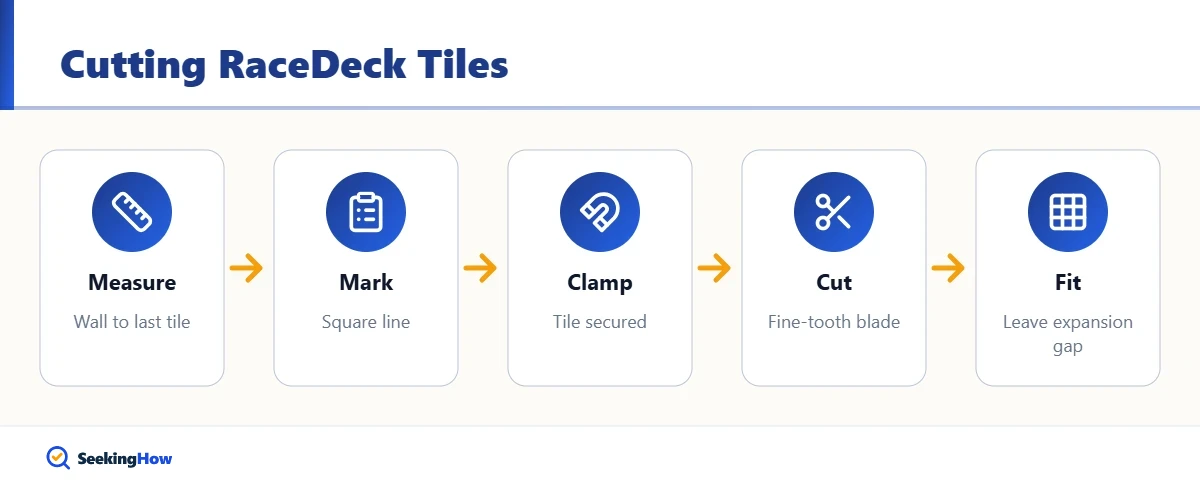
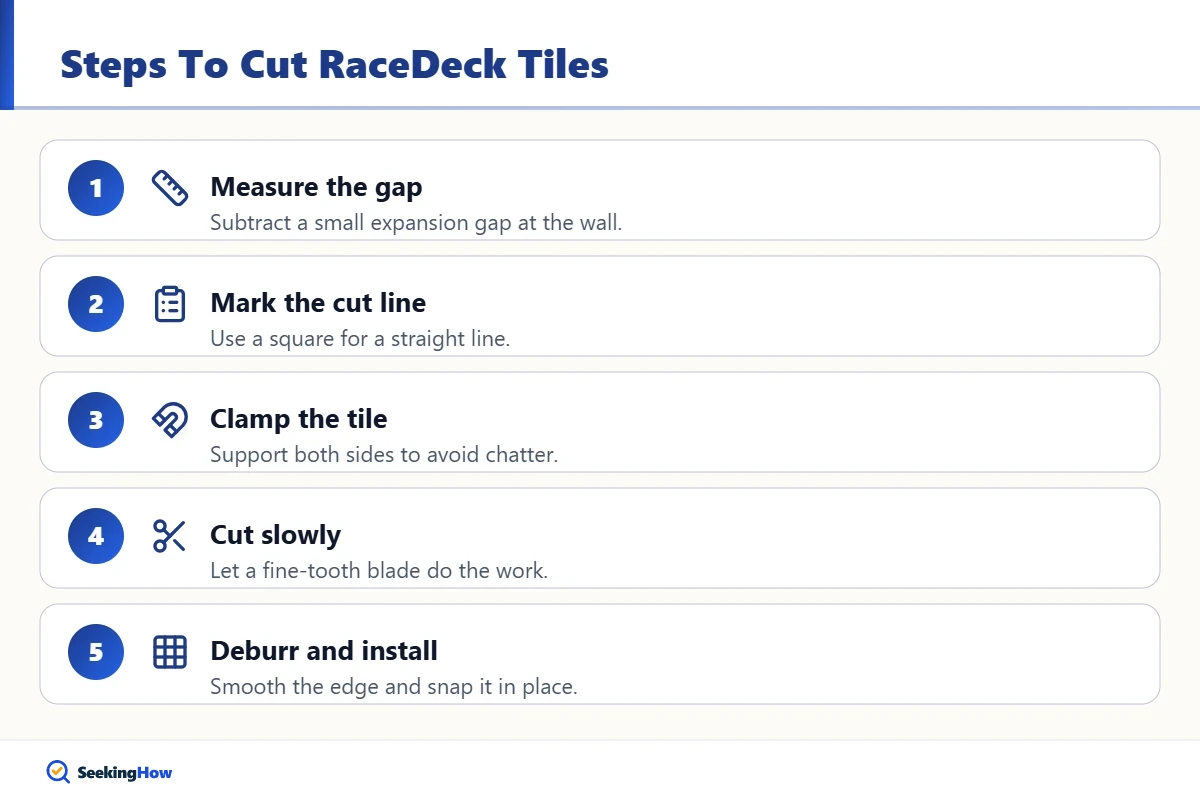
Step 1: Measure the gap and allow for expansion
Measure from the edge of the last full tile to the wall at both ends of the tile position, because garage walls are rarely perfectly straight. Subtract about 1/4 inch, or the gap your tile’s installation instructions specify, so the floor can expand in summer heat without buckling.
Step 2: Mark the cut line on the correct side
Flip or orient the tile so the interlocking edge you need to keep faces the installed floor. Transfer your measurements to the tile and connect the marks with a square or straightedge using a fine-tip marker. Write “cut here” and an X on the waste side so you never cut off the wrong edge.
Step 3: Clamp and support the tile
Clamp the tile to sawhorses or a work table with the cut line overhanging and the waste side free to fall away. On a circular saw cut, clamp a straightedge as a fence. Supporting both sides prevents the tile from flexing, which causes binding and rough cuts.
Step 4: Make the cut slowly and steadily
Set the blade depth about 1/4 inch deeper than the tile thickness. Start the saw before it touches the tile and feed at a steady, moderate pace. If you see melted plastic strings, slow down, let the blade clear, or switch to a finer blade.
Step 5: Cut notches and curves with a jigsaw
For posts, door jambs, water heater stands, or floor drains, make a cardboard template first and trace it onto the tile. Drill a 3/8 inch relief hole at inside corners, then cut with a jigsaw on low-to-medium speed. Relief holes help the blade turn cleanly and reduce stress cracks.
Step 6: Deburr and test-fit
Shave off burrs and melted lips with a sharp utility knife or a fine file. Snap the cut tile into place and check the gap at the wall. If it is too tight, trim another 1/8 inch rather than forcing it, since a tile jammed against the wall will push the floor up when temperatures rise.
What Are Common Mistakes When Cutting Garage Floor Tiles?
- Cutting off the wrong edge. Always confirm which interlocking side must stay. Mark the waste side clearly.
- No expansion gap. Polypropylene tiles move with temperature. Butting them tight against walls can cause humps and lifted seams.
- Using a coarse blade. Framing blades and dull blades chip, melt, and leave fuzzy edges.
- Measuring only once. Measure at both ends of each cut, since walls and slab edges are seldom square.
- Cutting tiny strips freehand. Narrow pieces can kick back on a table saw. Rework the layout to avoid slivers or cut them with a jigsaw while clamped.
How Do You Handle Walls, Baseboards, and Edges?
The small expansion gap at the wall is usually invisible once shelving or trim is in place. If your garage has baseboards or you want a finished look, a strip of trim can cover the gap; just fasten it to the wall, not the floor, so the tiles can still move. Our guide to installing baseboard molding on an uneven floor covers scribing trim to follow a wavy slab.
Leave tiles loose around heavy, fixed items so you can lift a section later for cleaning or repairs. Once the floor is down, it is a good time to get wall storage off the ground, such as hanging a backpack blower in the garage.
Is It Safe To Cut Plastic Floor Tiles Indoors?
Cutting produces plastic chips and a little fine dust, and an overheated blade can create fumes from melting plastic. Cut outdoors or with the garage door open, keep the blade sharp so it cuts rather than melts, and wear safety glasses and hearing protection. A dust mask is a sensible addition if you are making many cuts.
Safety: Never hold a small tile piece with your hand near the blade. Clamp it, use a push stick on a table saw, and unplug the saw before changing blades.
Alternatives to Cutting Tiles
- Edge and ramp pieces: Use manufacturer edging at the garage door and open edges instead of cutting a custom bevel.
- Leaving a perimeter strip uncovered: In some garages, stopping the floor at the line of shelving is acceptable and saves dozens of cuts.
- Professional installation: RaceDeck dealers and flooring installers can template and cut complex rooms quickly, which can be worth it in show garages.
If your project also involves metal trim or brackets, see our tips for cutting stainless steel without discoloration.
Frequently Asked Questions
What blade is best for cutting RaceDeck tiles?
A fine-tooth carbide blade gives the cleanest cut. For a 7-1/4 inch circular saw, look for 40 teeth or more; for a miter saw, 60 teeth or more. Blades rated for laminate flooring or plastics work well because they cut cleanly with less chipping and melting.
Can you cut RaceDeck tiles with a utility knife?
Not practically. The tiles are rigid polypropylene and too thick to score and snap like vinyl plank. A utility knife is useful only for trimming burrs and melted edges after you cut the tile with a saw.
How much expansion gap do RaceDeck tiles need?
Leave a small gap at walls and fixed objects, commonly about 1/4 inch, so tiles can expand in heat without buckling. Always follow the exact gap listed in the installation instructions for your specific RaceDeck tile line, since recommendations can vary.
Do you need to glue RaceDeck tiles down?
No. RaceDeck tiles are designed as a floating floor that interlocks without adhesive. Floating installation lets the floor expand and contract and makes it easy to lift and replace individual tiles later.
Can you cut garage floor tiles with a jigsaw only?
Yes, a jigsaw can handle every cut, but long straight cuts are slower and harder to keep straight. Clamp a straightedge as a guide, use a fine-tooth plastic or laminate blade, and run the saw at a moderate speed to avoid melting.