Quick Answer
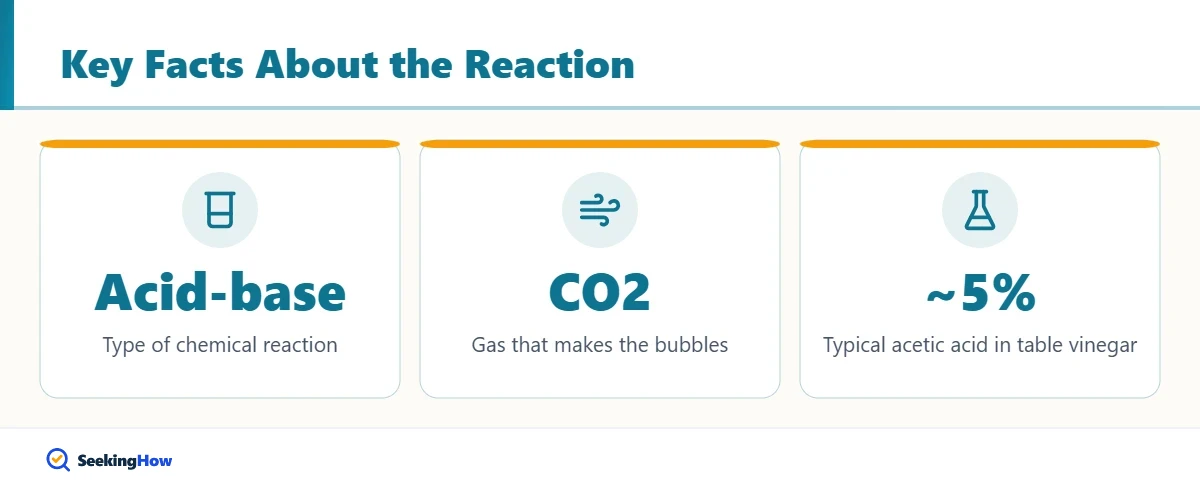
Vinegar and baking soda react because vinegar is an acid (about 5% acetic acid) and baking soda is a base (sodium bicarbonate). When they mix, they form carbonic acid, which instantly breaks down into water and carbon dioxide gas. That escaping CO2 is the fizz. What is left behind is mostly water and dissolved sodium acetate, a mild salt with little cleaning power.
Key Takeaways
- The reaction is an acid-base neutralization: NaHCO3 + CH3COOH produces CH3COONa + H2O + CO2.
- The bubbles are carbon dioxide gas, the same gas in soda and exhaled breath.
- The reaction feels slightly cool because it absorbs a small amount of heat.
- Mixing them in one container mostly cancels out each one’s cleaning strength; use them one after the other instead.
- Never seal the mixture in a closed bottle or jar, because the gas pressure can burst it.
The foaming volcano from science class is one of the easiest chemical reactions to watch at home. Understanding what happens explains why it works as a demonstration, why it helps with a few cleaning jobs, and why it is overrated as an all-purpose cleaner.
What Happens When Vinegar and Baking Soda Mix?
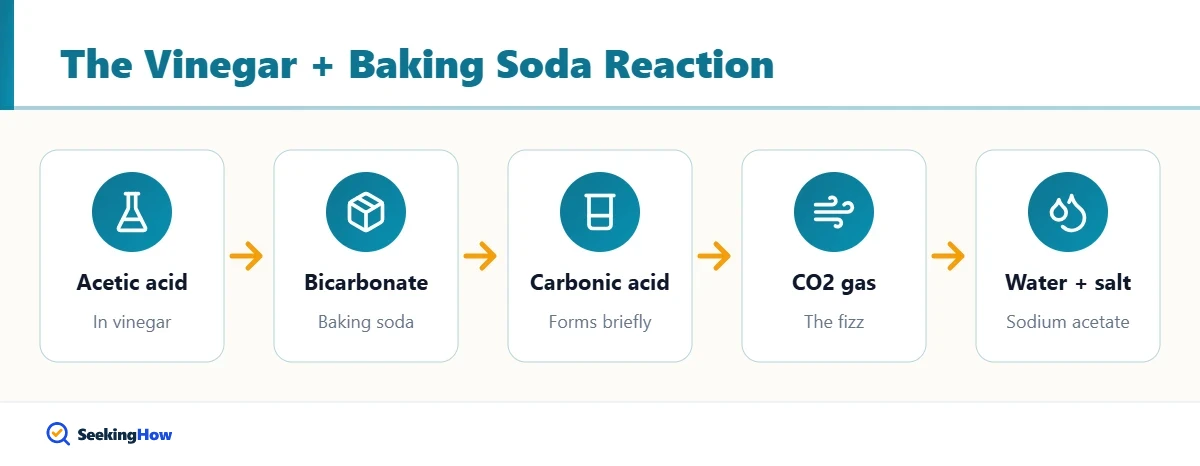
The reaction happens in two quick stages. First, the acetic acid in vinegar donates a hydrogen ion to the bicarbonate in baking soda, forming carbonic acid and sodium acetate. Second, the carbonic acid is unstable and almost instantly splits into water and carbon dioxide.
- Stage 1: NaHCO3 + CH3COOH produces CH3COONa + H2CO3
- Stage 2: H2CO3 produces H2O + CO2
- Overall: NaHCO3 + CH3COOH produces CH3COONa + H2O + CO2
Carbon dioxide is a gas that does not stay dissolved well in the liquid, so it rushes to the surface as bubbles. Dish soap added to the mix traps those bubbles and turns them into thick foam.
Why Does the Mixture Fizz So Fast?
Baking soda dissolves quickly and vinegar provides plenty of acid, so the reaction starts the instant they touch. Fine baking soda powder has a huge surface area, which speeds things up. The fizzing slows as one ingredient runs out: when bubbles stop even though you still see white powder, the vinegar is used up; when the liquid is clear and adding more vinegar does nothing, the baking soda is gone.
Is the Vinegar and Baking Soda Reaction Endothermic?
Yes, slightly. The reaction absorbs a little heat from its surroundings, so a cup holding a larger batch can feel cooler to the touch. This is the opposite of many reactions people expect, such as burning, which release heat. The temperature change is mild and harmless.
What Are the Products of the Reaction?
| Substance | Role | Common name | What you notice |
|---|---|---|---|
| NaHCO3 | Base (reactant) | Baking soda | White powder |
| CH3COOH | Acid (reactant) | Acetic acid in vinegar | Sharp smell |
| CO2 | Product | Carbon dioxide | Bubbles and foam |
| H2O | Product | Water | Liquid left behind |
| CH3COONa | Product | Sodium acetate | Dissolved salt; crystals if evaporated |
Sodium acetate is used as a food additive and is the chemical inside many reusable hand warmers. If you evaporate the leftover liquid, it forms white crystals.
How to Do the Vinegar and Baking Soda Experiment
This classic demonstration is safe for kids with adult supervision and takes about 10 minutes. Do it on a tray, in a sink, or outdoors.
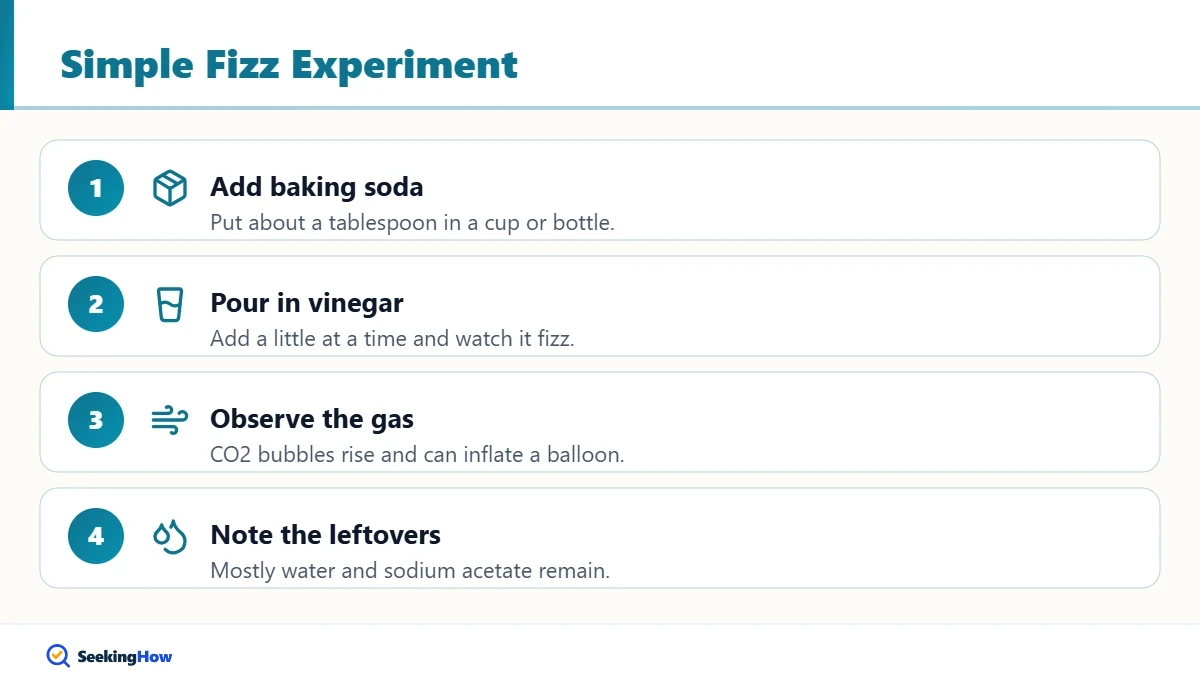
Step 1: Set Up a Container
Place a small bottle, cup, or modeling-clay volcano on a baking sheet or tray to catch overflow. An open container is essential; never put a cap or cork on it.
Step 2: Add Baking Soda and Dish Soap
Add 1-2 tablespoons of baking soda to the container. Add a squirt of dish soap for bigger foam and a few drops of food coloring if you like.
Step 3: Pour in the Vinegar
Pour in about 1/4 to 1/2 cup of white vinegar all at once and step back. The mixture will foam up and overflow within seconds.
Step 4: Observe and Test the Results
Watch until the fizzing stops, then add more vinegar to see whether any baking soda remains. Feel the side of the cup for the slight cooling, and hold a lit match safely above the cup with adult help: the CO2 layer can put out the flame.
Does Mixing Vinegar and Baking Soda Clean Better?
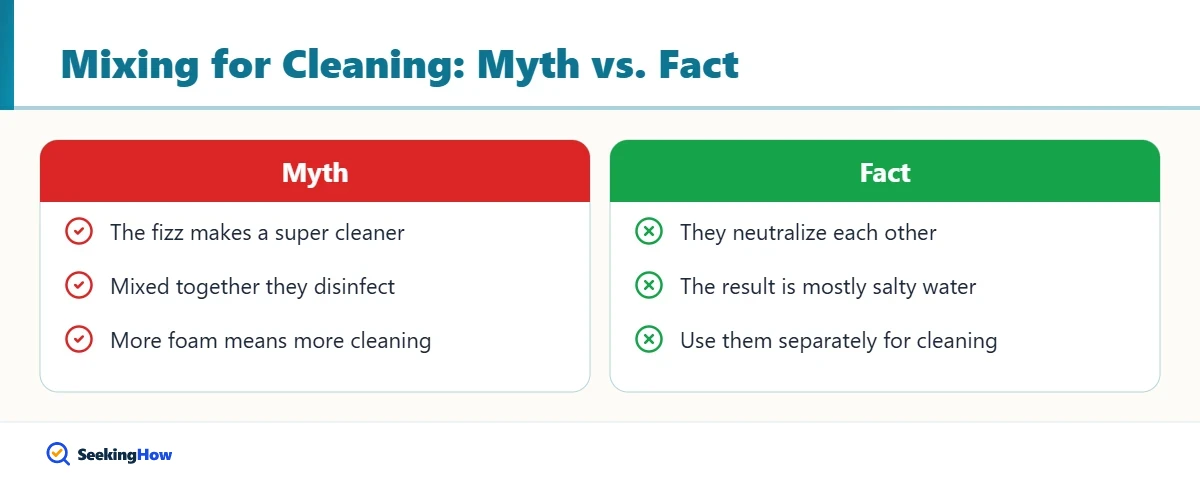
Not really. The two ingredients neutralize each other, leaving salty water. Each one has more cleaning value on its own:
- Vinegar alone: its acidity dissolves mineral deposits, hard-water spots, and soap scum on glass, faucets, and kettles.
- Baking soda alone: it is a mild abrasive and deodorizer, good for scrubbing pans, sinks, and absorbing odors in fridges and carpets.
- Used in sequence: sprinkling baking soda first and then spraying vinegar creates fizz that can help loosen light grime in drains or grout lines, mostly through the mechanical bubbling action.
For a full list of where vinegar shines, see this guide to genius vinegar uses around the house, and learn which bottle to buy in white vinegar vs. distilled white vinegar.
Can You Use Vinegar and Baking Soda to Unclog a Drain?
It can help with mild, slow drains caused by soap scum or light grease, but it will not clear a solid clog of hair or a heavy grease plug. A common routine is to pour 1/2 cup of baking soda into the drain, follow with 1 cup of vinegar, cover the drain loosely for 15 minutes, then flush with very hot water. For a fully blocked drain, a plunger or drain snake works better, as covered in this guide on how to unclog a bathtub drain.
Safety: Never mix vinegar with bleach, which releases toxic chlorine gas, and never store vinegar and baking soda together in a closed container, which can build pressure and burst. Do not pour the mixture into a drain right after using a chemical drain opener.
Where Else Does This Reaction Show Up?
- Baking: baking soda reacts with acidic ingredients such as buttermilk, yogurt, lemon juice, or vinegar to produce CO2 that makes cakes and quick breads rise.
- Baking powder: contains baking soda plus a dry acid, so it reacts once liquid is added and again with heat.
- Antacids: sodium bicarbonate neutralizes stomach acid in a similar acid-base reaction, which is why it can cause burping.
- Fire extinguishers: some older designs used a bicarbonate-acid reaction to produce gas pressure.
Common Misconceptions
- The foam is toxic: no; it is CO2, water, and sodium acetate.
- More vinegar always means more fizz: only until all the baking soda is used up.
- The mixture is a strong disinfectant: it is not registered or proven as a disinfectant; use an EPA-registered product when you need to kill germs.
- Apple cider vinegar does not work: it does, since it also contains acetic acid, though it can stain light surfaces.
Frequently Asked Questions
What gas is produced when vinegar and baking soda mix?
The gas is carbon dioxide. Acetic acid in vinegar reacts with sodium bicarbonate to form carbonic acid, which immediately breaks down into water and carbon dioxide. The CO2 escapes as the bubbles and foam you see, while sodium acetate stays dissolved in the leftover liquid.
Is the vinegar and baking soda reaction a chemical change?
Yes. New substances form that were not there before: carbon dioxide, water, and sodium acetate. Gas production, bubbling, and a temperature change are classic signs of a chemical change, and you cannot get the original vinegar and baking soda back by simply drying the mixture.
Is it safe to mix vinegar and baking soda?
Yes, in an open container. The products are carbon dioxide, water, and sodium acetate. The main risk is pressure: never seal the mixture in a bottle or jar. Also never combine vinegar with bleach, which creates toxic chlorine gas.
What is the ratio of vinegar to baking soda for the best reaction?
For a strong fizz, use roughly 1 tablespoon of baking soda to about 1/4 cup of vinegar. Household vinegar is only about 5 percent acid, so you need much more vinegar than baking soda by volume to use up all the powder.
Why does the reaction stop?
The fizzing stops when one ingredient is used up. If white powder remains at the bottom, the vinegar has run out; add more vinegar to restart it. If the liquid is clear and more vinegar does nothing, all the baking soda has reacted.