Quick Answer
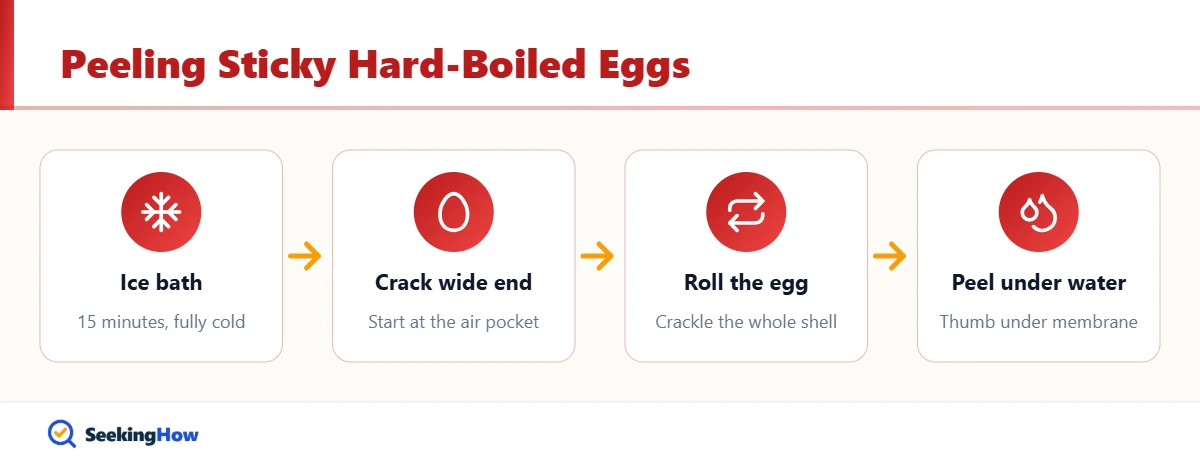
To peel hard-boiled eggs that stick, chill them in ice water for 15 minutes, crack the wide end where the air pocket sits, roll the egg to shatter the shell, and peel under a thin stream of cool water, slipping your thumb beneath the inner membrane. For future batches, steam eggs 12 to 13 minutes instead of boiling from cold water.
Key Takeaways
- Very fresh eggs stick most because their whites bond tightly to the inner shell membrane.
- Starting eggs in already boiling water or steam makes them far easier to peel than starting in cold water.
- An ice bath of at least 15 minutes shrinks the egg slightly away from the shell.
- Get under the thin inner membrane, not just the shell, and the peel comes off in large pieces.
- Running water floods the gap between white and membrane and loosens stubborn patches.
- Refrigerate peeled or unpeeled hard-boiled eggs within 2 hours and eat them within 1 week.
Few kitchen jobs are as frustrating as gouging craters into a perfectly cooked egg. This guide explains how to peel hard-boiled eggs that stick using the batch you already cooked, then shows the cooking changes that stop the problem before it starts.
Most people find that the rescue techniques below save about 90 percent of a stubborn batch, while a switch to hot-start cooking fixes the issue for good.
What You’ll Need
- Large bowl filled with ice and cold water (about half ice)
- Teaspoon with a thin edge
- Kitchen faucet or a bowl of cool water
- Lidded container or mason jar, 16 to 32 oz (optional, for the shake method)
- Steamer basket and lidded pot (for future batches)
- Paper towels
How To Peel Hard-Boiled Eggs That Stick: Step-by-Step
Step 1: Shock the Eggs in Ice Water
Move the cooked eggs straight into an ice bath and leave them for 15 minutes, or until they feel cold all the way through. Rapid cooling stops the cooking, shrinks the white slightly, and helps it release from the membrane. The common mistake is a quick 2-minute rinse under the tap, which leaves the egg warm and the membrane still glued on.
Step 2: Crack the Wide End First
Tap the wide, rounded end on the counter. That end holds the air pocket, so you get an easy entry point without digging into the white. Avoid starting at the pointed tip, where the white presses directly against the shell.
Step 3: Roll To Shatter the Whole Shell
Press the egg gently under your palm and roll it on the counter until the shell is covered in fine cracks. Many small cracks let the shell come off in sheets instead of tiny chips. Press lightly; heavy pressure splits the white.
Step 4: Get Under the Inner Membrane
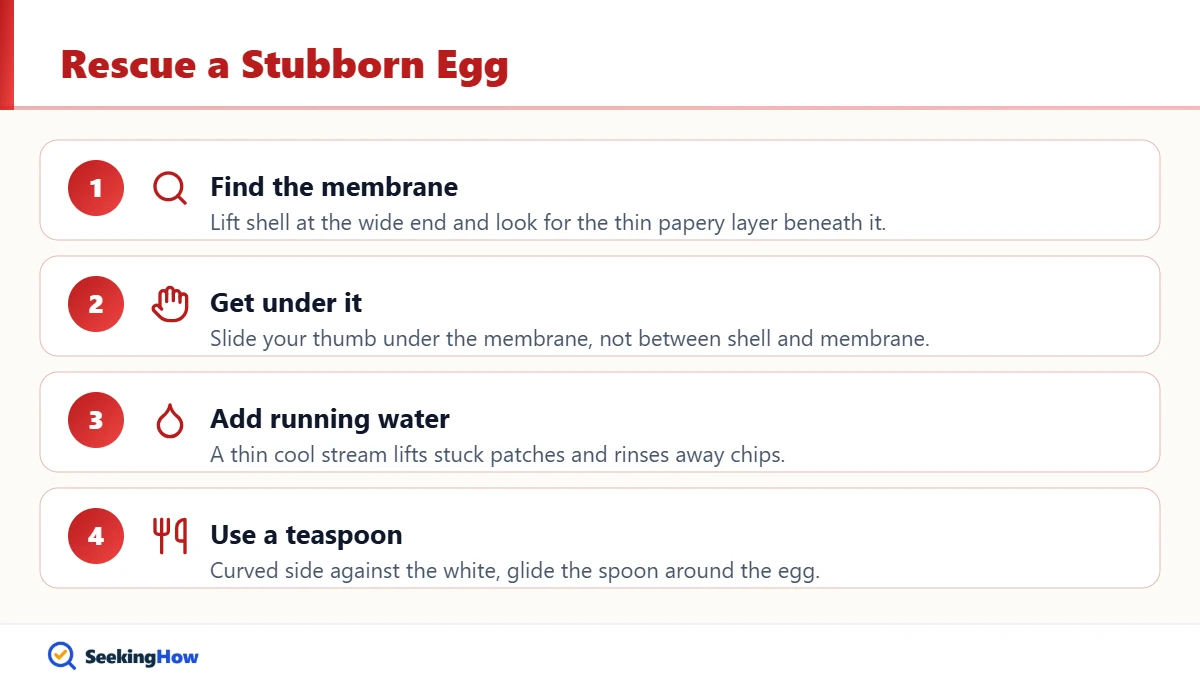
Lift a piece of shell at the air pocket and look for the thin, papery membrane underneath. Slide your thumb or the edge of a teaspoon under that membrane, not between shell and membrane. In practice, the moment you catch the membrane, the shell peels away in one or two large strips.
Step 5: Peel Under Cool Running Water
Hold the egg under a thin stream of cool water while you peel. Water seeps between white and membrane and lifts stubborn patches, and it rinses off shell fragments. A bowl of water works the same way if you want to save water.
Step 6: Use the Spoon Method for Stubborn Eggs
If a patch still clings, slip a teaspoon, curved side against the white, under the shell and glide it around the egg. The spoon follows the curve of the egg and separates the white without tearing it. Work slowly; forcing the spoon pushes it into the white.
Quick-Peel Method: Shake in a Jar
For a batch of 4 to 6 eggs, place 1 to 2 cooled eggs in a lidded jar with about 1 inch of cold water and shake hard for 10 to 20 seconds. The shell breaks into a mesh and often slides off in one piece. This works best on eggs cooked with a hot start and is less effective on very fresh, cold-start eggs.
How To Cook Eggs So They Don’t Stick Next Time
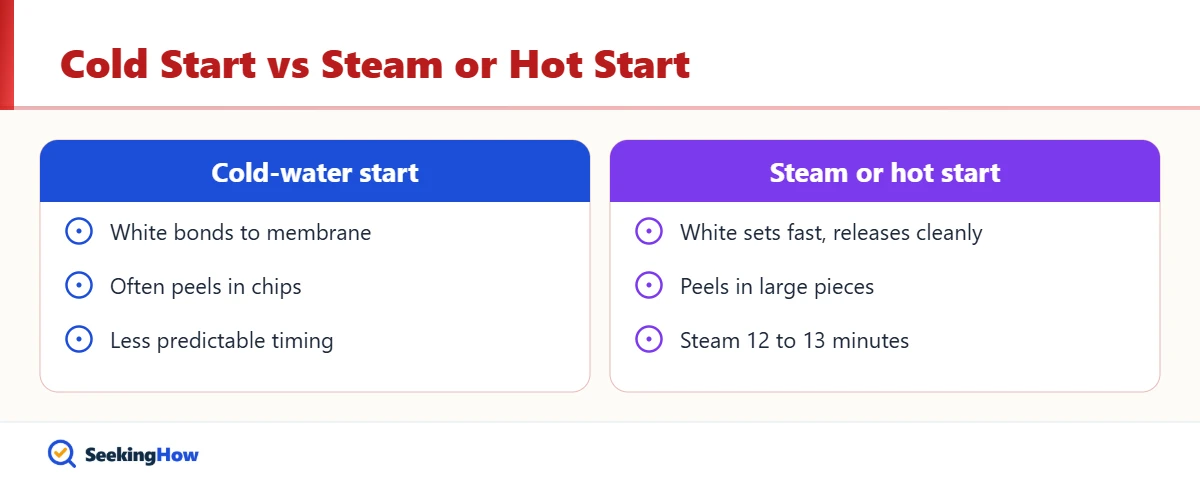
The way eggs go into the heat matters more than any peeling trick. Eggs that start in already hot water or steam set the outer white quickly, before it can bond to the membrane. Our guide on how to hard boil eggs perfectly covers timing for every yolk texture.
- Steam: bring 1 inch of water to a boil, add eggs in a steamer basket, cover, and steam 12 to 13 minutes for firm yolks.
- Hot start: lower cold eggs gently into rapidly boiling water with a slotted spoon, cook 11 to 12 minutes, then ice bath.
- Pressure cooker: many cooks use the 5-5-5 approach (5 minutes high pressure, 5 minutes natural release, 5 minutes ice bath).
- Rice cooker steam tray: works too; see how to use an Aroma rice cooker for steaming basics.
- Egg age: eggs bought 7 to 10 days earlier peel more easily than eggs laid days ago.
Bottom line: rescue a sticky batch with a long ice bath, membrane-first peeling and running water, then switch to steaming so the next batch peels cleanly.
If That Didn’t Work
Problem: The white tears off with every piece of shell. Cause: Very fresh eggs or a cold-water start. Fix: Use the spoon method, and for later batches buy eggs a week ahead and steam them.
Problem: The shell comes off in tiny chips. Cause: Too few cracks. Fix: Roll the egg longer so the entire shell is crackled before you start peeling.
Problem: The membrane stays stuck to the white. Cause: Peeling between shell and membrane. Fix: Pinch the membrane at the air pocket and peel it together with the shell.
Problem: Eggs are still hard to peel after an ice bath. Cause: The eggs were not fully chilled. Fix: Return them to fresh ice water for another 10 minutes or refrigerate them overnight in the shell.
Problem: A greenish ring around the yolk. Cause: Overcooking or slow cooling. Fix: Shorten cooking by 1 to 2 minutes and move eggs to ice water immediately; the ring is harmless.
Peeling Methods Compared
| Method | Time per egg | Difficulty | Best for |
|---|---|---|---|
| Crack, roll and peel under water | 30 to 60 seconds | Easy | Most eggs, best overall |
| Spoon method | 45 to 90 seconds | Medium | Very sticky, fresh eggs |
| Shake in a jar | 15 to 20 seconds | Easy | Hot-start or steamed eggs |
| Peel in a bowl of water | 45 to 60 seconds | Easy | Saving water, big batches |
Safety and When To Toss the Eggs
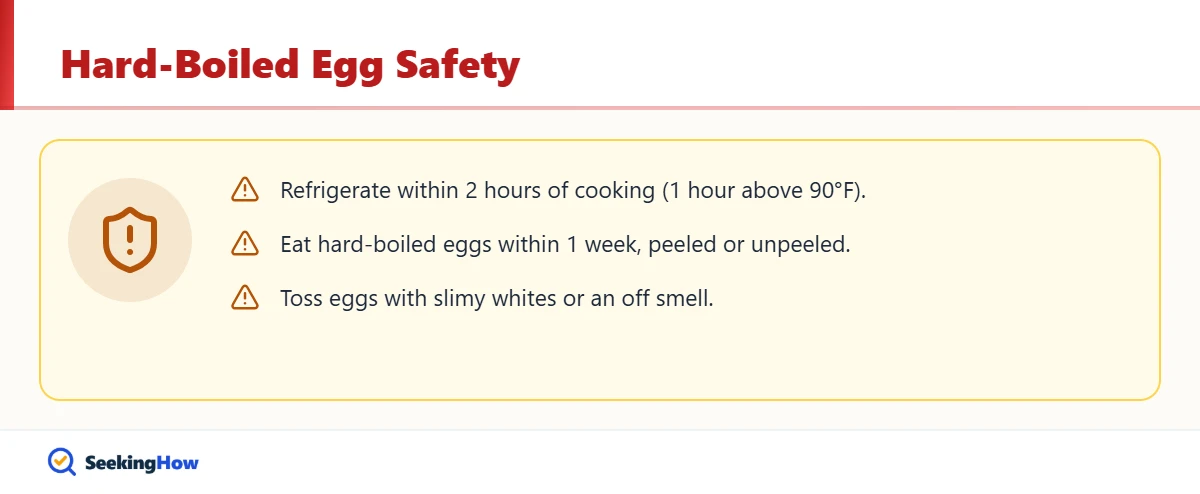
Hard-boiled eggs are a perishable food. Refrigerate them within 2 hours of cooking, and throw them out if they sat at room temperature longer than that (1 hour above 90°F).
- Discard eggs with a sulfur smell stronger than normal, slimy whites, or chalky gray texture.
- Eggs with cracked shells that sat unrefrigerated should be thrown away.
- Keep eggs for dyeing or egg hunts separate from eggs you plan to eat if they sit out for hours.
- Use hard-boiled eggs within 1 week, peeled or unpeeled.
Prevention Tips
- Buy eggs about a week before you plan to boil them.
- Use steam or a hot-water start instead of a cold start.
- Always finish with at least 15 minutes in ice water.
- Peel eggs within a day or two for the easiest peel, then refrigerate in a covered container.
Related Guides
- How to hard boil eggs perfectly so they peel easily
- How to use an Aroma rice cooker, including the steam tray
- How to make buttermilk yogurt at home
Sources
- USDA Food Safety and Inspection Service: Shell eggs from farm to table (fsis.usda.gov)
- U.S. Food and Drug Administration: Egg safety guidance for consumers (fda.gov)
- American Egg Board: Hard-boiled egg cooking and storage tips (incredibleegg.org)
Frequently Asked Questions
Why are my hard-boiled eggs so hard to peel?
Hard-boiled eggs are hard to peel mainly because they are very fresh or were started in cold water. In fresh eggs the white bonds tightly to the inner membrane. As eggs age, they lose carbon dioxide, the white becomes more alkaline, and it releases more easily. Starting eggs in steam or boiling water also sets the outer white before it can stick.
Does adding baking soda or vinegar help eggs peel?
Baking soda and vinegar give inconsistent results and are not worth relying on. A small amount of baking soda raises the water pH, which some cooks find helpful, but it can give whites a sulfur taste. Vinegar mainly helps seal leaks from cracked shells. Steaming and a long ice bath make a much bigger, more reliable difference.
Is it easier to peel eggs warm or cold?
Cold eggs are usually easier to peel after an ice bath. The quick chill shrinks the white slightly away from the shell. Some cooks prefer peeling eggs while still slightly warm right after a short shock, but eggs left to cool slowly at room temperature tend to stick the most.
How long should eggs sit in an ice bath before peeling?
Eggs should sit in an ice bath for about 15 minutes before peeling. That is enough time to cool the egg through and stop the cooking so yolks do not turn green. If the eggs still feel warm in the center, add more ice and leave them another 5 to 10 minutes.
Are older eggs better for hard boiling?
Yes, eggs that are about 7 to 10 days old are better for hard boiling because they peel more easily. Supermarket eggs are often already a week or more old. Farm-fresh eggs laid within a few days are the hardest to peel, so steam them rather than boiling from a cold start.
Can you peel hard-boiled eggs the night before?
Yes, you can peel hard-boiled eggs the night before. Store peeled eggs in a covered container in the refrigerator, optionally with a damp paper towel to keep them from drying out. Use them within about a week. Many people find eggs that rested overnight in the fridge peel more easily than freshly cooked ones.
What is the fastest way to peel a lot of hard-boiled eggs?
The fastest way to peel many hard-boiled eggs is to shake them in a lidded container with a little cold water. Shake 1 or 2 eggs for 10 to 20 seconds and the shells crack into a mesh that slides off. It works best on steamed or hot-start eggs, so pair it with that cooking method.