Quick Answer
To make a riding lawn mower faster safely, first restore lost speed: replace a stretched drive belt, set tire pressure to spec, change the air filter and spark plug, and adjust the hydrostatic or speed-control linkage. For a real gain beyond factory speed, fit taller rear tires or a larger drive pulley. Most fixes take 1-2 hours. Never bypass the governor.
Key Takeaways
- A riding mower that slowed down over time usually has a worn belt, low tires or a maladjusted speed linkage, not a weak engine.
- Taller rear tires raise ground speed in proportion to their diameter but reduce pulling power and stability.
- Changing pulley ratios increases speed on belt-drive mowers but adds load on the belt and transmission.
- Raising the engine governor setting can over-rev the engine, cause failure and make the mower unsafe; leave it at factory spec.
- Higher speed raises tip-over and rollover risk, especially on slopes, so modifications should stay modest.
Most riding mowers top out around walking-to-jogging speed in high gear, and many lose speed as belts stretch and linkages drift. This guide explains how to make a riding lawn mower faster, starting with free and cheap fixes that restore lost speed, then the modest upgrades that add real speed without wrecking the transmission.
What You’ll Need
- Owner’s manual for belt routing, tire pressure and linkage specs
- Tire pressure gauge and air compressor
- Socket set and wrenches
- Replacement drive belt (exact OEM part number)
- Air filter, spark plug and spark plug socket
- Jack stands or a mower lift
- Larger rear tires on matching rims (optional upgrade)
- Larger engine drive pulley or smaller transmission pulley (optional, belt-drive mowers)
How To Make a Riding Lawn Mower Faster: Step-by-Step
Step 1: Check Tire Pressure and Size
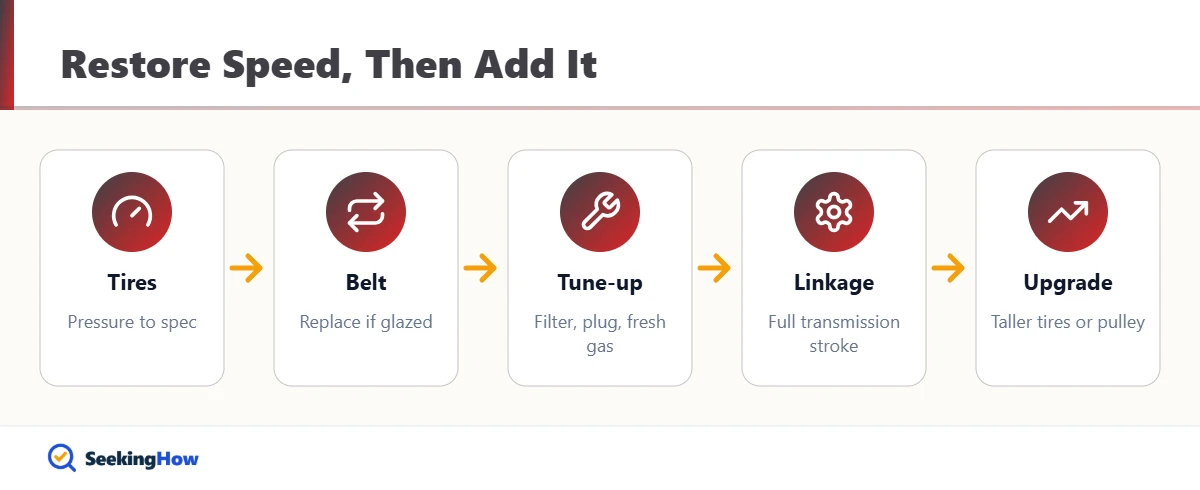
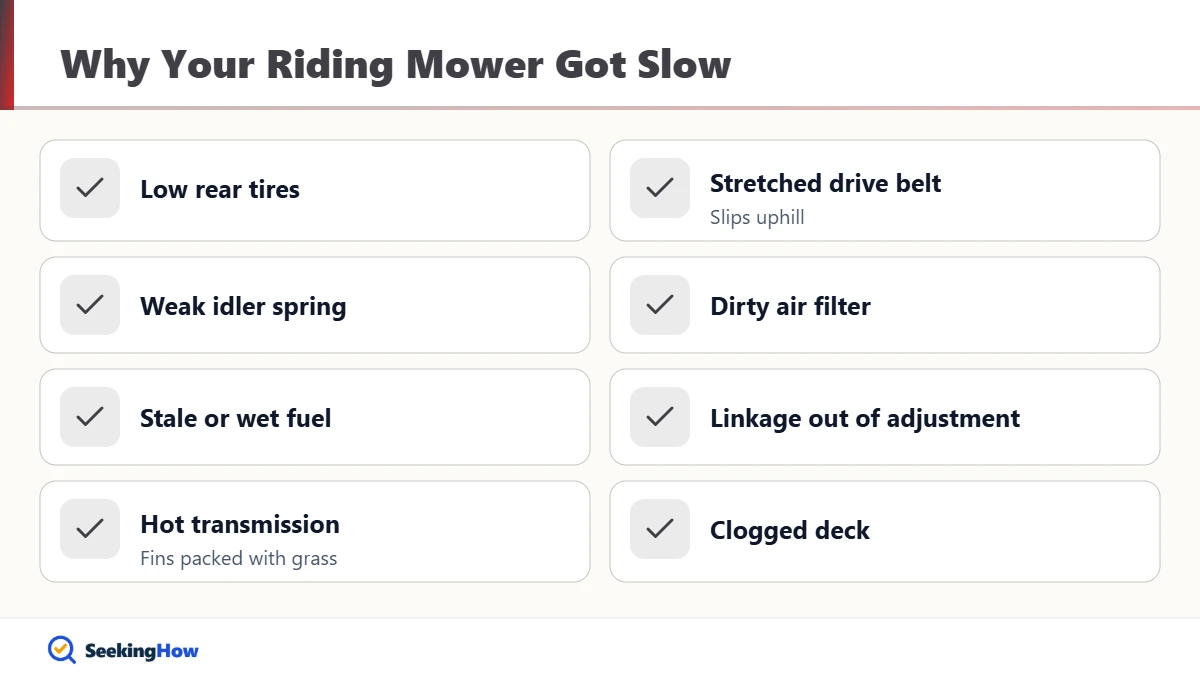
Set every tire to the pressure on the sidewall or in the manual; riding mower tires often run around 10-14 psi in the rear, but check yours. Low rear tires shrink the rolling diameter and add drag. Most people find at least one soft tire when a mower feels sluggish.
Step 2: Inspect and Replace the Drive Belt
With the key removed and the plug wire off, look for glazing, cracks, fraying or a belt that sits low in the pulley grooves. A stretched belt slips and robs speed, especially uphill. Replace it with the exact OEM part number; an “almost right” belt slips just as badly.
Step 3: Tune the Engine
Replace a dirty air filter and worn spark plug, and run fresh fuel. A clogged filter or stale gas makes the engine bog under load, which slows hydrostatic mowers noticeably. If the mower sputters, water in the fuel may be the cause; see how to get water out of a lawn mower gas tank.
Step 4: Adjust the Speed Control Linkage
On hydrostatic mowers, the pedal or lever linkage can drift so the transmission never reaches full stroke. Follow the manual’s adjustment procedure for the control rod or neutral setting. Also check hydrostatic fluid level if your unit has a serviceable reservoir. On gear-drive mowers, make sure the clutch and brake are fully releasing.
Step 5: Clean the Deck and Grease Pivots
Scrape caked grass from under the deck, sharpen blades and grease all fittings. A clogged deck and dull blades load the engine and slow travel while mowing. See how to install a grease fitting if any are missing or broken.
Step 6: Fit Taller Rear Tires (Upgrade)
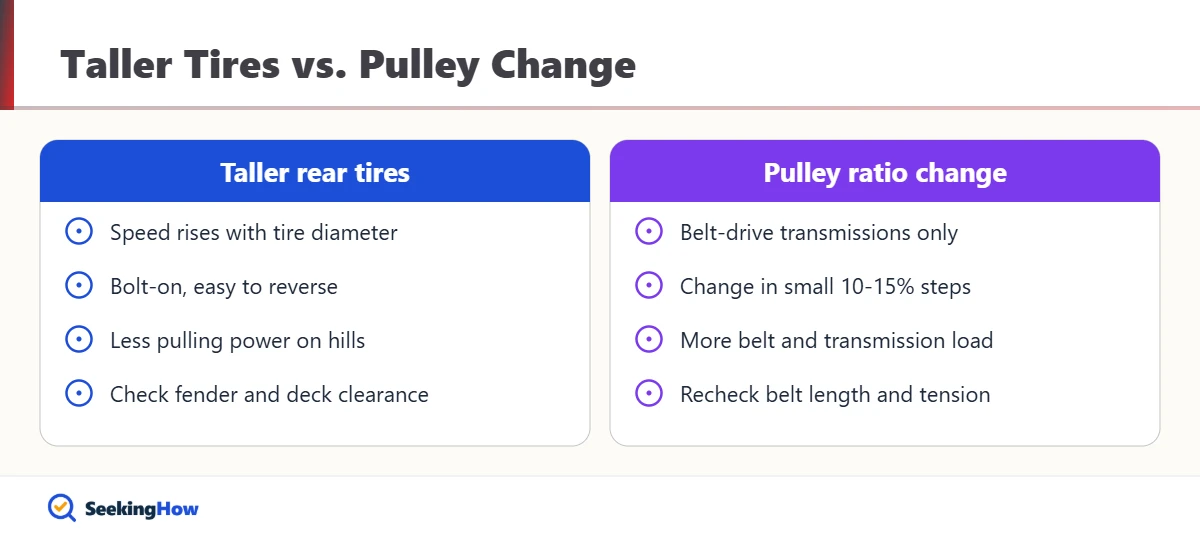
Taller rear tires increase ground speed roughly in proportion to the diameter change; going from 20 to 22 inches adds about 10%. Confirm clearance with the fenders and deck, and keep the same rim width. Expect slightly less climbing power and a higher center of gravity.
Step 7: Change the Pulley Ratio (Advanced)
On belt-drive transmissions, a larger engine drive pulley or smaller transmission input pulley raises output speed. Change ratios in small steps, typically no more than 10-15% at a time, and recheck belt length and tension. Bigger jumps overheat transmissions that are not built for it.
Bottom line: Restore factory speed first; if you still want more, taller tires are the safest upgrade, and governor changes are off the table.
| Method | Speed gain | Difficulty | Trade-off |
|---|---|---|---|
| Tire pressure, belt, tune-up | Restores lost speed | Easy | None |
| Linkage adjustment | Restores full range | Moderate | Must follow manual specs |
| Taller rear tires | About proportional to diameter | Easy-moderate | Less torque, higher center of gravity |
| Pulley ratio change | Moderate | Moderate-hard | More belt and transmission wear |
| Governor adjustment | Not recommended | – | Engine damage, safety risk, voids warranty |
If That Didn’t Work
Problem: Mower slows down when warm. Cause: Overheating hydrostatic transmission or low fluid. Fix: Clean debris off the transmission fan and fins and check fluid where serviceable.
Problem: Mower is slow uphill only. Cause: Belt slipping or idler spring weak. Fix: Replace the belt and idler spring.
Problem: New tires made it slower. Cause: Engine can’t pull the taller gearing under load. Fix: Return to stock size or raise cut height when mowing.
Problem: Speed varies or surges. Cause: Fuel or carburetor problem. Fix: Use fresh fuel and clean the carburetor.
Safety and When To Call a Pro
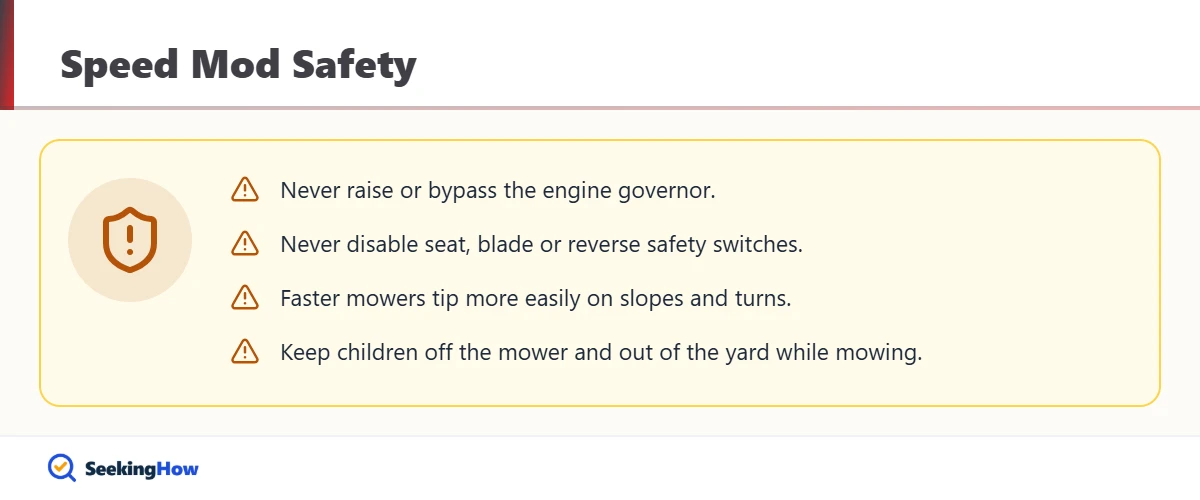
Riding mowers are designed for low speeds, and faster mowers are more likely to tip on slopes and turns. Never disable seat, blade or reverse safety switches, and never raise the governor setting. Drive up and down slopes rather than across them where the manual allows, and keep children off and away. Call a small-engine shop if the transmission whines, leaks or loses drive, if the mower creeps in neutral after adjustments, or if you want ratio changes on a hydrostatic unit. For heavily modified racing builds, see how to make a lawn mower go 40 mph, which covers what that level of build involves.
Prevention Tips
- Check tire pressure monthly during mowing season.
- Keep the transmission cooling fan and fins clear of grass.
- Replace the drive belt at the first sign of slipping or glazing.
- Store the mower with stabilized fuel over winter.
Related Guides
- How to make a lawn mower go 40 mph
- How to get water out of a lawn mower gas tank
- How to install a grease fitting
- How to remove a stuck grease fitting
Sources
- U.S. Consumer Product Safety Commission – Riding mower safety information
- Your mower operator’s manual – tire pressure, belt routing and transmission adjustment
- Engine manufacturer guidance – governor settings and maintenance intervals
Frequently Asked Questions
How fast does a riding lawn mower go?
Most riding lawn mowers and lawn tractors travel a few miles per hour, typically up to about 5-7 mph forward in top speed depending on model. Zero-turn mowers are often faster. Check your manual for the rated speed, since that is what the transmission and brakes are designed to handle.
Why is my riding mower so slow?
A riding mower is usually slow because of a stretched or glazed drive belt, low rear tire pressure, a misadjusted speed control linkage or an engine bogging from a dirty air filter or stale fuel. Hydrostatic units also slow down when they overheat. Fixing these restores factory speed.
Will bigger tires make my riding mower faster?
Yes, bigger rear tires make a riding mower faster in proportion to the diameter increase, so a 10% taller tire gives about 10% more speed. The trade-off is less pulling power, possible clearance problems and a higher center of gravity, which raises tip-over risk on slopes.
Is it safe to adjust the governor on a riding mower?
No, adjusting the governor to raise engine speed is not safe. Small engines are built for a specific maximum RPM, and over-revving can damage the connecting rod, flywheel or blades and void the warranty. Overspeed blades are also a serious hazard. Keep the governor at factory setting.
Can you make a hydrostatic mower faster?
You can make a hydrostatic mower reach its full rated speed by adjusting the control linkage, keeping the transmission cool and checking fluid where serviceable. Going beyond factory speed mainly comes from taller tires. Pulley changes on hydrostatic units add heat and wear, so ask a dealer first.
Does a new belt make a riding mower faster?
A new drive belt makes a riding mower faster if the old belt was stretched, glazed or slipping. You will notice the biggest difference uphill and when starting from a stop. Use the exact OEM part number; a slightly longer aftermarket belt can slip like the old one.