Quick Answer
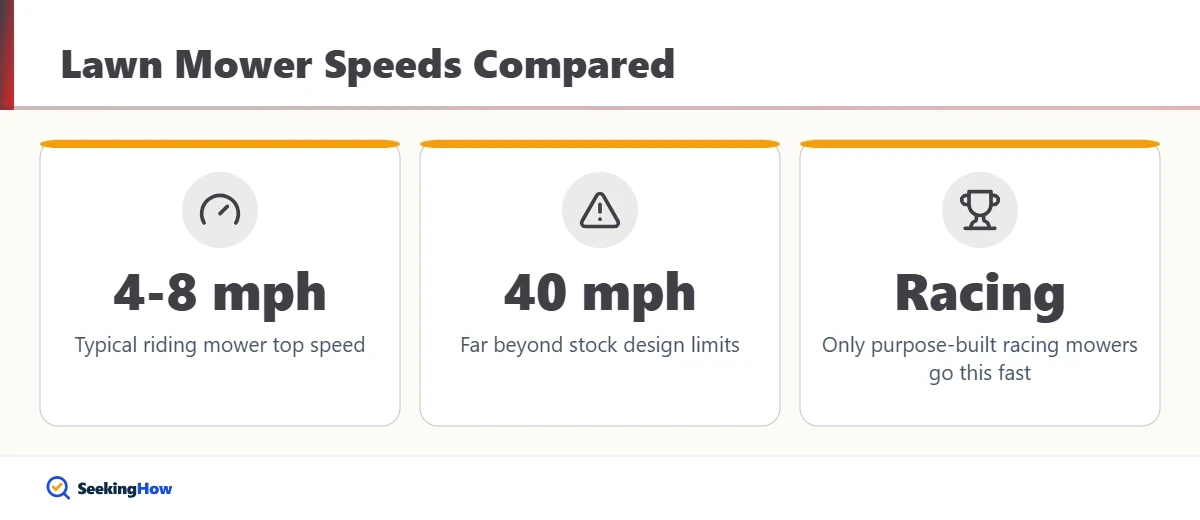
A stock riding mower cannot safely go 40 mph. Lawn tractors typically top out around 5-8 mph and zero-turns around 7-12 mph, and their brakes, steering, tires, and transmissions are built for those speeds. Reaching 40 mph requires a purpose-built racing mower with a new drivetrain, brakes, and safety gear, ideally built to the rules of a sanctioned lawn mower racing class.
Key Takeaways
- Going from about 6 mph to 40 mph is roughly a sevenfold speed increase and roughly 44 times more kinetic energy in a crash.
- Hydrostatic transaxles, small tires, and light frames on yard mowers are not designed for high speed and can fail.
- Speed builds that work are full conversions: manual transmission, chain or belt reduction changes, real brakes, and a reinforced chassis.
- Always remove the cutting blades on any mower modified for speed; racing organizations require it.
- Racing mowers belong on closed tracks, not public roads or neighborhood streets.
The idea of a 40 mph lawn mower is fun, and lawn mower racing is a real hobby with clubs and organized events. But the honest answer is that you do not “tweak” a riding mower to 40 mph; you rebuild it into a different machine. This guide explains why, what speed builders actually change, and how to do it as safely as possible.
How Fast Does a Riding Lawn Mower Go?
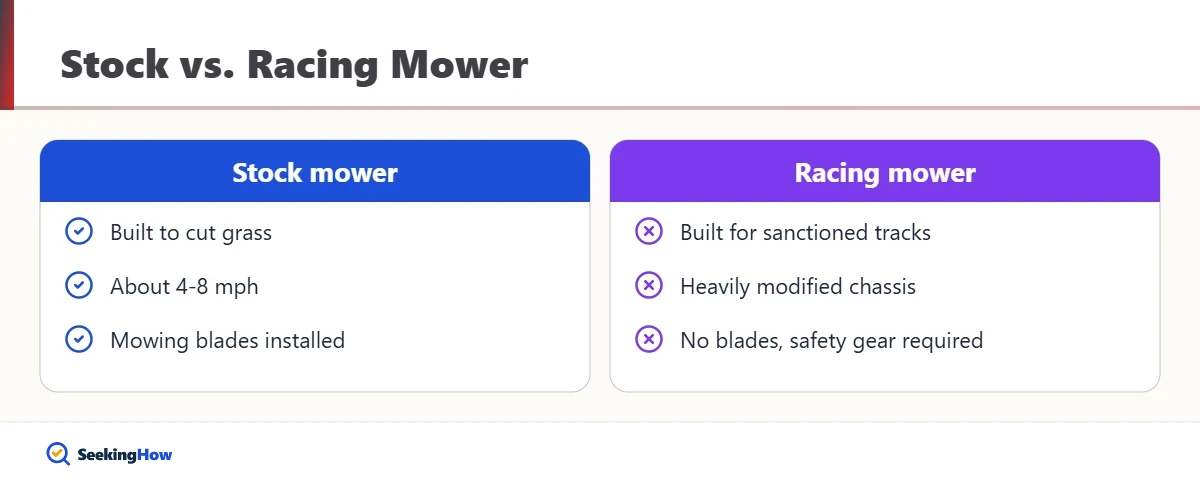
Riding mowers are geared for cutting quality and control, not speed. Blades cut best when the machine moves slowly enough for grass to be sliced evenly.
| Machine | Typical top speed | Designed for |
|---|---|---|
| Walk-behind self-propelled mower | About 2-4 mph | Walking pace mowing |
| Lawn tractor | About 5-8 mph | Residential lawns |
| Residential zero-turn | About 7-9 mph | Faster mowing on open lawns |
| Commercial zero-turn | Around 10-12 mph on some models | Professional crews |
| Purpose-built racing mower | Varies by class, can exceed 40 mph | Closed-course racing |
Exact speeds vary by model; your owner’s manual lists the rated forward speed. The gap between 8 mph and 40 mph is enormous, which is why speed builds involve major changes.
Why Is 40 MPH Dangerous on a Lawn Mower?
Crash energy rises with the square of speed
Kinetic energy grows with speed squared. At 40 mph, a mower carries about 25 times the energy it has at 8 mph, and nearly 45 times what it has at 6 mph. A rollover or collision at that speed can cause severe injuries.
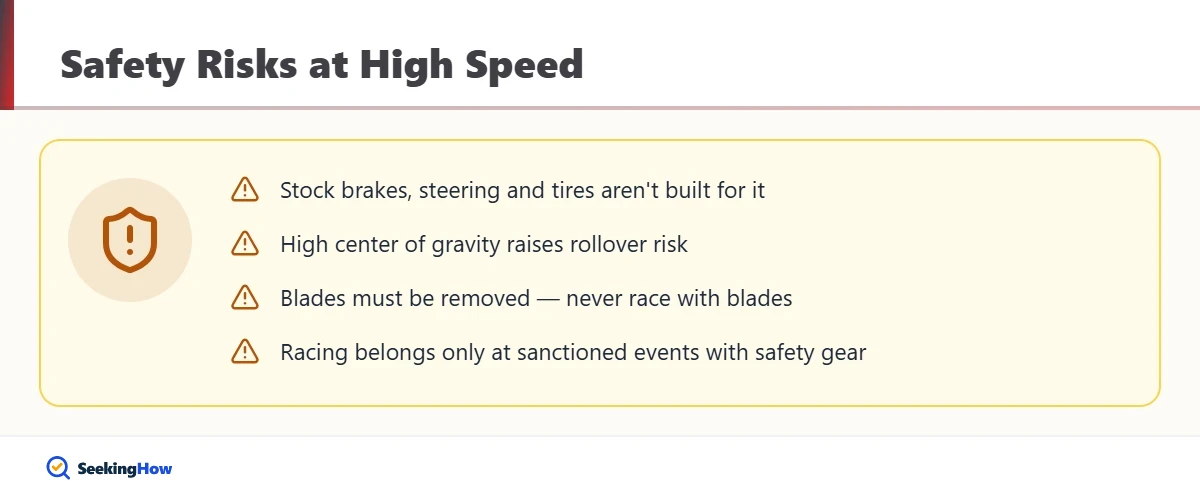
The brakes and steering are not built for it
Many lawn tractors stop using the transmission or a small band or disc brake intended for walking-pace speeds. Steering gear is simple and has play. Neither will reliably control a machine at highway-like speeds.
The chassis is tall, short, and light
A high seat, short wheelbase, and narrow track make mowers prone to tipping in fast turns, especially on uneven grass. Rollover risk is already a known hazard on slopes at mowing speed.
The drivetrain can fail
Hydrostatic transaxles are designed for low speed and high torque. Spinning them faster can overheat them or break internals. Small engines run past their governed speed can suffer catastrophic failures, throwing parts.
Safety: Never operate a modified mower with the cutting deck or blades attached, never on public roads, and never with passengers or children nearby. A fast mower needs a helmet, eye protection, and a closed, clear area at minimum.
What Do Builders Change To Make a Mower Fast?
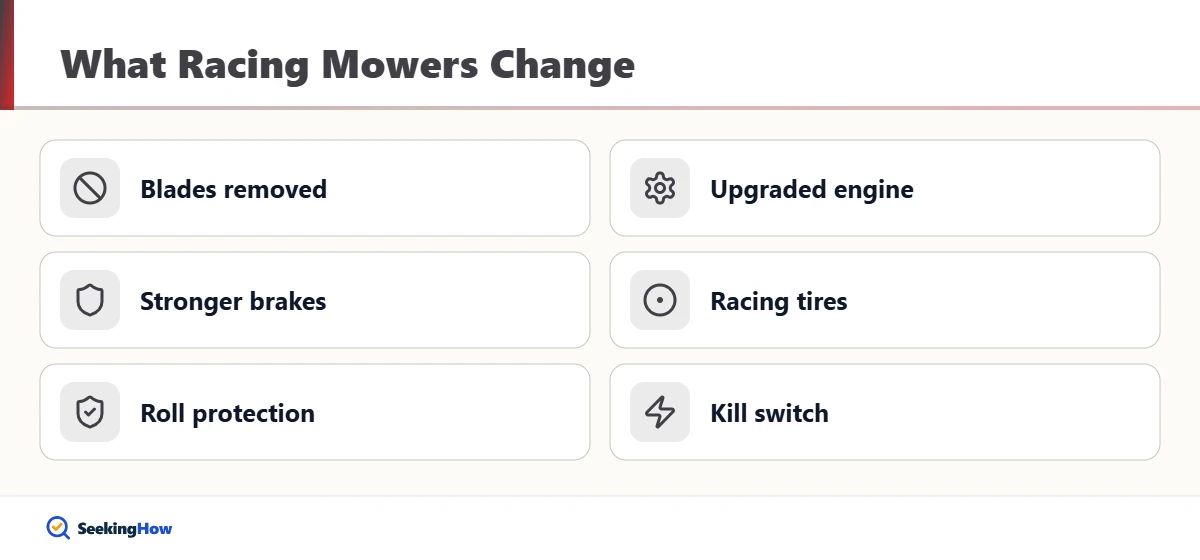
Lawn mower racing hobbyists build machines that look like mowers but share little with the original drivetrain. The common changes are below. Treat this as an overview of what is involved, not a shortcut list for your yard mower.
Remove the mower deck and blades
The first step in every speed build is removing the deck and blades. This drops weight, lowers drag, and eliminates the most dangerous part of the machine. Racing organizations require blades to be removed.
Replace the transmission
Builders typically swap hydrostatic or low-geared transaxles for a manual or a belt/chain drive setup with different gearing. Changing pulley or sprocket ratios raises top speed at the cost of acceleration and pulling power.
Upgrade engine output carefully
Engine changes range from tuning to swapping in a larger engine. Engine governors limit RPM to protect the engine; running far beyond the manufacturer’s maximum RPM risks connecting rod and flywheel failure. Racing classes set specific engine rules for this reason.
Add real brakes
Speed builds add disc brakes, often borrowed from go-karts, sized for the higher speed and weight. Stopping power must increase at least as much as speed does.
Strengthen the frame and lower the center of gravity
Builders reinforce or replace the frame, lower the seat, widen the stance, and fit stronger spindles and wheel bearings. A lower, wider machine is far less likely to roll in a turn.
Fit tires and wheels rated for speed
Turf tires are made for traction at low speed on grass. Racing builds use tires and wheels from go-karts or similar machines that can handle higher speed and cornering loads.
Add safety equipment
A kill switch tether, throttle return springs, chain or belt guards, and the rider’s helmet, gloves, and protective clothing are standard. Sanctioned events inspect machines before they race.
How Do You Get Started in Lawn Mower Racing Safely?
If you want a fast mower, start with a sanctioned racing organization rather than improvising. In the United States, the U.S. Lawn Mower Racing Association publishes class rules, safety requirements, and event schedules, and similar clubs exist in other countries, including the British Lawn Mower Racing Association.
- Read the class rules for beginner or stock-appearing classes before buying parts.
- Attend an event to see machines up close and talk to builders.
- Choose a donor lawn tractor that matches your class’s chassis rules.
- Build brakes, safety switches, and guards first, then work on speed.
- Pass technical inspection and race only on closed courses.
Many racing classes have speed ranges well below 40 mph, which is a good place to learn handling before chasing top speed. Purpose-built record machines have gone far faster, but they were engineered from the ground up by professional teams.
Can You Make Your Mower a Little Faster for Mowing?
If you simply want to finish mowing sooner, speed mods are the wrong tool. Better options include:
- Keeping blades sharp and the deck clean so you can mow at the top of the normal range without missing grass.
- Servicing the engine with fresh fuel, a clean air filter, and a new spark plug so it holds full rated RPM. If the engine stutters after storage, see our guide to getting water out of a gas tank.
- Checking tire pressure and drive belt condition; a slipping belt costs real speed.
- Upgrading to a zero-turn mower if you mow large, open areas.
When you replace worn tires during a tune-up or build, our guide to disposing of used tires explains your options.
Is It Legal To Drive a Lawn Mower on the Road?
In most places, lawn mowers are not street-legal vehicles. They lack lights, signals, mirrors, and other equipment required on public roads. Some localities allow brief crossings or travel on road shoulders under specific rules, but a modified high-speed mower on a public road can bring citations and leaves you exposed in any collision. Check your state and local laws, and keep fast machines on private property or sanctioned tracks.
Common Mistakes With Mower Speed Modifications
- Changing gearing without upgrading brakes. Faster always needs stronger stopping.
- Removing the governor and over-revving. Small engines can fail violently above their designed RPM.
- Leaving the deck on. Spinning blades on a fast machine are a serious hazard.
- Keeping turf tires and stock spindles. They are not built for high-speed cornering.
- Riding without protective gear. A helmet is the minimum.
Store your project safely between sessions; our guide to organizing outdoor power equipment in the garage can help free up floor space.
Frequently Asked Questions
What is the fastest a riding lawn mower can go stock?
Most residential lawn tractors top out around 5 to 8 mph, and many zero-turn mowers run about 7 to 12 mph depending on the model. Check the rated forward speed in your owner manual, since exact figures vary by brand and model.
Is it safe to remove the governor on a lawn mower engine?
It is risky. The governor keeps the engine within its designed RPM range. Running a small engine far beyond that speed can break the connecting rod or flywheel and throw parts. Racing classes set engine rules for this reason, and many beginners keep governed engines.
Do racing lawn mowers still cut grass?
No. Racing mowers have their cutting decks and blades removed, and racing organizations require this for safety. They keep the appearance of a lawn tractor but are built for closed-course racing, not mowing.
Can a zero-turn mower go faster than a lawn tractor?
Usually, yes. Zero-turn mowers are designed for faster mowing on open lawns and often run several mph faster than lawn tractors. They still are not designed for high speeds, and they can be unstable on slopes, so follow the manufacturer slope and speed guidance.
Is it legal to ride a lawn mower on the street?
In most places, lawn mowers are not street legal because they lack required lights, signals and safety equipment. Some local rules allow brief crossings. Check your state and local laws, and keep modified or fast mowers on private property or sanctioned tracks.