Quick Answer
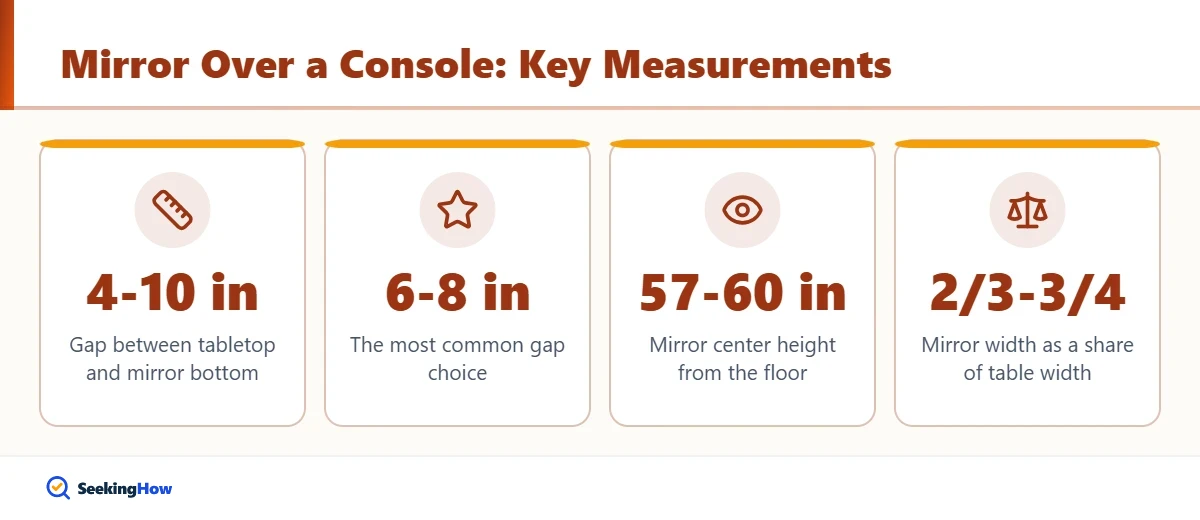
Hang a mirror so its bottom edge sits 4-10 inches above a console table, with 6-8 inches the most common choice. Aim to put the mirror’s center near 57-60 inches from the floor, and pick a mirror about two-thirds to three-quarters as wide as the table. Hang heavy mirrors on studs or a French cleat, never on a single nail.
Key Takeaways
- A 4-10 inch gap between table and mirror makes the two read as one grouping.
- Center the mirror horizontally over the table, not the wall.
- Mirror width of about 2/3 to 3/4 of the table width looks balanced.
- Raise the mirror if tall lamps or decor would block it; lower it in rooms with low ceilings.
- Use hardware rated for at least the mirror’s weight, ideally anchored into studs.
A mirror over a console table is one of the easiest ways to brighten an entryway or hallway, but hang it too high and it floats away from the table; too low and it gets hidden behind lamps and keys. Here are the measurements designers use, how to adjust them for your space, and how to hang the mirror securely.
How High Should a Mirror Be Above a Console Table?
The most reliable rule is to leave 4-10 inches between the tabletop and the bottom of the mirror. Most rooms look best at 6-8 inches. Standard console tables are usually around 30-34 inches tall, so the bottom of the mirror typically lands about 36-42 inches from the floor.
A second check is eye level. Galleries and designers often center art at about 57-60 inches from the floor, and that works for mirrors too. For a medium mirror, both rules usually point to a similar spot. For a very tall mirror, prioritize the gap above the table.
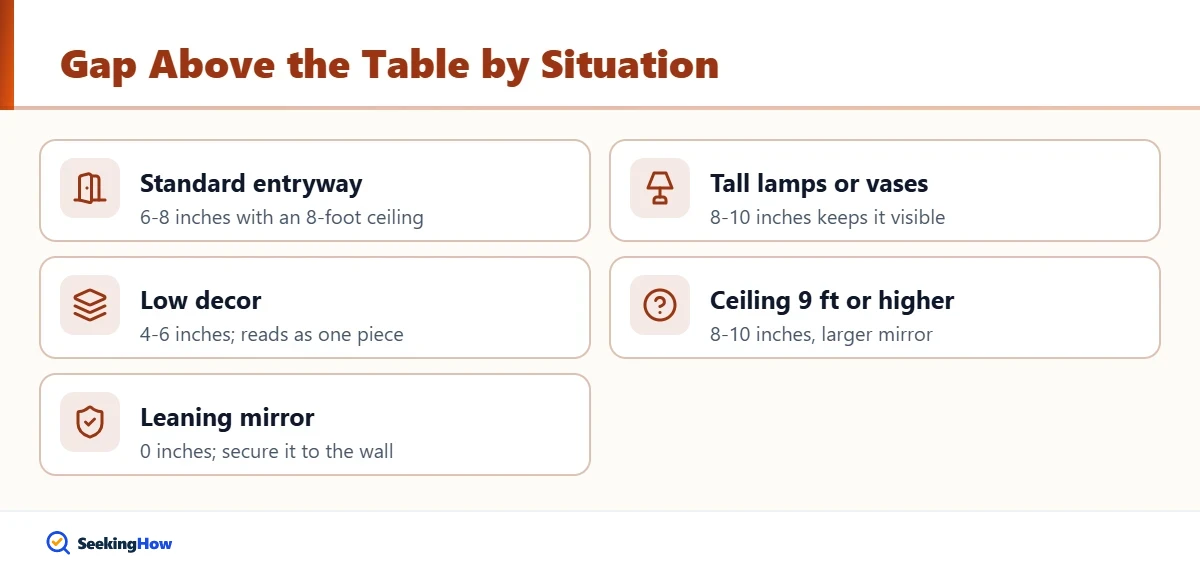
| Situation | Gap above table | Why |
|---|---|---|
| Standard entryway, 8-foot ceiling | 6-8 inches | Balanced, connected look |
| Tall lamps or tall vases on table | 8-10 inches | Keeps the mirror visible |
| Low decor or bare tabletop | 4-6 inches | Mirror and table read as one piece |
| Ceiling 9 feet or higher | 8-10 inches, larger mirror | Fills vertical space |
| Mirror leaning on the table | 0 inches | Casual layered look; secure it to the wall |
What Size Mirror Should Go Over a Console Table?
Choose a mirror that is narrower than the table, generally about two-thirds to three-quarters of the table’s width. A 48-inch console pairs well with a mirror roughly 32-36 inches wide. Never let the mirror be wider than the table; it looks top-heavy.
For height, a mirror that is taller than it is wide suits narrow hallways and tall ceilings. Round and wide horizontal mirrors work in rooms with lower ceilings. Leave at least 6-12 inches between the top of the mirror and the ceiling.
How Do You Hang a Mirror Over a Console Table?
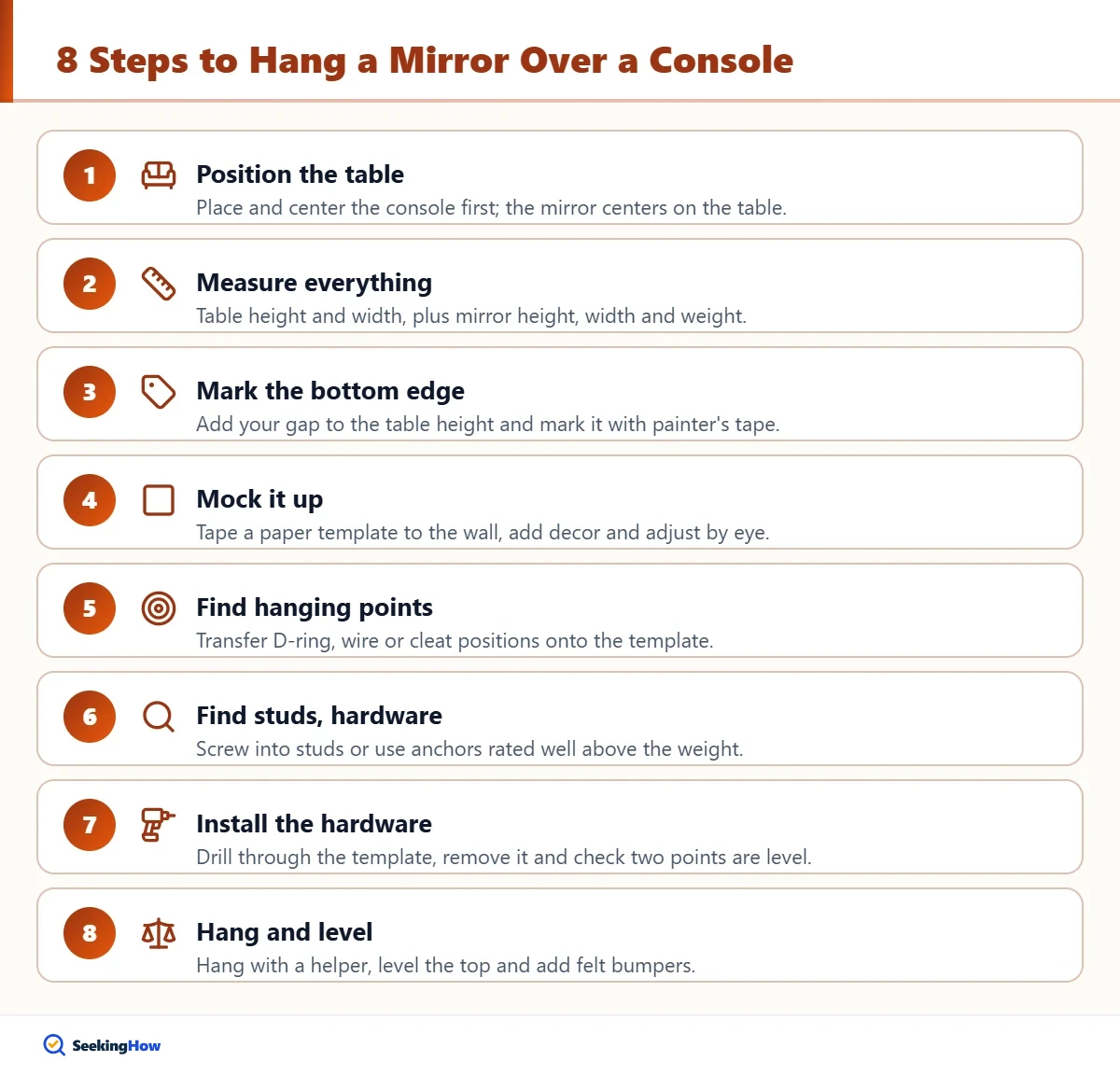
Step 1: Position the Table
Place the console where it will stay and center it on the wall or the space you want. The mirror will be centered on the table, so the table location comes first.
Step 2: Measure the Table and Mirror
Measure the table height and width, and the mirror’s height, width and weight. Check the weight on the packaging or by weighing yourself holding the mirror and subtracting your own weight.
Step 3: Mark the Bottom Edge
Add your chosen gap, say 7 inches, to the table height and mark that line lightly on the wall with painter’s tape. This is where the bottom of the mirror frame will sit.
Step 4: Mock It Up
Cut kraft paper or cardboard to the mirror’s size and tape it to the wall above your bottom-edge line. Add the lamps and decor you plan to use, then step back. Adjust up or down an inch or two until it looks right from the doorway.
Step 5: Locate the Hanging Points
Measure from the top of the mirror down to its hanging hardware, such as D-rings, a wire pulled taut, or a cleat. Transfer that distance onto your paper template and mark the hardware positions on the wall. Mark the horizontal center of the table so the mirror stays centered.
Step 6: Find Studs and Choose Hardware
Use a stud finder to check for studs near your marks. Drive screws into studs when you can. If studs do not line up, use anchors rated for well above the mirror’s weight, such as toggle bolts, or install a French cleat that spans at least one stud.
Step 7: Install the Hardware
Drill pilot holes or anchor holes through the paper template, then remove the paper. Install screws or hooks, leaving them out slightly if the mirror hangs on D-rings. Check that two-point hardware is level before hanging.
Step 8: Hang and Level the Mirror
Lift the mirror with a helper, hang it, and check with a level on the top edge. Add small felt bumpers on the bottom back corners so it sits flat and does not shift. Then style the table.
How Do You Style a Console Table With a Mirror?
- Overlap a little: a lamp or tall vase can overlap the mirror’s lower edge slightly, which layers the look.
- Balance the sides: pair two lamps, or offset one lamp with a stack of books and a plant.
- Watch reflections: stand where you enter and check what the mirror reflects; a window, light fixture or artwork is better than a closet or clutter.
- Add a tray or bowl for keys in an entryway so the surface stays tidy.
Tip: The same rules work for a dining room. For a mirror above a sideboard, see our guide on how high to hang a mirror over a buffet.
Common Mistakes When Hanging a Mirror Over a Console
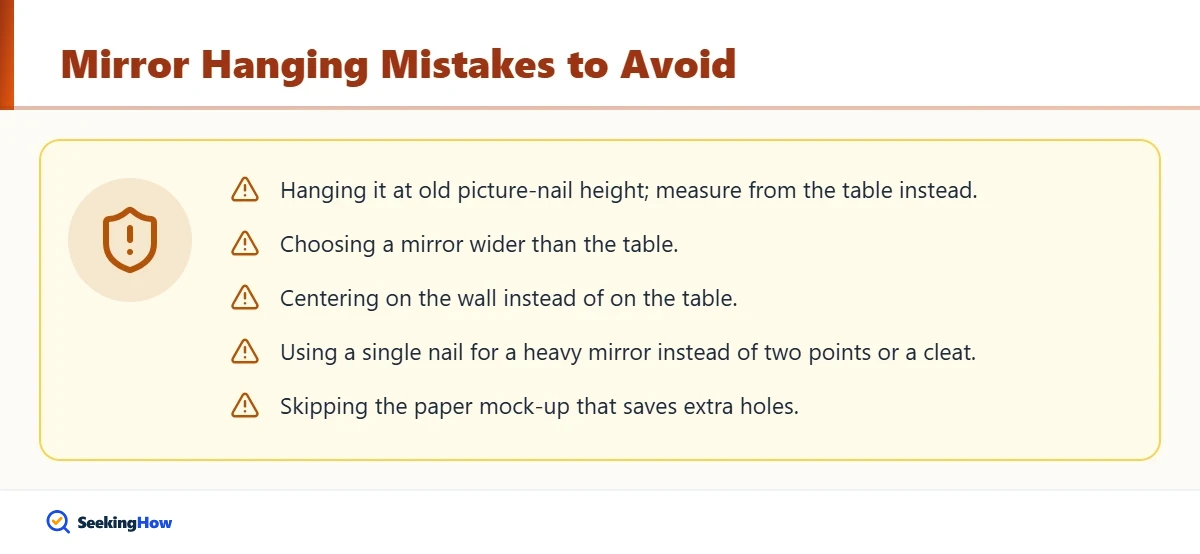
- Hanging it at the old picture-nail height. Mirrors often end up too high. Measure from the table, not the ceiling.
- Choosing a mirror wider than the table. It overwhelms the console.
- Centering on the wall instead of the table. If the table is off-center, the mirror should follow the table.
- Using a single nail for a heavy mirror. Mirrors are heavy for their size and can fall; use two points or a cleat into studs.
- Skipping the mock-up. A paper template saves extra holes.
Is It Safe to Hang a Heavy Mirror on Drywall?
Yes, with the right hardware. Heavy mirrors should hang on screws in studs, on a French cleat screwed into studs, or on toggle-style anchors rated well above the mirror’s weight. Plastic expansion anchors and adhesive hooks are fine only for light mirrors within their ratings.
Safety: In high-traffic entryways or homes with children, secure the bottom of the mirror with clips or felt-backed L-brackets as well, and avoid leaning tall mirrors against the wall unless the top is tethered. If you need to stabilize the console itself, the methods in stabilizing a bookshelf without drilling work for tall narrow tables too.
For a coordinated entry, pair the mirror with a DIY freestanding project elsewhere in the home or add trim to finish the wall, as in our guide on installing baseboard molding on an uneven floor.
Frequently Asked Questions
Should a mirror be wider than a console table?
No. A mirror wider than the console looks top-heavy and out of proportion. Aim for a mirror about two-thirds to three-quarters of the table width so the table frames it, with a few inches of tabletop visible on each side.
Can a mirror sit directly on a console table?
Yes, leaning a mirror on the tabletop creates a relaxed, layered look. Secure the top of the mirror to the wall with a hidden hook or anti-tip strap so it cannot slide or fall, especially in busy entryways or homes with children and pets.
How high should a round mirror be over a console?
Use the same gap of about 4 to 10 inches between the tabletop and the bottom of the round mirror. Round mirrors often look best on the lower end of that range, around 5 to 7 inches, so they connect visually with the table.
Do you center a mirror on the wall or the table?
Center it on the table. The mirror and console should read as one grouping, so if the table is placed off-center on the wall, the mirror follows the table. Only center on the wall when the table is also centered.
How do I hang a mirror if there is no stud?
Use hollow-wall anchors such as toggle bolts rated well above the mirror weight, or mount a French cleat with screws into the nearest studs on either side. Avoid plastic expansion anchors and adhesive hooks for anything but light mirrors.