Quick Answer
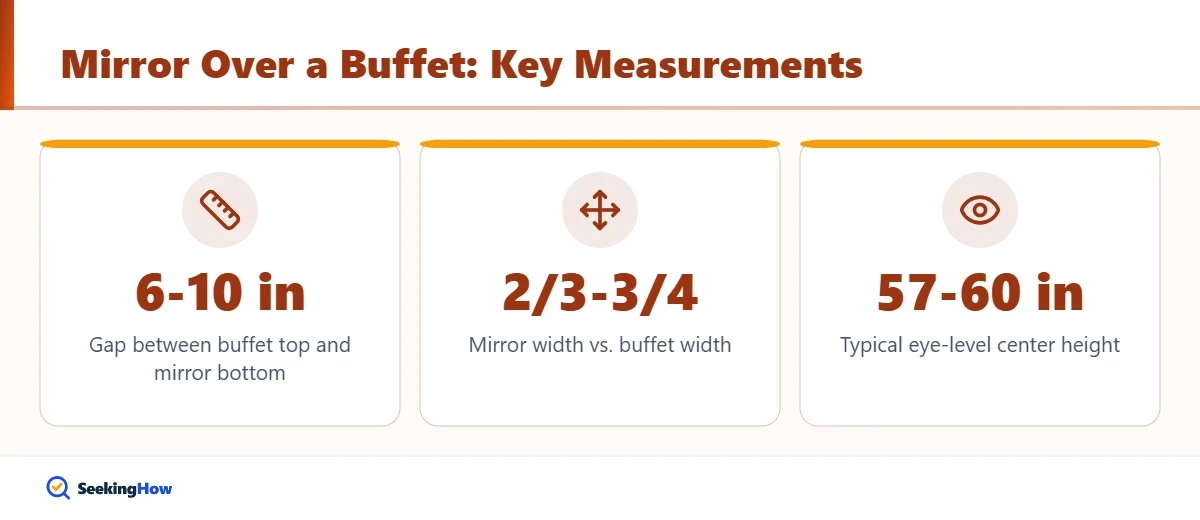
Hang a mirror so its bottom edge sits about 6 to 10 inches above the buffet top, with 4 inches as a practical minimum. Choose a mirror roughly two-thirds to three-quarters as wide as the buffet, center it over the piece, and anchor heavy mirrors into wall studs or with hardware rated for at least the mirror’s weight.
Key Takeaways
- The usual gap between buffet top and mirror bottom is 6 to 10 inches; go closer for low ceilings, higher if you display tall lamps or decor.
- A mirror about 2/3 to 3/4 of the buffet width looks balanced; never wider than the buffet.
- Most buffets are 30 to 36 inches tall, so a mirror’s bottom edge typically lands around 38 to 46 inches from the floor.
- Use two hanging points or a French cleat so the mirror stays level.
- Heavy mirrors should go into studs; check every hook, anchor and wire weight rating.
A mirror over a buffet or sideboard brightens a dining room and makes the furniture look intentional. Hang it too high and it floats away from the buffet; hang it too low and lamps and serving pieces crowd it. These measurements and steps help you get the height, size and hardware right the first time.
How High Should a Mirror Be Above a Buffet?
Designers generally aim for 6 to 10 inches between the top of the buffet and the bottom edge of the mirror. That gap is close enough that the mirror and buffet read as one grouping, yet high enough to keep the mirror clear of decor. In rooms with 8-foot ceilings or with short mirrors, 4 to 6 inches often looks better.
Adjust for what you place on the buffet. If you use tall table lamps, candlesticks or a large centerpiece, let the decor overlap the mirror slightly rather than pushing the mirror high on the wall. Overlap layers the look; a big empty band of wall breaks it.
| Situation | Gap Above Buffet | Why |
|---|---|---|
| Standard 8-ft ceiling | 4-8 in | Keeps the mirror from crowding the ceiling |
| 9-ft or higher ceiling | 6-10 in | More wall to fill; a taller mirror often fits |
| Tall lamps on each side | 6-10 in | Lamps frame the mirror; small overlap is fine |
| Low decor or nothing on top | 4-6 in | Tighter grouping looks more anchored |
| Leaning mirror instead of hanging | 0 in (rests on top) | Casual look; secure it to the wall |
What Size Mirror Should Go Over a Buffet?
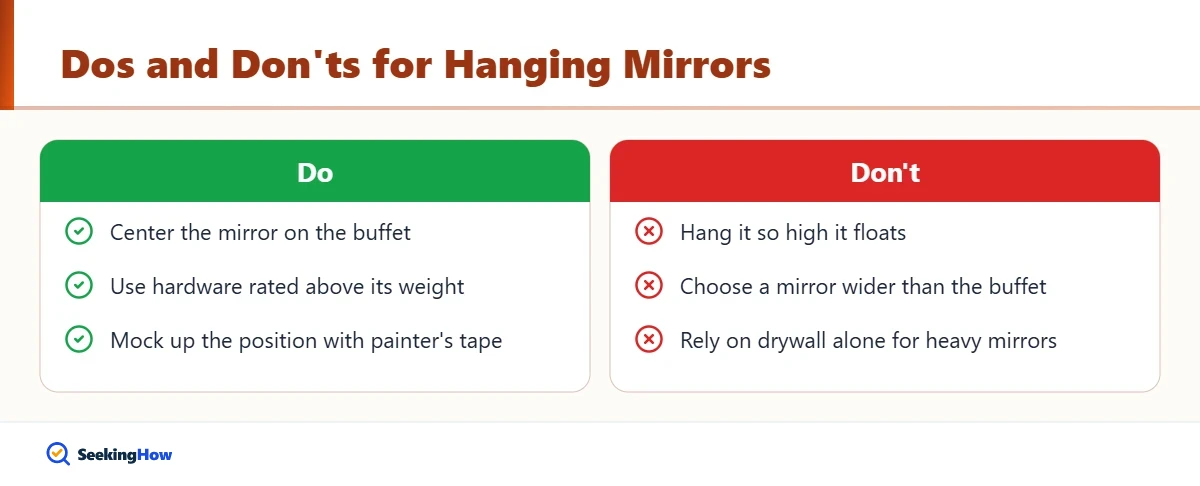
For width, a mirror about two-thirds to three-quarters as wide as the buffet is the classic proportion. On a 60-inch buffet, that means a mirror roughly 40 to 45 inches wide. A mirror wider than the buffet looks top-heavy, while one under half the width can look lost.
For height, keep the top of the mirror at least several inches below the ceiling or crown molding. Round and arched mirrors can be a bit narrower than rectangular ones because their shape adds visual weight. Two matching narrow mirrors side by side are another option for a very long sideboard.
| Buffet Width | Mirror Width (2/3 to 3/4) |
|---|---|
| 48 in | 32-36 in |
| 60 in | 40-45 in |
| 72 in | 48-54 in |
| 84 in | 56-63 in |
What You Need To Hang the Mirror
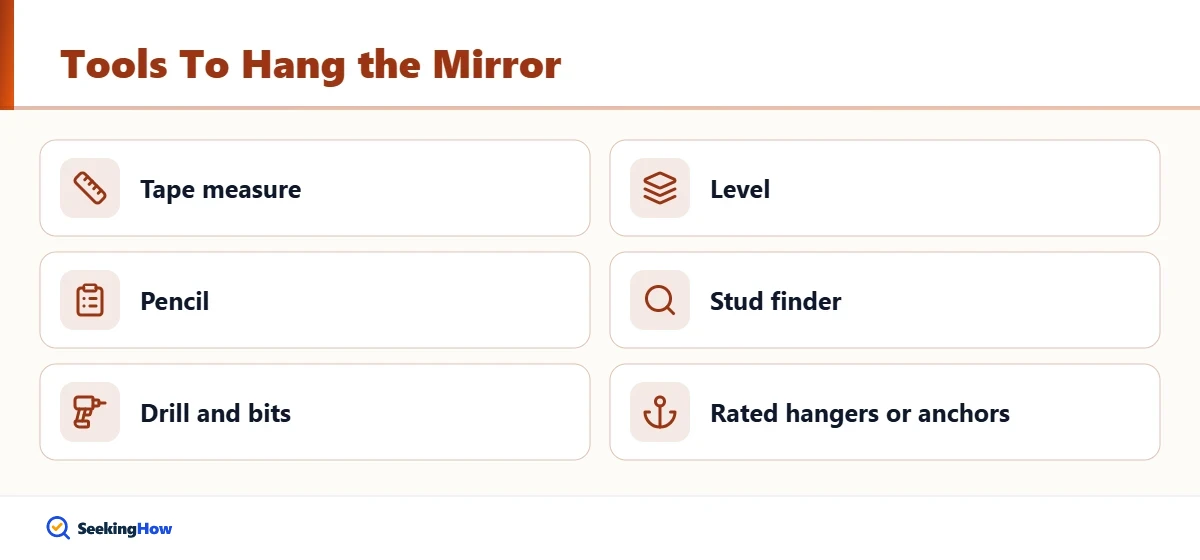
- Tape measure, pencil and painter’s tape
- Level (a 24-inch level or a laser level)
- Stud finder
- Drill/driver and bits
- Hanging hardware rated for the mirror’s weight: D-rings and screws, a French cleat, or heavy-duty picture hooks
- Wall anchors rated for your wall type if no stud is available
- Kraft paper or cardboard for a template (optional)
- A helper for mirrors over about 20 pounds
How To Hang a Mirror Over a Buffet Step by Step
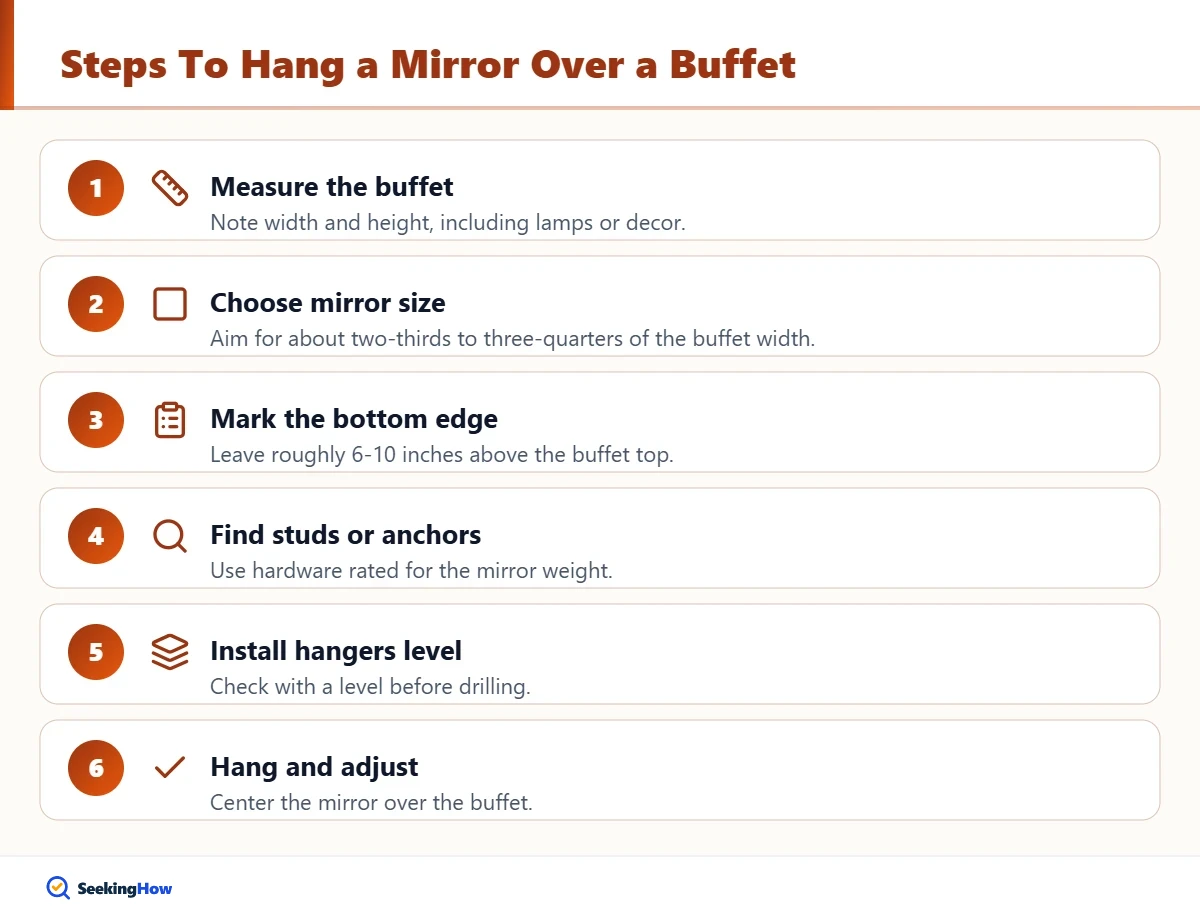
Step 1: Center the Buffet and Mark Its Midpoint
Position the buffet where it will stay, measure its width, and mark the center on the wall with painter’s tape. Everything else is measured from this centerline.
Step 2: Choose the Gap and Mark the Bottom Edge
Measure the buffet height from the floor and add your chosen gap, for example 34 inches plus 8 inches equals 42 inches. Run a strip of painter’s tape level across the wall at that height to show where the mirror’s bottom edge will sit.
Step 3: Make a Paper Template
Trace the mirror onto kraft paper, mark the hanging points on the template, and tape it to the wall. Step back and view it from the dining table and the doorway. Adjust the height an inch or two until it looks right with your lamps and decor.
Step 4: Locate Studs and Mark Hanging Points
Use a stud finder to locate studs behind the template. Drive screws into studs where possible; wall studs are commonly 16 inches on center in U.S. homes. Mark the hanging points directly through the template, then remove the paper.
Step 5: Install the Hardware
Drill pilot holes and install screws, hooks or a French cleat at the marks, checking level between points. If a point misses a stud, use an anchor rated above the mirror’s weight for your drywall or plaster. Two hanging points keep the mirror from tilting.
Step 6: Hang, Level and Secure the Mirror
With a helper, lift the mirror onto the hardware, check it with a level and adjust. Add felt bumpers to the lower corners to keep it flush and protect the wall. Give the mirror a gentle tug to confirm it is secure before you style the buffet.
Which Hanging Hardware Is Best for a Heavy Mirror?
| Hardware | Best For | Pros | Watch Out For |
|---|---|---|---|
| D-rings with screws into studs | Most framed mirrors | Stays level, very secure | Points must align precisely |
| French cleat | Heavy and wide mirrors | Spreads load, self-leveling | Adds a little depth behind mirror |
| Picture wire on two hooks | Light to medium mirrors | Easy to adjust | Can tilt forward; wire must be rated |
| Heavy-duty anchors | When studs do not line up | Flexible placement | Ratings vary with wall material |
Safety: A large mirror can weigh 30 to 60 pounds or more and can shatter if it falls. Check the mirror’s weight on a bathroom scale, use hardware rated above that weight, and avoid relying on adhesive strips or a single nail for a mirror hanging over a dining area.
Common Mistakes To Avoid
- Hanging at gallery eye level. The 57-to-60-inch center rule is for bare walls; over furniture, measure from the buffet top instead.
- Choosing a mirror wider than the buffet. It overwhelms the piece and the wall.
- Ignoring what the mirror reflects. Check that it reflects a window, chandelier or art, not a cluttered corner.
- Skipping the template. Paper templates prevent extra holes in the wall.
- Hanging before placing furniture. Always set the buffet first and center the mirror on it.
How Do You Style a Buffet Under a Mirror?
Use the mirror as the center of a balanced vignette. Symmetrical styling, such as matching lamps or tall vases on each end, suits traditional dining rooms, while an asymmetrical mix of one lamp, a stack of books and a low bowl feels more relaxed. Leave some open surface for serving dishes.
The same height and width principles apply in an entryway. Our guide on how high to hang a mirror over a console table covers narrower furniture. For other wall decor, see how to hang a tapestry on the ceiling without holes, and if an older mirror shows dark spots at the edges, read how to repair mirror desilvering.
Frequently Asked Questions
Should a mirror be wider than the buffet?
No. A mirror wider than the buffet usually looks top-heavy. Aim for a mirror about two-thirds to three-quarters of the buffet width, so a 60-inch buffet pairs well with a mirror roughly 40 to 45 inches wide.
Can a mirror sit directly on a buffet?
Yes, leaning a large mirror on the buffet top is a popular casual look. Secure the top of the mirror to the wall with an anti-tip strap or cleat so it cannot slide or fall, especially in homes with kids or pets.
How high should a mirror be from the floor over a sideboard?
Measure from the sideboard rather than the floor. With a typical 30 to 36 inch tall sideboard and a 6 to 10 inch gap, the bottom of the mirror usually ends up around 38 to 46 inches from the floor.
Should a round or rectangular mirror go over a buffet?
Either works. Rectangular mirrors echo the long shape of a buffet and suit traditional rooms, while round or arched mirrors soften the lines and can be a little narrower. Keep the same gap and width proportions for both shapes.
What if there is no stud where I need to hang the mirror?
Use a French cleat that spans to the nearest studs, or install heavy-duty anchors rated for your wall type and above the mirror weight. Toggle-style anchors hold far more than plastic expansion anchors in drywall.