Quick Answer
To tie a wacky rig without an O-ring, either hook a stick worm straight through its middle, or wrap a strip of heat-shrink tubing or a small zip tie around the worm’s center and slide the hook under it. Heat-shrink tubing is the best substitute because it grips tightly and saves baits. Each method takes under two minutes; pierced worms tear after a fish or two.
Key Takeaways
- Hooking straight through the worm’s middle is the original wacky rig and needs no O-ring.
- Heat-shrink tubing makes a tight, durable band and is the closest match to an O-ring.
- A small zip tie trimmed flush works well and is easy to find in a tackle box or garage.
- Place any band at the worm’s balance point so the bait falls with an even shimmy.
- Pierced worms tear quickly, so carry extra baits if you skip the band.
O-rings are cheap, but they break, stretch, or get left at home. You can still tie a wacky rig without an O-ring using the classic through-the-worm method or a quick band made from items you probably already own. Here are the options, ranked by how well they hold.

What You’ll Need
- Wacky or octopus hook, size 1 to 1/0 (weedless wacky hook for cover)
- Soft plastic stick worms, 4 to 5 inches
- Heat-shrink tubing sized just over the worm’s diameter, plus a lighter (recommended)
- Small zip ties, 4 inches, and clippers (alternative)
- 6 to 10 lb fluorocarbon line
- Electrical tape (emergency option)
How To Tie a Wacky Rig Without an O-Ring: Step-by-Step
Step 1: Tie the Hook to Your Line
Tie the hook on with a Palomar or improved clinch knot and trim the tag end. Do this first so you are not threading a knot through a rigged worm. Wet the knot before cinching to avoid weakening fluorocarbon.
Step 2: Find the Balance Point
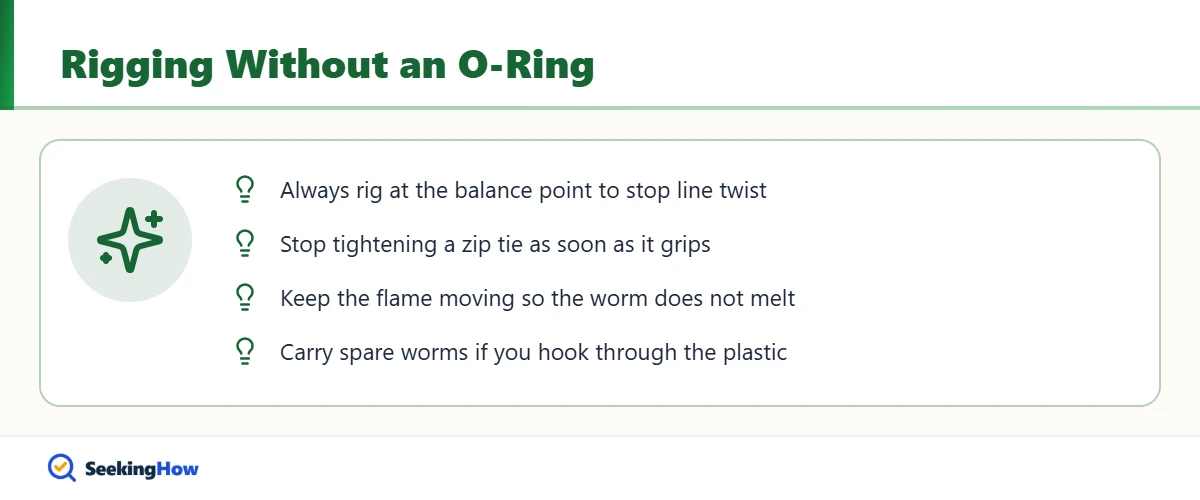
Lay the worm across a finger until it balances, usually at the middle or slightly toward the thicker end. That spot is where the hook or band goes. Rigging off-center makes the bait spin and twist your line.
Step 3: Method A: Hook Straight Through
Push the hook point through the worm at the balance point, side to side, leaving the point fully exposed. This is the fastest method and gives a solid hookup rate. The tradeoff is that the plastic tears after a few bites or casts, especially with soft salt-impregnated baits.
Step 4: Method B: Make a Heat-Shrink Band
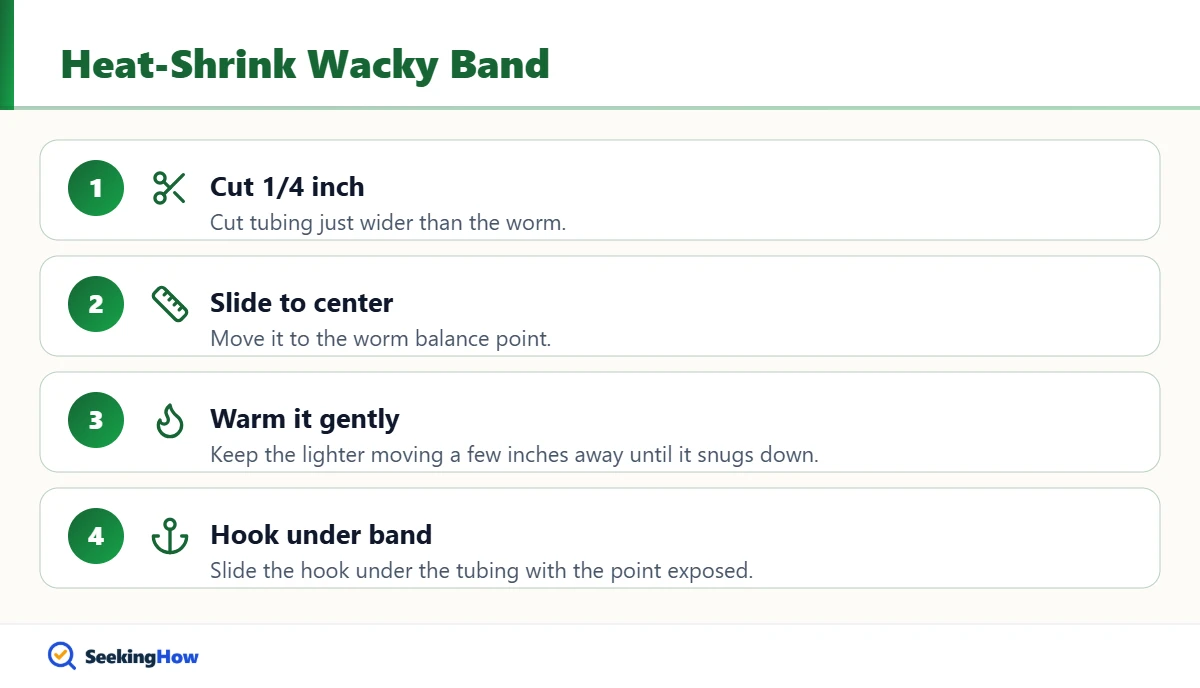
Cut a piece of heat-shrink tubing about 1/4 inch long, slide it over the worm to the balance point, and warm it briefly with a lighter held a few inches away until it snugs down. Keep the flame moving so the plastic worm does not melt. Slide the hook under the band, point up.
Step 5: Method C: Use a Zip Tie
Wrap a small zip tie around the worm’s balance point, pull it just snug enough to grip without pinching the worm, and clip the tail flush. Slide the hook under the tie. In practice, an overtightened zip tie cuts the plastic, so stop as soon as it stops sliding.
Step 6: Fish and Check the Rig
Cast, let the bait fall on slack line, and watch for the line to jump. After each fish, check that the band has not slid. For retrieves and hooksets, see our guide to fishing a wacky rig, and for snag-free setups read how to rig a wacky rig weedless.
Bottom line: Use heat-shrink tubing if you have it, a zip tie if you do not, and hook straight through only when you have plenty of spare worms.
If That Didn’t Work
Problem: The worm flies off on the cast. Cause: A torn worm or loose band. Fix: Use a fresh worm and tighten or replace the band.
Problem: The heat-shrink melted the worm. Cause: The flame was too close. Fix: Hold the lighter farther away and keep it moving for a second or two.
Problem: The bait spins. Cause: The hook is off the balance point. Fix: Re-rig at the center.
Problem: Missed bites. Cause: The hook point is buried in plastic or covered by the band. Fix: Make sure the point is fully exposed.
| Method | Bait durability | Setup time | Best for |
|---|---|---|---|
| Heat-shrink tubing | High | 1 to 2 minutes | All-day fishing (recommended) |
| Zip tie | Good | 1 minute | Quick fix on the water |
| Hook through the worm | Low | 10 seconds | Fast bites, plenty of spares |
| Electrical tape | Fair | 1 minute | Emergency only |
Safety Tips
Use a lighter away from fuel, dry grass, and your boat’s gas tank, and let tubing cool before handling. Keep exposed hook points away from fingers when cinching bands. If a hook embeds past the barb in your skin, especially near the eye, get medical care rather than forcing it out.
Prevention Tips
- Keep a short length of heat-shrink tubing and a few zip ties in your tackle box.
- Store O-rings in a small bag so they do not dry out and crack.
- Buy extra worms when using the through-the-worm method.
Related Guides
- How to fish a wacky rig
- How to rig a wacky rig weedless
- How to make fishing weights
- How to hang fishing line from the ceiling
Sources
- Take Me Fishing (Recreational Boating and Fishing Foundation): knots and rigs
- U.S. Fish and Wildlife Service: fishing resources and regulations
Frequently Asked Questions
Can you wacky rig a worm without an O-ring?
Yes. The original wacky rig simply runs the hook through the middle of the worm. It works well but tears baits quickly. A band of heat-shrink tubing or a small zip tie gives you the durability of an O-ring with items you can find in most garages.
What can I use instead of an O-ring for a wacky rig?
Heat-shrink tubing is the best substitute, followed by small zip ties. Some anglers use a tight wrap of electrical tape or a small rubber band in a pinch. Whatever you use, it should grip the worm without cutting into the plastic.
Where do you hook a wacky worm?
Hook it at the balance point, which is usually the middle or slightly toward the thicker end. A centered hook gives the slow, shimmying fall that makes the wacky rig work. Off-center rigging makes the bait spin and twists your line.
Does heat-shrink tubing work as well as an O-ring?
For most anglers, yes. It grips firmly, does not stretch out like rubber O-rings, and costs very little. The main drawbacks are that it takes a lighter to set and cannot be moved once shrunk, so place it carefully at the balance point.
Will a zip tie hurt the worm?
Only if you overtighten it. Pull the tie just until it stops sliding on the worm, then clip the tail flush. A tie pulled too tight cuts into soft plastic and can tear the bait on the cast or hookset.
Is a hooked-through wacky worm better for hookups?
It can be slightly better because nothing blocks the point and the worm slides off the hook easily on the set. The tradeoff is durability: most hooked-through worms tear after one or two fish, while a banded worm lasts much longer.