Quick Answer
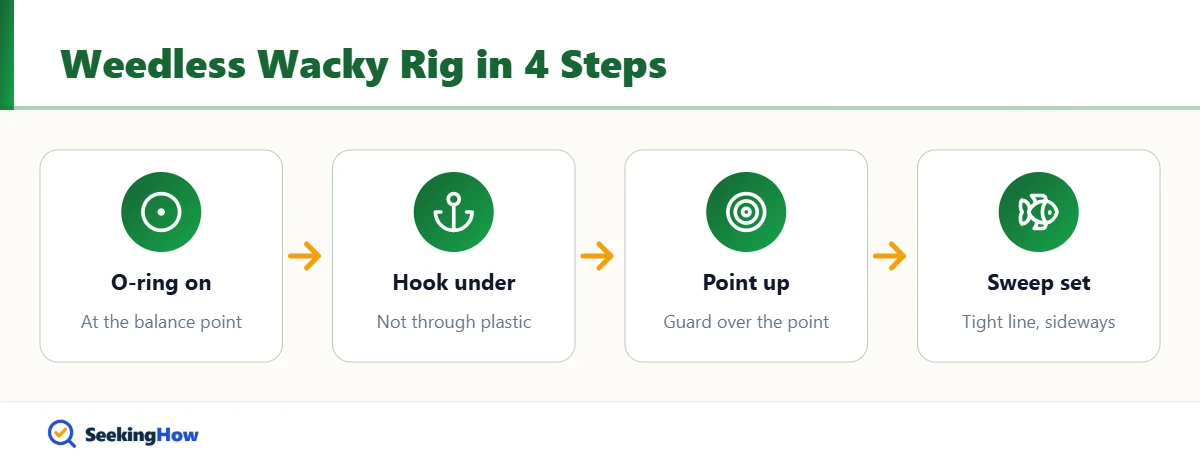
To rig a wacky rig weedless, slide an O-ring onto the middle of a 5-inch stick worm, then thread a weedless wacky hook (size 1 or 1/0 with a wire or fiber weed guard) under the O-ring so the point faces up toward the guard. Rigging takes about one minute. Avoid hooking through the worm itself; it tears and snags.
Key Takeaways
- A weedless wacky hook has a wire or fiber guard that covers the point until a fish bites.
- An O-ring holds the hook so the soft plastic lasts many more fish.
- Place the O-ring at the worm’s balance point, slightly toward the thicker end for a faster fall.
- Hook point up, guard resting just in front of the point, gives the best weedless setup.
- Use a steady sweep hookset, not a hard jerk, to fold the guard and drive the hook.
The wacky rig catches bass everywhere, but an exposed hook grabs every weed, branch, and dock line it touches. Learning how to rig a wacky rig weedless lets you skip and drop the bait into the cover where bass hide. It takes the same one minute as a standard wacky setup, just with the right hook.
What You’ll Need
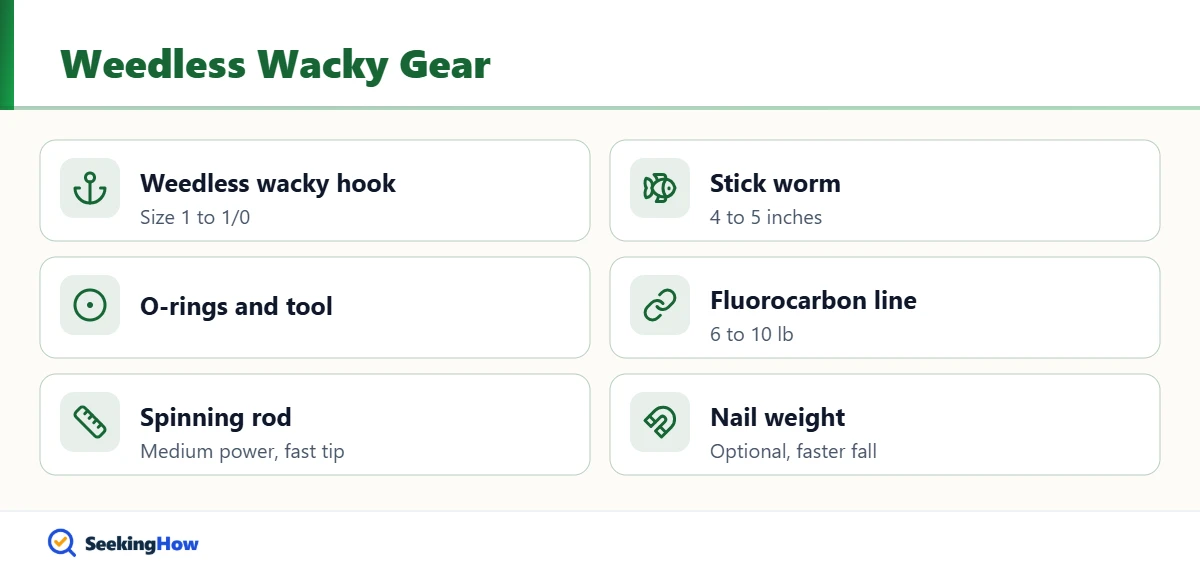
- Weedless wacky hooks, size 1 to 1/0, with a wire or fiber weed guard
- Soft plastic stick worms, 4 to 5 inches (Senko-style)
- Wacky O-rings sized for your worm, and an O-ring tool
- 6 to 10 lb fluorocarbon line, or 10 to 15 lb braid with a fluorocarbon leader
- Spinning rod, 6.5 to 7 feet, medium power with a fast tip
- Nail weight, 1/32 to 1/16 oz, for a faster fall (optional)
How To Rig a Wacky Rig Weedless: Step-by-Step
Step 1: Load an O-Ring Onto the Tool
Roll an O-ring onto the end of the O-ring tool. The tool stretches the ring so you can slip it over the worm without tearing the plastic. Pick a ring that fits snugly; a loose ring slides and changes the action.
Step 2: Center the O-Ring on the Worm
Push the worm into the tool and roll the O-ring off at the balance point, usually the middle or slightly toward the thicker end. A centered ring gives the classic slow, shimmying fall. Shifting it a quarter inch toward the head makes the bait fall a little faster.
Step 3: Slide the Hook Under the O-Ring
Lift the weed guard out of the way, then slide the hook point under the O-ring, parallel to the worm. The hook should be fully under the ring, not pierced through the plastic. This keeps the worm from tearing on the cast and hookset.
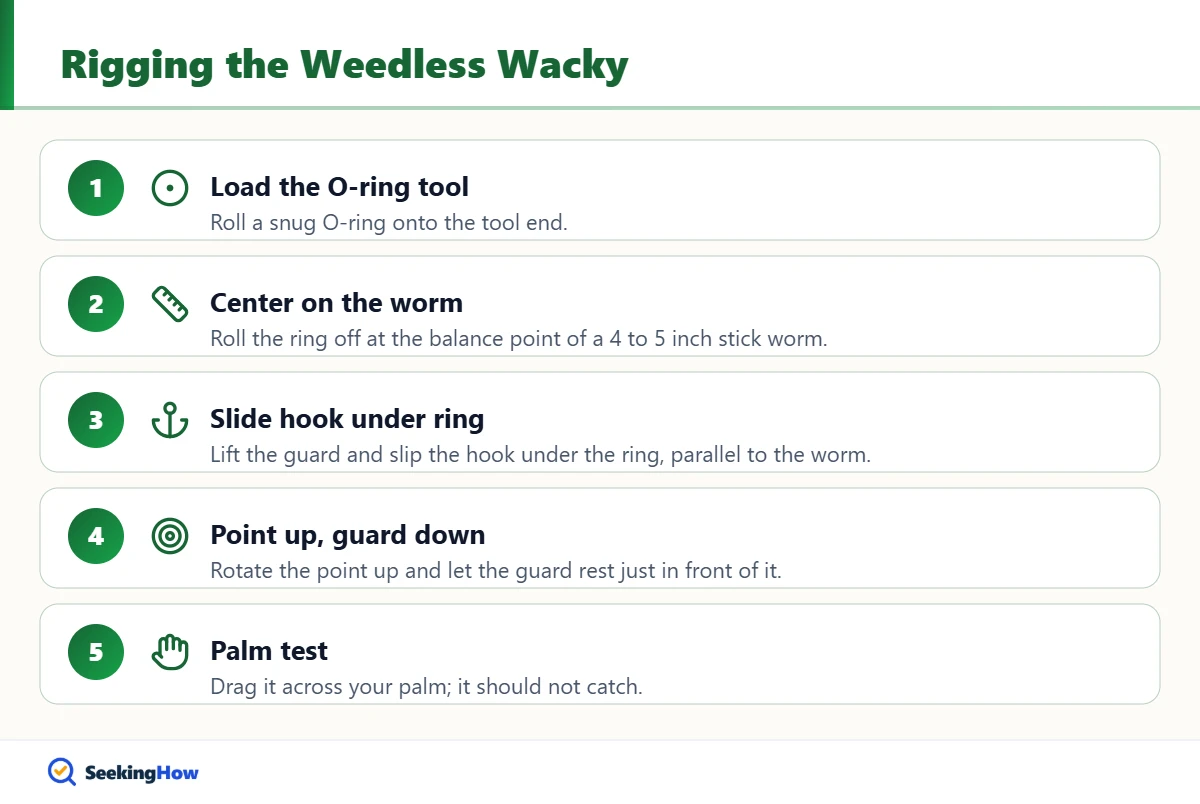
Step 4: Set the Point Up and Seat the Weed Guard
Rotate the hook so the point rides up and away from the worm, then let the wire guard spring back so it rests just in front of the point. The guard deflects grass and wood, and a fish’s bite pushes it down. The most common mistake is bending the guard so stiff that it blocks hooksets; it should flex easily with a fingertip.
Step 5: Tie It On and Test
Tie the hook to your line with a Palomar or improved clinch knot. Drag the rig across your palm: it should slide without the point catching skin. If it grabs, bend the guard slightly so it sits closer to the point. For working the bait, see our guide to fishing a wacky rig.
Step 6: Set the Hook With a Sweep
When the line jumps or moves sideways, reel down to tight line and sweep the rod firmly to the side. A sweeping set compresses the guard and pins the hook, while a slack-line jerk often pulls the bait free. In practice, a fast-tip spinning rod makes this much easier.
Bottom line: Use a weedless wacky hook under an O-ring, point up, with a flexible guard, for any cover that would snag an open hook.
If That Didn’t Work
Problem: Missing bites. Cause: The weed guard is too stiff or too far over the point. Fix: Bend the guard up slightly or trim fiber guards shorter.
Problem: Still snagging grass. Cause: The point is facing down or sideways. Fix: Rotate the hook so the point rides up under the guard.
Problem: Worms fly off on the cast. Cause: The O-ring is too loose or the hook pierced the plastic. Fix: Use a smaller ring and slide the hook only under the ring.
Problem: The bait spins and twists line. Cause: The ring is off center. Fix: Re-center the ring at the balance point.
| Setup | Snag resistance | Hookup rate | Best for |
|---|---|---|---|
| Weedless wacky hook with O-ring | High | Good | Docks, laydowns, sparse grass |
| Open wacky hook with O-ring | Low | Highest | Open water, clear banks |
| Neko rig with weedless hook | Medium to high | Good | Bottom-dragging in rocks and grass |
Safety Tips
Keep hook points covered in your tackle box and handle hooked fish with pliers or a lip grip. If a hook buries past the barb in your skin, do not yank it out; seek medical care, especially for hooks near the eye or a deep puncture, and keep your tetanus shot current. Wear sunglasses when skipping baits under docks to protect your eyes from rebounding hooks.
Prevention Tips
- Carry spare O-rings; they stretch out after several fish.
- Check the weed guard after each snag and bend it back to shape.
- Keep stick worms in their original bag; some plastics melt when mixed.
Related Guides
- How to fish a wacky rig
- How to make fishing weights
- How to install a fish finder on a kayak
- How to practice fly fishing
Sources
- Take Me Fishing (Recreational Boating and Fishing Foundation): knots and rigs
- U.S. Fish and Wildlife Service: fishing resources and regulations
Frequently Asked Questions
What size hook is best for a weedless wacky rig?
A size 1 or 1/0 weedless wacky hook suits most 4 to 5 inch stick worms. Go up to 2/0 for thicker 6-inch baits and heavier line. The hook gap must clear the worm and O-ring so the point can penetrate when the guard folds.
Do weedless wacky hooks miss more fish?
Slightly, compared with an open hook, but the difference is small when the guard is tuned. Bend the wire so it flexes easily under a fingertip and use a sweeping hookset on a tight line. The extra fish you reach in cover usually outweighs a few misses.
Can you rig a wacky rig weedless without a special hook?
Partly. You can skin-hook the point just under the worm surface, Texas-style, at the middle of the bait. It deflects some weeds but tears worms faster and hooks less reliably. A dedicated weedless wacky hook with an O-ring works better.
Where should the O-ring go on a wacky worm?
Put it at the balance point, usually the middle of the worm. Moving it slightly toward the thicker end makes the bait fall faster and more nose-down. Keep the ring snug so the hook does not slide along the plastic during casts.
What line is best for a weedless wacky rig?
Fluorocarbon in 6 to 10 lb test is the common choice for clear water. Around heavy cover, use 10 to 15 lb braid with a fluorocarbon leader so you can pull fish out of brush and docks without breaking off.
Should the hook point face up or down on a wacky rig?
Point up for weedless rigging. With the point riding up and the guard in front of it, the bait slides over branches and grass. With an open hook in clear water, point direction matters less.