Quick Answer
To sell scrap gold jewelry for the most money, sort pieces by karat stamp, weigh each group in grams, calculate melt value from the day’s gold spot price, and get at least three written offers from local gold buyers, coin dealers or reputable refiners. Pull out designer, antique or gemstone pieces to sell separately. The process takes a day or two, and you should never accept an offer without knowing your melt value.
Key Takeaways
- Scrap gold is priced by pure gold content: weight times karat purity times the spot price.
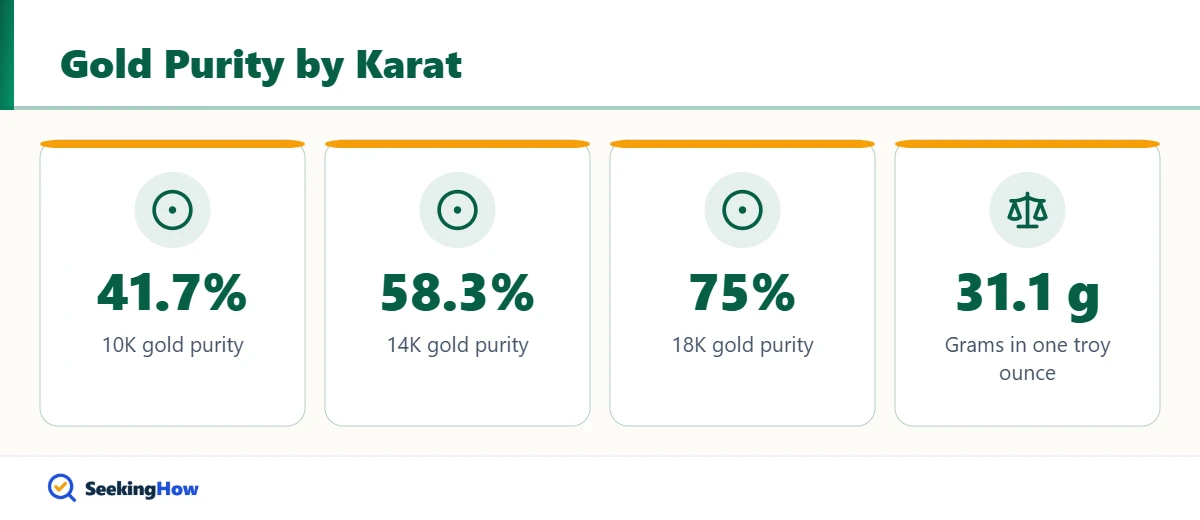
- 14K gold is 14 parts gold out of 24, about 58.3 percent pure; 10K is about 41.7 percent and 18K is 75 percent.
- A troy ounce is 31.1035 grams, so divide the spot price by 31.1035 to get the price per gram of pure gold.
- Sorting by karat before selling stops buyers from paying the lowest karat rate for the whole lot.
- Gold-plated and gold-filled pieces contain little gold and are worth far less than solid gold.
Most people leave money on the table by selling a mixed bag of gold to the first buyer who names a price. This guide explains how to sell scrap gold jewelry for the most money: test and sort it, calculate what it’s actually worth, and make buyers compete. Gold prices change daily, so recalculate on the day you sell.
What You’ll Need
- A digital kitchen or jewelry scale that reads to 0.1 gram or better
- A jeweler’s loupe or magnifying glass, 10x, for reading karat stamps
- Small zip bags and a marker for sorting by karat
- The current gold spot price from a financial news site or dealer
- A calculator or phone
- A strong magnet, to screen out plated base metal (optional)
How To Sell Scrap Gold Jewelry for the Most Money: Step-by-Step
Step 1: Separate Pieces Worth More Than Melt
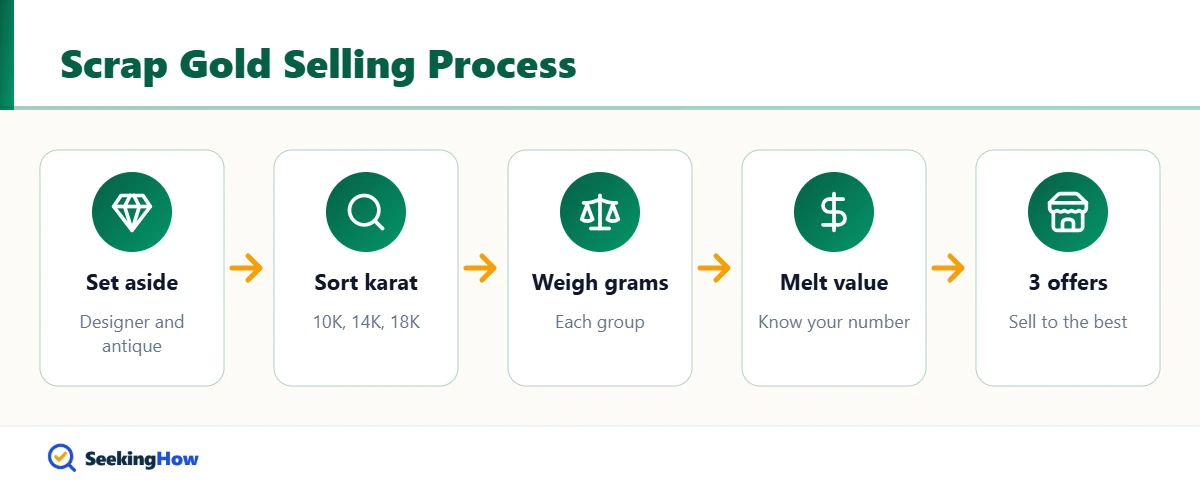
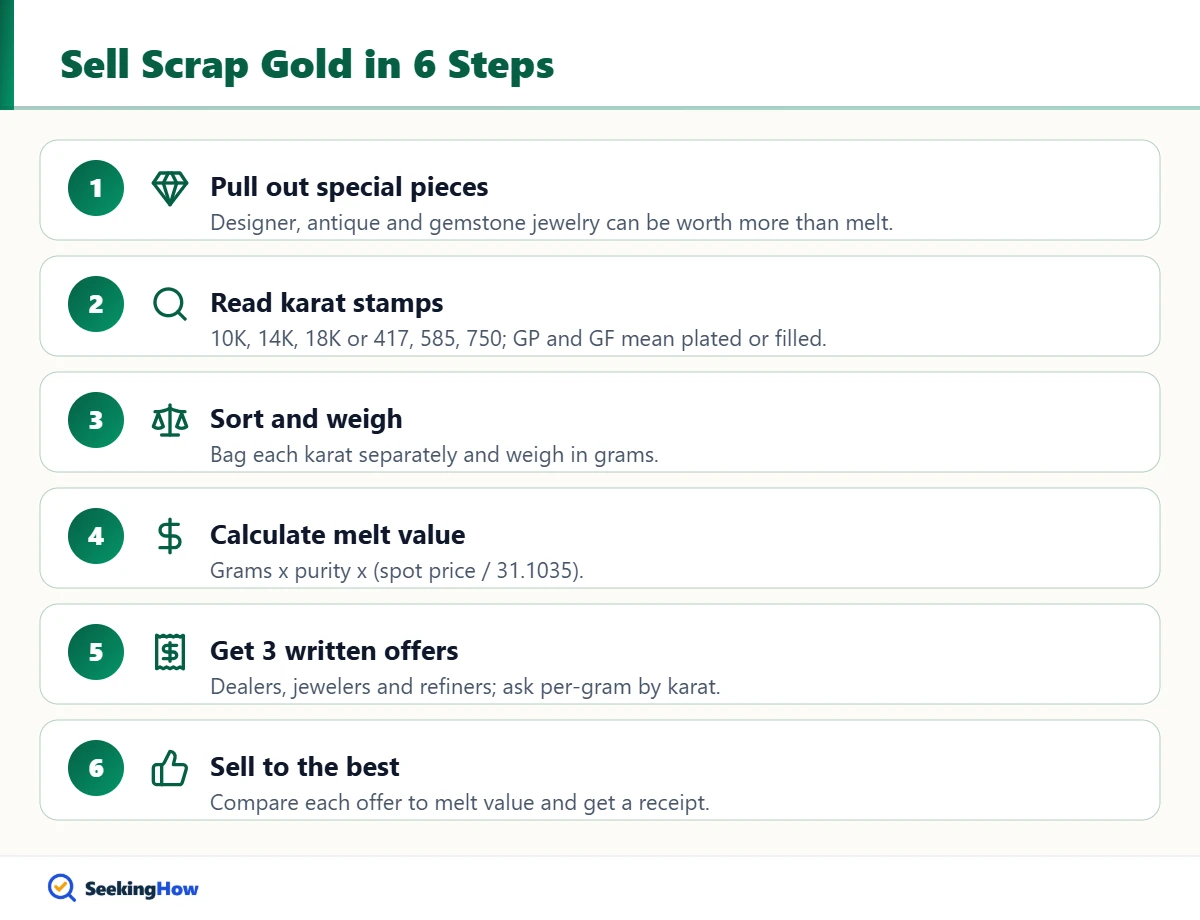
Set aside signed designer jewelry, antique or estate pieces, and items with sizable diamonds or gemstones. These can sell for well above scrap value through a jeweler, consignment or estate buyer. Melting a signed vintage piece is the most expensive mistake sellers make.
Step 2: Read the Karat Stamps
Use a loupe to find marks like 10K, 14K, 18K, 22K or European numbers like 417, 585 and 750. Marks such as GP, GF, HGE, RGP or “gold filled” mean plated or filled base metal with little gold. A piece strongly attracted to a magnet is not solid gold, though some clasps contain steel springs.
Step 3: Sort and Weigh by Karat
Bag each karat separately and weigh each bag in grams. Remove non-gold parts you can, such as steel watch bands. Buyers who weigh a mixed lot often pay the lowest karat rate for everything.
Step 4: Calculate Melt Value
Use this formula for each karat group: grams times purity times (spot price divided by 31.1035). Purity is 0.417 for 10K, 0.583 for 14K, 0.750 for 18K and 0.916 for 22K. For example, 20 grams of 14K at a spot price of $2,500 per troy ounce contains about 11.66 grams of pure gold worth about $937 at spot.
Step 5: Get at Least Three Written Offers
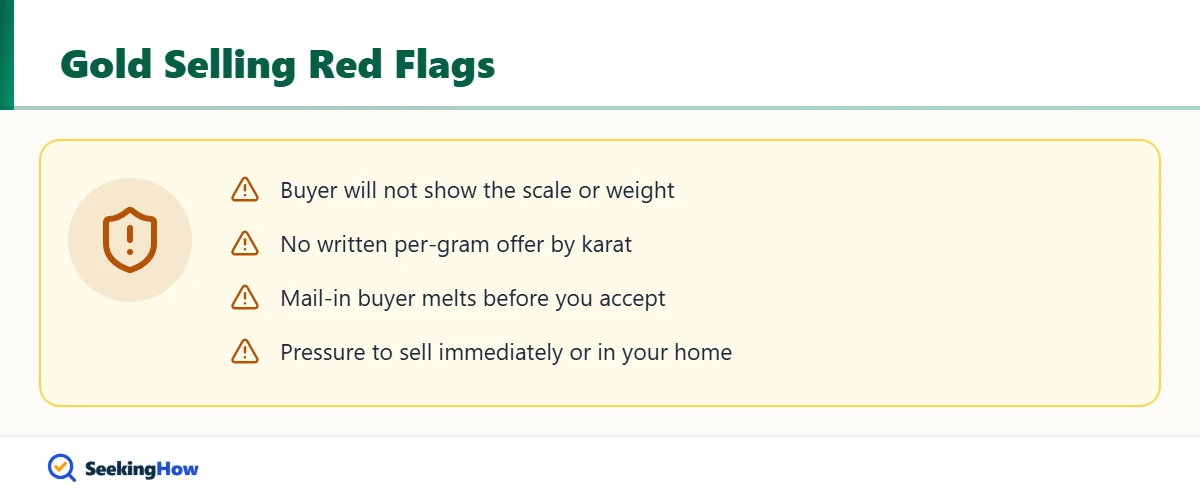
Visit a local coin or bullion dealer, an independent jeweler and a refiner or established gold buyer, and ask each for the offer per gram by karat. Most people find quotes differ significantly between buyers on the same day. Ask how they test gold and watch them weigh it on a certified scale.
Step 6: Compare Offers to Melt and Sell
Divide each offer by your melt value to see the percentage you’re being paid. Choose the highest offer from a buyer with a physical location, clear licensing and good reviews, and get a written receipt listing weight, karat and price.
Bottom line: Know your melt value before you walk in, sort by karat, and sell to the highest of at least three written offers.
Where To Sell Scrap Gold
| Buyer | Typical payout | Speed | Best for |
|---|---|---|---|
| Coin or bullion dealer | Often among the higher offers | Same day | Plain scrap gold |
| Refiner (direct or mail-in) | Can be high, especially for larger lots | Days to weeks | Larger quantities |
| Independent jeweler | Varies widely | Same day | Pieces with resale value |
| Pawn shop | Often lower | Same day | Quick cash, small amounts |
| Mall kiosks, gold parties, cash-for-gold ads | Often lowest | Same day | Avoid when possible |
If That Didn’t Work
Problem: Offers are far below your melt calculation. Cause: The buyer is pricing at a low karat or a large margin. Fix: Ask for the per-gram price by karat in writing and walk away to the next buyer.
Problem: The buyer says your piece isn’t gold. Cause: It may be plated, filled or a lower karat than marked. Fix: Get a second test from another dealer; an XRF test is non-destructive.
Problem: No karat stamp is visible. Cause: Worn stamp, resized band or foreign piece. Fix: Have a dealer acid or XRF test it before pricing.
Problem: A mail-in buyer’s offer is low after receiving your gold. Cause: You have little leverage once the gold leaves your hands. Fix: Use only buyers that hold your items until you accept, return them insured if you decline, and state their payout terms in advance; photograph and weigh everything before shipping.
Safety and When To Call a Pro
Sell in person at a business with a fixed address, during business hours, and never invite strangers to your home to buy gold. Bring photo ID, since many states require gold buyers to record seller identification. Have a certified appraiser evaluate pieces with large diamonds, signed designer marks or antique hallmarks before selling them as scrap. Be wary of buyers who refuse to show the scale or won’t put an offer in writing.
Tips To Get More Money
- Sell when you can be flexible; prices move daily with the spot market.
- Clean pieces gently so stamps are readable; see how to clean rings safely at home for stones that need care.
- Keep gemstones you can reuse; scrap buyers often pay little or nothing for small stones.
- Bundle larger lots, which some refiners pay higher percentages for.
- Understand weight units; see how much a pound of gold is worth for troy-weight math.
Related Guides
- How much is a pound of gold worth?
- How to clean tanzanite rings safely
- What items does Goodwill accept?
Sources
- Federal Trade Commission: Buying platinum, gold and silver jewelry (karat and plating terms)
- Federal Trade Commission: Jewelry Guides
- National Institute of Standards and Technology: troy weight units, Handbook 44 and SI conversions (nist.gov)
Frequently Asked Questions
How much is 14K scrap gold worth per gram?
Multiply the gold spot price per troy ounce by 0.583 and divide by 31.1035. At a spot price of $2,500 per ounce, 14K gold contains about $46.86 of gold per gram at melt. Buyers pay a percentage of that, so compare offers to your calculation.
Is it better to sell gold to a pawn shop or a jeweler?
Neither is automatically best; get written offers from both plus a coin dealer or refiner. Pawn shops often pay less because they price in risk and margin. Jewelers may pay more for pieces they can resell intact. The highest per-gram offer wins.
Do gold buyers pay for diamonds in scrap jewelry?
Scrap gold buyers often pay little or nothing for small diamonds and gemstones. Remove stones you want to keep, or have pieces with larger stones appraised and sold to a jeweler or estate buyer, where the stone value can be recovered.
How can I tell if my jewelry is real gold?
Look for a karat stamp such as 10K, 14K, 18K, 417, 585 or 750. Marks like GP, GF, HGE or RGP indicate plated or filled metal. A strong pull from a magnet suggests base metal. For certainty, ask a dealer for an acid or XRF test.
Are mail-in gold buyers safe?
Some are reputable, but you lose leverage once your gold is shipped. Choose companies that state payout percentages up front, hold your items until you accept the offer, and return items insured if you decline. Photograph and weigh everything before shipping.
What percentage of melt value should I get for scrap gold?
There is no fixed rate; payouts vary by buyer, lot size and market. Compare every offer as a percentage of your calculated melt value. Larger lots and dealers or refiners often pay higher percentages than mall kiosks or cash-for-gold mailers.
Do I need ID to sell gold?
Usually yes. Many states and cities require gold and secondhand dealers to record government-issued photo ID from sellers to deter sales of stolen goods. A buyer who does not ask for ID may not be operating legally.