Quick Answer
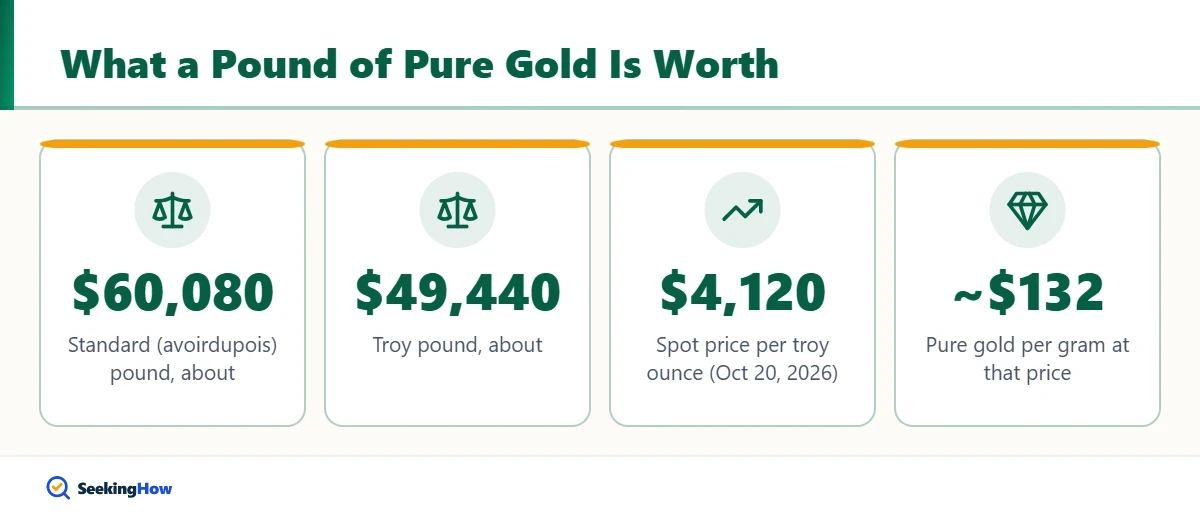
A pound of pure gold is worth about $60,080 if you mean a standard (avoirdupois) pound, or about $49,440 if you mean a troy pound, based on a spot price of roughly $4,120 per troy ounce as of October 20, 2026. Multiply the spot price by 14.583 for an avoirdupois pound or by 12 for a troy pound.
Key Takeaways
- Gold is priced per troy ounce (31.1035 grams), not the ounce on your kitchen scale.
- A standard pound (453.59 g) holds 14.583 troy ounces; a troy pound (373.24 g) holds exactly 12.
- At about $4,120 per troy ounce (October 20, 2026), pure gold is roughly $132 per gram.
- Jewelry is worth less per pound because 14k gold is only 58.3% gold and buyers pay below spot.
- Spot prices move every trading minute, so always recalculate with a live quote before buying or selling.
The value of a pound of gold depends on three things: which pound you mean, how pure the gold is, and the live spot price. This guide shows the math step by step, gives worked examples at a recent price, and explains why the number a dealer offers you will differ from the spot calculation.
How Much Is a Pound of Gold Worth Right Now?
As of 9 a.m. Eastern Time on October 20, 2026, gold traded at about $4,120 per troy ounce, according to Fortune’s daily gold price report. That was down from roughly $4,316 a year earlier and from about $4,360 a month earlier, a reminder of how much the price can swing.
At that price, the melt value of one pound of pure (24-karat, .999 fine) gold works out as follows:
- Avoirdupois pound (the everyday pound): 14.583 troy oz x $4,120 = about $60,080
- Troy pound (the precious-metals pound): 12 troy oz x $4,120 = about $49,440
Price note: These figures are a snapshot. Gold trades nearly around the clock on global markets, so check a live spot quote from a major dealer or financial news site and plug it into the formulas below before making any decision.
Troy Pound vs. Avoirdupois Pound: Which One Do You Mean?
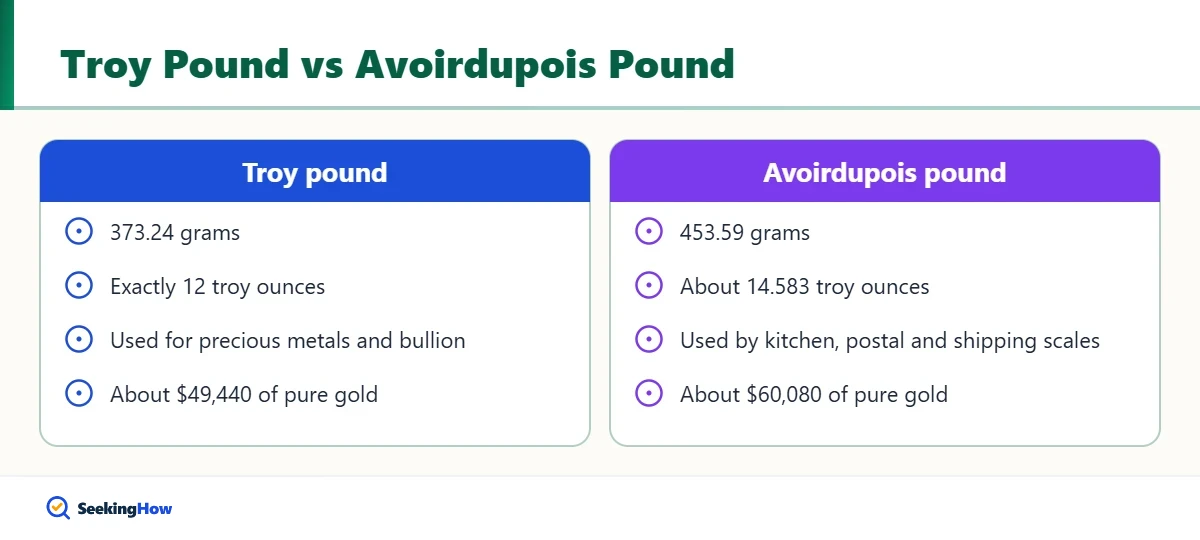
Most confusion about gold weights comes from two different measuring systems. The avoirdupois system is what bathroom scales, grocery stores and shipping companies use. The troy system is used for precious metals and dates back centuries in the bullion trade.
The troy ounce is heavier than a regular ounce, but the troy pound is lighter than a regular pound because it contains only 12 ounces instead of 16. That is why the same phrase, “a pound of gold,” can mean two values that differ by more than $10,000.
| Unit | Grams | Troy ounces | Pure gold value at $4,120/troy oz |
|---|---|---|---|
| Troy ounce | 31.1035 | 1 | $4,120 |
| Avoirdupois ounce | 28.3495 | 0.9115 | about $3,755 |
| Troy pound | 373.24 | 12 | about $49,440 |
| Avoirdupois pound | 453.59 | 14.583 | about $60,080 |
| Kilogram | 1,000 | 32.151 | about $132,460 |
| Gram | 1 | 0.03215 | about $132.46 |
If you weighed your gold on a normal kitchen or postal scale, you have an avoirdupois weight. If the item is stamped or documented in troy units, such as bullion bars, use the troy figure.
How Do You Calculate the Value of a Pound of Gold?
You only need a reliable scale, a calculator and a live spot price. The method below works for bullion, coins and scrap jewelry.
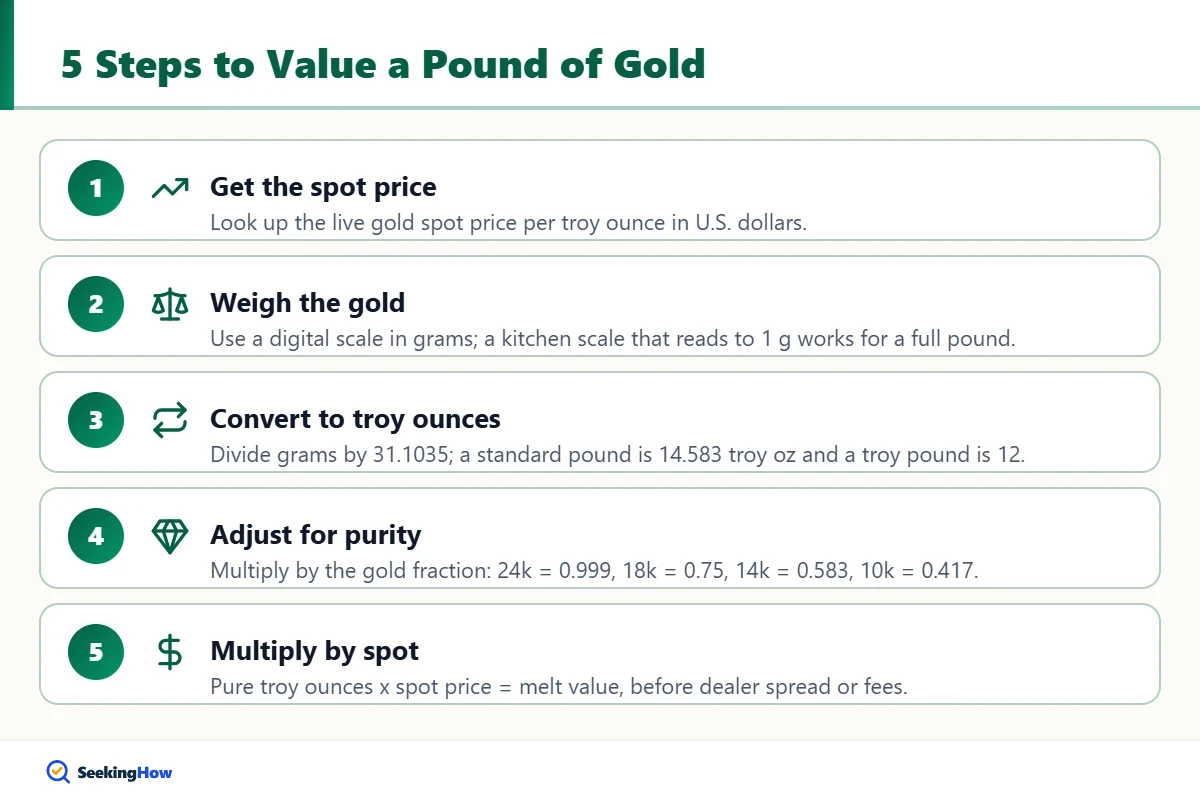
Step 1: Get the current spot price
Look up the live gold spot price per troy ounce in U.S. dollars. Spot is the price for immediate delivery of large, wholesale quantities, and it is the baseline every dealer uses.
Step 2: Weigh the gold accurately
Use a digital scale that reads in grams for the most precise result. A jewelry scale with 0.01 g resolution is ideal for small items; for a full pound, a kitchen scale that reads to 1 g is acceptable.
Step 3: Convert the weight to troy ounces
Divide the weight in grams by 31.1035. A shortcut: an avoirdupois pound is 14.583 troy ounces and a troy pound is 12 troy ounces, so you can skip the grams if you already know which pound you have.
Step 4: Adjust for purity (karat or fineness)
Multiply the troy ounces by the gold fraction: 24k = 0.999, 22k = 0.9167, 18k = 0.75, 14k = 0.583 and 10k = 0.417. Bullion bars and many coins list fineness directly, such as .9999.
Step 5: Multiply by the spot price
Multiply the pure troy ounces by the spot price. The result is the melt value, which is the theoretical value of the gold content before any dealer spread, refining fee or collector premium.
Formula: Melt value = (weight in grams / 31.1035) x purity x spot price per troy ounce.
What Is a Pound of 14k, 18k or 10k Gold Worth?
Gold jewelry is an alloy of gold with metals such as silver, copper, zinc or nickel. The karat number tells you how many parts out of 24 are gold, so a pound of 14k jewelry contains a little more than half a pound of actual gold.
| Purity | Gold content | Avoirdupois pound melt value | Troy pound melt value |
|---|---|---|---|
| 24k (.999) | 99.9% | about $60,020 | about $49,390 |
| 22k | 91.67% | about $55,080 | about $45,320 |
| 18k | 75% | about $45,060 | about $37,080 |
| 14k | 58.3% | about $35,030 | about $28,820 |
| 10k | 41.7% | about $25,050 | about $20,620 |
Values are calculated at $4,120 per troy ounce (October 20, 2026) and rounded. Note that jewelry often contains stones, clasps or solder that add weight without adding gold, so remove or account for those before you calculate.
Why Will a Dealer Pay Less Than the Calculated Value?
Spot price is a wholesale benchmark. When you sell, the buyer has to cover assaying, refining, shipping, insurance and their own profit margin, so offers come in below melt value. When you buy, you pay a premium above spot for fabrication, distribution and the dealer’s margin.
- Scrap jewelry usually gets the lowest percentage of melt value because it must be tested and refined.
- Recognized bullion bars and coins from major mints usually get offers closer to spot because they are easy to verify and resell.
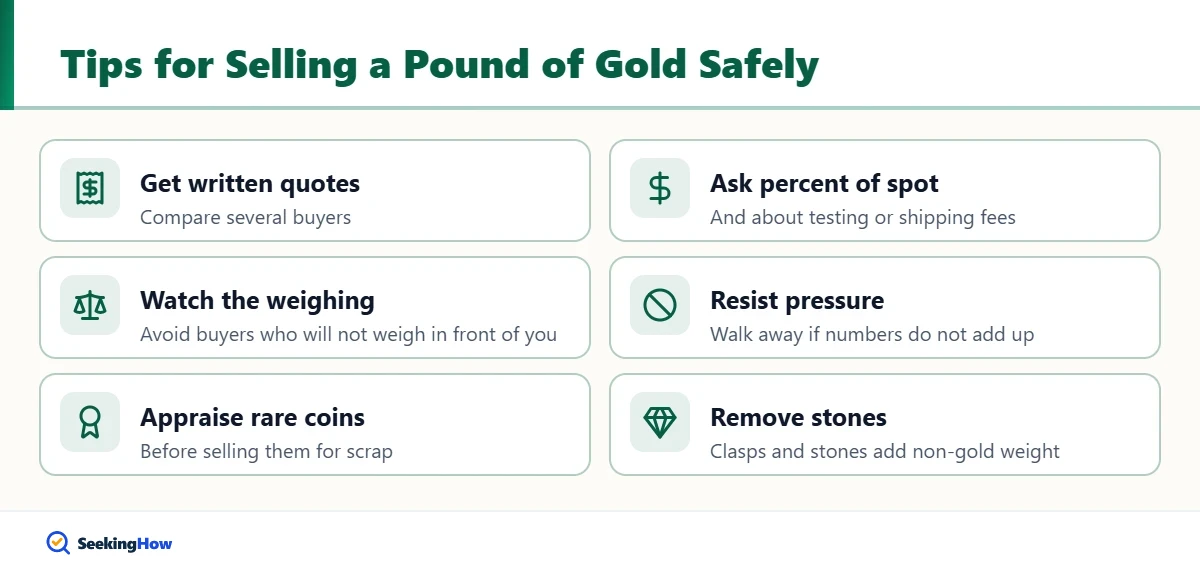
- Rare or collectible coins can be worth far more than melt value; have them appraised by a numismatic professional before selling them for scrap.
The practical takeaway: compare written quotes from several buyers, ask what percentage of spot they are paying, and ask whether there are testing or shipping fees. If you are sorting through old pieces first, our guide on cleaning nickel silver explains why some silver-colored items contain no precious metal at all.
What Moves the Price of Gold?
Gold has no fixed price. It responds to a mix of financial and physical forces, and understanding them helps you interpret why your pound of gold might be worth thousands of dollars more or less from one month to the next.
- Interest rates: Gold pays no interest, so higher real interest rates tend to make it less attractive, while expected rate cuts tend to support it.
- The U.S. dollar: Gold is priced in dollars, so a weaker dollar often lifts the dollar price of gold.
- Inflation and uncertainty: Investors often buy gold as a hedge during inflation, financial stress or geopolitical conflict.
- Central bank buying: Purchases by national central banks add to demand.
- Jewelry and industrial demand: Consumer demand, especially in large gold-buying markets such as India and China, also plays a role.
How Can You Tell If Your Gold Is Real?
Before you calculate value, confirm what you have. Look for hallmarks such as 10K, 14K, 18K, 585 or 750. Marks like GP, GF, GE or HGE mean gold plated or gold filled, which contain only a thin layer of gold.
A magnet test is a quick first screen, because gold is not magnetic; if a piece sticks strongly, it is not solid gold. For certainty, ask a reputable jeweler or assayer for an acid test, electronic tester or X-ray fluorescence (XRF) analysis. Avoid home tests that scratch or damage the piece.
Watch out: Be cautious with buyers who will not weigh your gold in front of you, refuse to state their payout as a percentage of spot, or pressure you to sell on the spot. Get a written quote and walk away if the numbers do not add up.
Common Mistakes When Valuing Gold by the Pound
- Mixing up ounces: Using 16 regular ounces per pound with a troy-ounce price overstates value; use 14.583 troy ounces instead.
- Ignoring purity: Treating 14k jewelry as pure gold overstates its value by about 70%.
- Using a stale price: Gold can move tens of dollars per ounce in a single day, which changes a pound’s value by hundreds of dollars.
- Counting stones and findings: Gemstones, steel springs in clasps and solder add weight but not gold.
- Selling collectibles as scrap: Rare coins can carry a premium well above their gold content.
If you are clearing out a home and deciding what to sell, donate or keep, our guide to what items Goodwill accepts can help with non-precious items, and our tips for cleaning tanzanite rings cover gem-set jewelry you plan to keep.
Not financial advice: This article explains how gold is measured and valued. It is not investment advice. For decisions about buying or selling gold as an investment, consider speaking with a licensed financial professional.
Frequently Asked Questions
How many ounces are in a pound of gold?
It depends on the pound. A troy pound contains 12 troy ounces, while a standard avoirdupois pound contains about 14.583 troy ounces or 16 regular ounces. Gold prices are quoted per troy ounce, so convert to troy ounces before you multiply by the spot price.
Is a troy ounce heavier than a regular ounce?
Yes. A troy ounce weighs 31.1035 grams, while a regular avoirdupois ounce weighs 28.3495 grams, so a troy ounce is about 10% heavier. A troy pound, however, is lighter than a regular pound because it contains only 12 ounces.
How much is a gram of gold worth?
Divide the spot price per troy ounce by 31.1035. At about $4,120 per troy ounce on October 20, 2026, a gram of pure gold was worth roughly $132. A gram of 14k gold contains 58.3% gold, so its melt value was about $77.
How much does a gold bar weigh?
Gold bars come in many sizes, from 1 gram to 1 kilogram for retail buyers. The large bars held by central banks, known as London Good Delivery bars, weigh roughly 400 troy ounces, which is about 27 pounds avoirdupois.
Why do gold buyers pay less than spot price?
Buyers must cover testing, refining, shipping, insurance and their profit margin, so their offers are below melt value. Recognized bullion coins and bars typically fetch offers closer to spot than scrap jewelry, which must be assayed and refined first.