Quick Answer
To use chopsticks, rest the bottom stick in the crook between your thumb and index finger and against your ring finger, where it stays still. Hold the top stick like a pencil with your thumb, index and middle fingers. Line up the tips, then move only the top stick up and down to pinch food. Hold them about two-thirds of the way up for control.
Key Takeaways
- The bottom chopstick stays fixed; only the top one moves, like a pencil.
- Keep the tips even by tapping them on the table before you pick anything up.
- Gripping higher gives more reach; gripping lower gives more control for beginners.
- Practice with large, easy foods first, then move on to rice, noodles and slippery items.
- Basic etiquette: never stick chopsticks upright in rice or pass food chopstick to chopstick.
Using chopsticks is a skill that takes a few minutes to understand and a few meals to make natural. The common mistake is moving both sticks like scissors, which makes food slip and hands cramp. Once you learn that one stick is an anchor and the other is a lever, everything gets easier.
How Do You Hold Chopsticks Correctly?
The standard grip used across China, Japan, Korea and Vietnam follows the same basic idea: a stable bottom stick and a mobile top stick. Small regional differences exist, but the steps below work for any chopsticks.
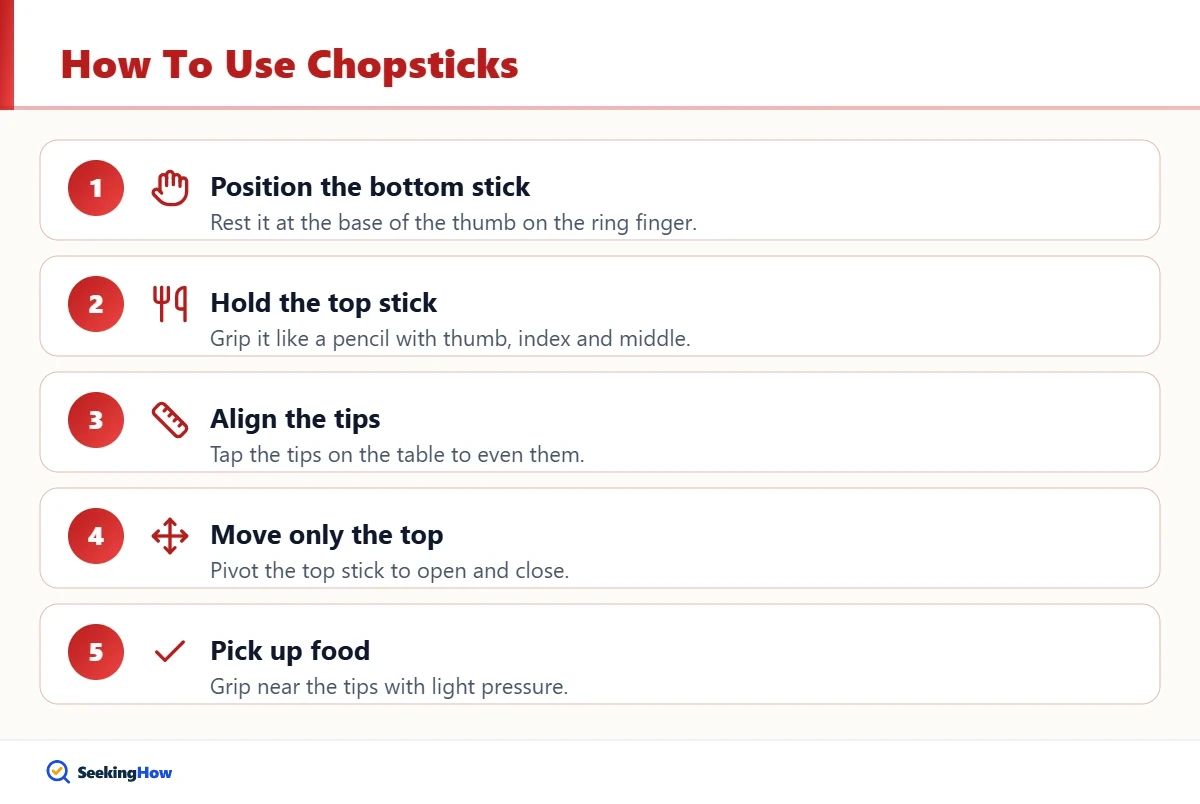
Step 1: Relax Your Hand
Let your dominant hand rest loosely, palm slightly up, with your fingers gently curved. Tension is the enemy of control, so shake out your hand if it feels stiff.
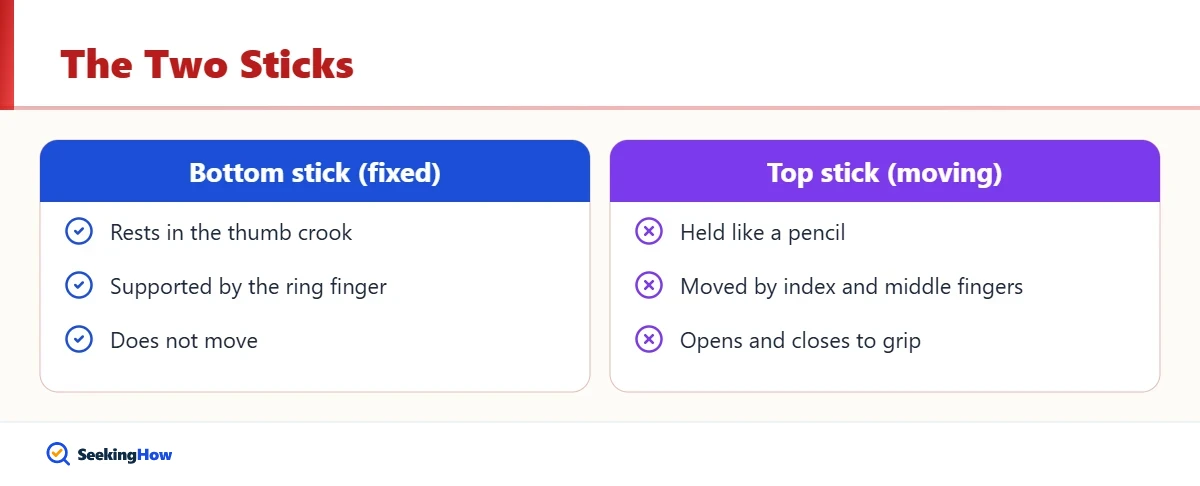
Step 2: Position the Bottom Chopstick
Place the first chopstick in the crook between your thumb and index finger, with the lower part resting on the side of your ring finger near the fingertip. Press it lightly in place with the base of your thumb. This stick should not move while you eat.
Step 3: Hold the Top Chopstick Like a Pencil
Pick up the second chopstick and hold it between the pad of your thumb and the tips of your index and middle fingers, the same way you would hold a pencil. Your middle finger sits between the two sticks.
Step 4: Line Up the Tips
Tap the tips gently on the table or plate so both chopsticks end at the same point. Uneven tips are the most common reason food escapes.
Step 5: Move Only the Top Stick
Using your index and middle fingers, lift the top chopstick up and bring it back down to meet the bottom one. Your thumb acts as a pivot. Practice opening and closing in the air until the bottom stick stays still.
Step 6: Pick Up Food
Open the tips slightly wider than the food, slide the bottom stick under it, and close the top stick gently on top. Squeeze just enough to hold it, then lift. Bring the bowl closer to your mouth for rice and noodles, which is normal in many Asian dining cultures.
Tip: If food keeps slipping, check two things: are the tips even, and is the bottom stick moving? Fixing those solves most problems.
Where Should You Hold Chopsticks?
The height of your grip changes the feel. Holding near the top end gives more reach and looks elegant, but it magnifies small hand movements. Holding closer to the middle gives you more precision while you learn. Most people settle about two-thirds of the way up from the tips.
| Grip position | Control | Reach | Best for |
|---|---|---|---|
| Near the top | Lower | Long | Shared dishes, experienced users |
| About two-thirds up | Balanced | Medium | Everyday eating |
| Near the middle | Higher | Short | Beginners, small or slippery foods |
Which Chopsticks Are Easiest for Beginners?
Different cuisines use different styles, and some are easier to learn on than others.
| Type | Typical material and shape | Ease for beginners |
|---|---|---|
| Japanese (hashi) | Wood or lacquered, shorter, pointed tips, often textured | Easy; textured tips grip well |
| Chinese (kuaizi) | Bamboo, wood or plastic, longer, blunt square-to-round ends | Moderate; good for shared dishes |
| Korean (jeotgarak) | Flat stainless steel, medium length | Harder; smooth and slippery |
| Disposable wooden | Raw wood, joined at the top | Easy; rough surface holds food |
| Training chopsticks | Joined with a hinge or finger loops | Easiest; good for kids |
Wooden or bamboo chopsticks with textured tips are the friendliest place to start. When you separate disposable chopsticks, pull them apart gently and avoid rubbing them together at the table, which in some places implies the restaurant’s chopsticks are cheap.
How Do You Practice Using Chopsticks?
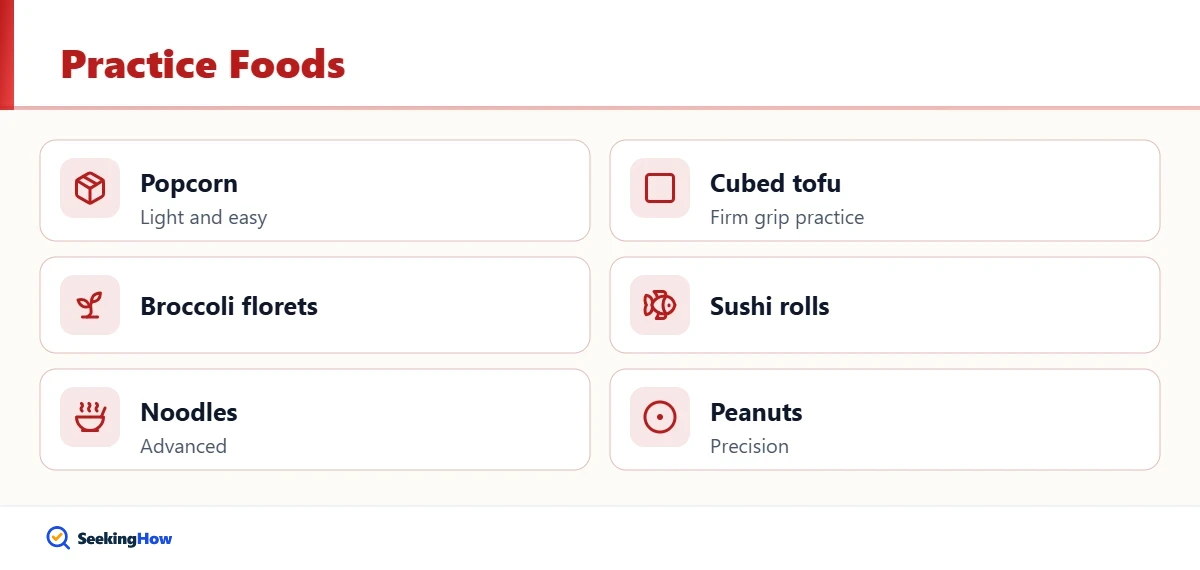
- Start large: practice with cubes of bread, broccoli florets or chunks of tofu.
- Move to small dry items: peanuts, popcorn, or cereal pieces build precision.
- Try sticky rice: short-grain rice clumps together and is easier than long-grain. A rice cooker like the one in our Oster rice cooker guide makes perfect practice rice.
- Graduate to noodles: lift a small bundle, let it hang, then guide it to your mouth over the bowl.
- Finish with slippery foods: sliced cucumbers, ramen eggs and pieces of fish test your grip pressure. A halved hard-boiled egg is a good challenge.
Practice for a few minutes at each meal rather than in long sessions. Muscle memory builds quickly with short, regular repetition.
How Do You Eat Specific Foods With Chopsticks?
- Rice: lift the bowl to chest height and push or scoop small clumps toward your mouth. Short-grain rice makes this easier.
- Noodles: lift a modest bundle, bring the bowl closer, and slurp; in Japan and parts of China slurping noodles is acceptable.
- Sushi: pick up nigiri on its side so you can dip the fish, not the rice, into soy sauce. Eating nigiri by hand is also traditional.
- Dumplings: grip around the middle, not the thin edges, to avoid tearing the wrapper. Use a spoon underneath for soup dumplings.
- Large pieces: it is fine to bite a piece and return it to your own bowl, or split soft foods by pressing the chopsticks apart.
What Is the Etiquette for Using Chopsticks?
Customs vary by country, but a few rules are widely shared and worth following anywhere.
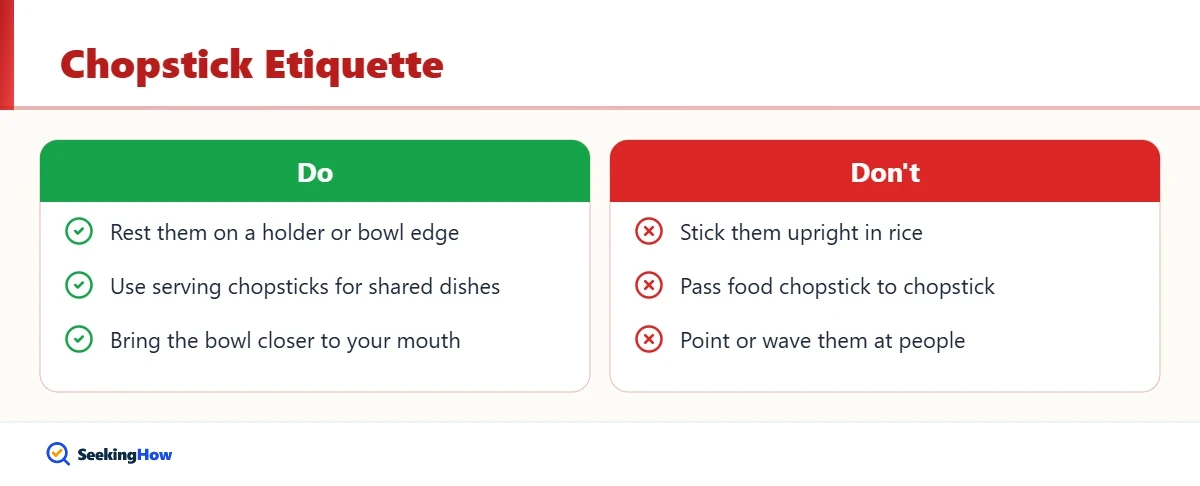
- Never stick chopsticks upright in a bowl of rice; it resembles incense offerings at funerals in several cultures.
- Never pass food directly from your chopsticks to someone else’s chopsticks, which echoes a funeral rite in Japan.
- Do not point with chopsticks, wave them around, or tap them on dishes.
- Do not spear food unless you truly cannot pick it up.
- Use serving chopsticks or the back ends of your own when taking food from shared plates, where that is the custom.
- Rest them on a chopstick rest or across your bowl or plate when not in use.
Can Left-Handed People and Kids Use Chopsticks?
Yes. Left-handed users follow the exact same grip in a mirror image: the bottom stick rests in the crook of the left thumb and on the left ring finger, and the top stick moves like a pencil. At a crowded table, sitting at a left-hand corner avoids bumping elbows with a right-handed neighbor.
Children usually learn best with training chopsticks, which are joined at the top with a hinge or have plastic finger loops that hold the fingers in the correct position. Once a child can pick up larger pieces reliably, move them to short, lightweight wooden chopsticks with textured tips. Keep practice playful, such as moving pom-poms or cereal from one bowl to another, and accept that it can take many meals before the grip feels natural.
For anyone with arthritis or limited hand strength, hinged chopsticks or ones joined by a spring clip do the opening for you, so you only need to squeeze. They are a perfectly acceptable choice in most restaurants.
What Are Common Chopstick Mistakes?
- Moving both sticks like scissors instead of keeping the bottom one still.
- Gripping too hard, which makes the sticks cross and food shoot away.
- Holding the sticks at the very end before you have control.
- Letting the tips drift out of alignment.
- Crossing the sticks into an X shape, which cannot hold food.
How Do You Care for Reusable Chopsticks?
Wash wooden and bamboo chopsticks by hand in warm soapy water and dry them standing upright or flat in the air; long soaks and dishwashers can warp and crack them. Lacquered chopsticks need gentle sponges, not scouring pads. Stainless steel and many plastic chopsticks can go in the dishwasher. Replace wooden chopsticks that become cracked, fuzzy or moldy.
Frequently Asked Questions
Which finger goes between the chopsticks?
Your middle finger sits between the two chopsticks. The bottom stick rests on your ring finger and in the crook of your thumb, while the top stick is held by the thumb, index finger and middle finger, which lift and lower it like a pencil.
How long does it take to learn chopsticks?
Most people understand the grip in a few minutes and can eat larger foods within a meal or two. Handling rice, noodles and slippery foods comfortably usually takes several meals of short, regular practice. Starting with textured wooden chopsticks speeds things up.
Is it rude to ask for a fork at an Asian restaurant?
Generally no. Most restaurants are happy to provide a fork or spoon, and staff would rather you enjoy your meal. Using chopsticks politely is appreciated, but struggling or spearing food is less graceful than simply asking for a fork.
Why does food keep slipping from my chopsticks?
The usual causes are uneven tips, a bottom stick that moves, or squeezing too hard so the sticks cross. Tap the tips even, keep the bottom stick anchored against your ring finger, and close the top stick gently. Smooth metal chopsticks are also harder for beginners.
Can you use chopsticks with your left hand?
Yes. The grip is the same mirrored for the left hand. At a shared table, choose a seat on the left end if you can, so your elbow does not bump a right-handed neighbor while you eat.