Quick Answer
To stop hair breakage from ponytails, switch to snag-free ties such as fabric scrunchies or spiral ties without metal, wear the ponytail looser and lower, move its position daily, never tie up wet hair, and give your hair ponytail-free days. Remove ties gently by unwinding, not pulling. Most people see fewer broken strands within 4–6 weeks.
Key Takeaways
- Ponytail breakage happens where the elastic grips and where tension pulls hair at the hairline.
- Elastics with metal joins and rubber bands snag and cut hair; fabric-covered or spiral ties are gentler.
- Wet hair stretches and snaps more easily, so tie it up only when dry or nearly dry.
- Repeated tight ponytails can cause traction alopecia, hair loss that may become permanent.
- Changing the ponytail’s height and position spreads stress across different strands.
Short broken hairs around the elastic line or frizzy flyaways at the crown are telltale signs that a ponytail habit is damaging hair. This guide explains how to stop hair breakage from ponytails without giving up the style.
What You’ll Need
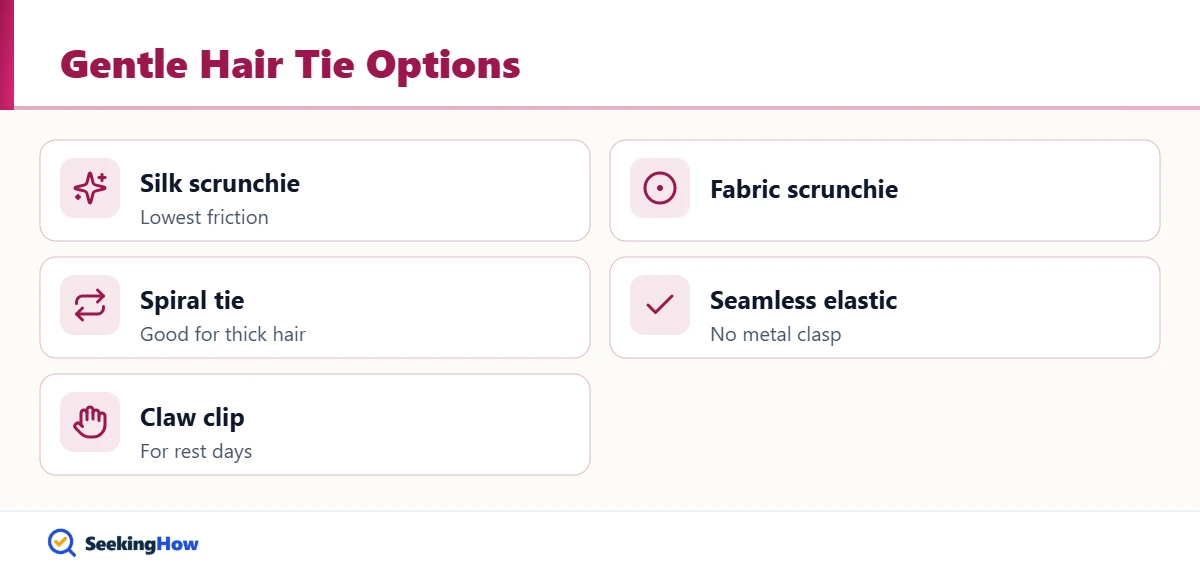
- Fabric scrunchies, silk or satin scrunchies, or spiral (coil) hair ties
- Seamless elastics with no metal clasp
- Claw clip (for days off from elastics)
- Leave-in conditioner or lightweight hair oil
- Wide-tooth comb or soft-bristle brush
- Small scissors to cut out tangled elastics (optional)
How To Stop Hair Breakage From Ponytails: Step-by-Step
Step 1: Replace Damaging Hair Ties
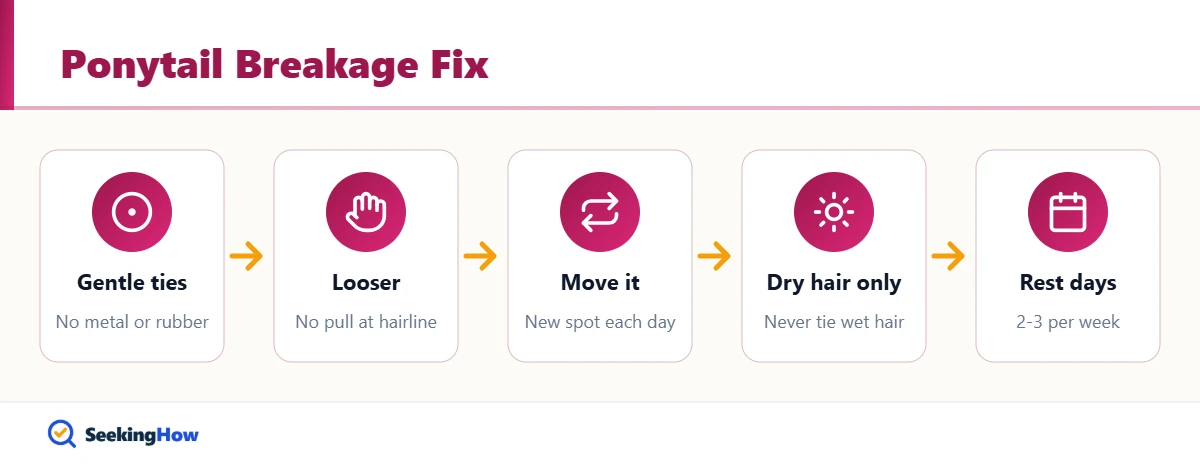
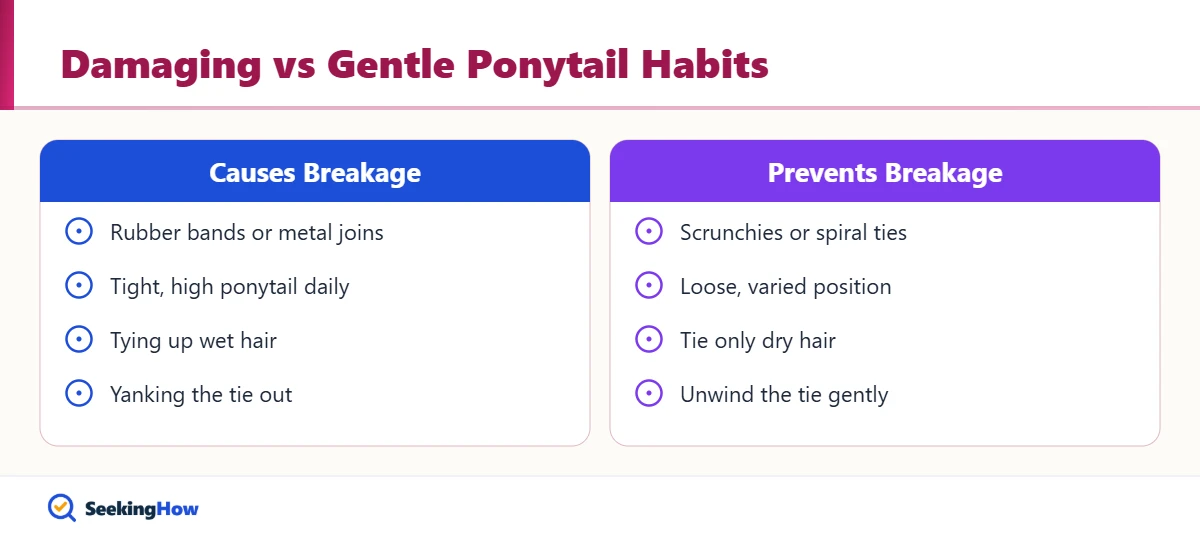
Throw out rubber bands and elastics with metal joins, which grip and slice the hair shaft. Use fabric scrunchies, silk or satin ties, or spiral ties that spread pressure. Most people find this single change makes the biggest difference.
Step 2: Loosen the Ponytail
Wrap the elastic one fewer time than usual so the ponytail sits snug but not tight. If you feel pulling at the hairline, a headache, or tenderness when you take it out, it is too tight. The American Academy of Dermatology recommends loosening tight hairstyles to help prevent hair loss.
Step 3: Change the Position Every Day
Alternate high, mid, and low ponytails, and shift slightly left or right. Tying hair in exactly the same spot concentrates friction on the same strands until they snap. A low ponytail at the nape puts the least strain on the hairline.
Step 4: Only Tie Up Dry Hair
Let hair dry fully or nearly fully before putting it in a ponytail. Wet hair is more elastic and fragile, and an elastic on wet hair dries into a crease that breaks. Use a claw clip if you need hair off your face after a shower.
Step 5: Remove Ties Gently
Unwind the elastic loop by loop instead of yanking it down the length. If a tie is tangled in, snip the elastic rather than pulling hair through it. Detangle from ends to roots with a wide-tooth comb afterward.
Step 6: Condition the Breakage Zone
Apply leave-in conditioner or a drop of oil to the section where the elastic sits. Moisturized hair has more slip and is less likely to snap under friction. Pair this with ponytail-free days, at least 2 or 3 a week.
Bottom line: loose, dry, moving, and snag-free; if you can’t do all four, switch to a claw clip or loose braid.
Hair Ties Compared
| Tie type | Breakage risk | Hold | Best for |
|---|---|---|---|
| Rubber band | Very high | Strong | Never for hair |
| Elastic with metal join | High | Strong | Avoid |
| Seamless fabric elastic | Low | Good | Daily wear |
| Silk or satin scrunchie | Very low | Moderate | Sleep, fine or damaged hair |
| Spiral tie | Low | Good | Thick hair, workouts |
| Claw clip | Very low | Moderate | Rest days, wet hair |
If That Didn’t Work
Problem: Short broken hairs at the crown. Cause: Breakage from tying hair in the same high spot. Fix: Move the ponytail lower and use scrunchies only.
Problem: Thinning at the temples or edges. Cause: Early traction alopecia. Fix: Stop tight styles now and see a dermatologist.
Problem: Breakage everywhere, not just at the tie. Cause: Chemical damage, heat, or nutritional or medical causes. Fix: Review your routine and see a doctor if shedding is heavy.
Problem: Ponytail slips with gentle ties. Cause: Silky or fine hair. Fix: Use two loose ties or a spiral tie instead of tightening one.
When To See a Dermatologist
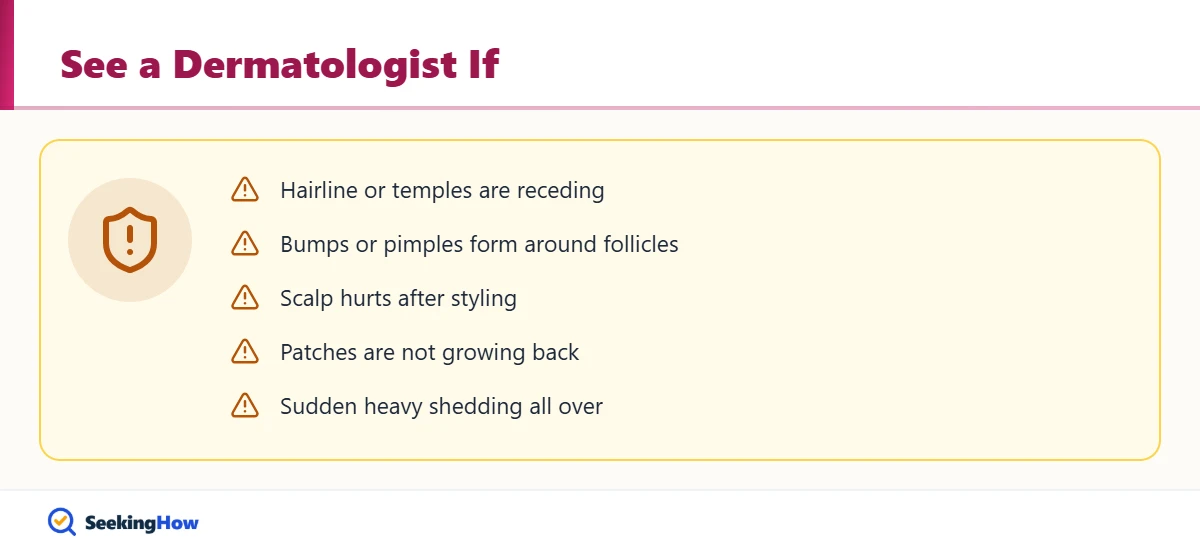
See a dermatologist if you notice receding hair at the temples or along the hairline, small bumps or pimples around hair follicles, scalp pain or tenderness after styling, or patches where hair is not growing back. Traction alopecia is often reversible when caught early but can become permanent with years of tension. Also see a doctor for sudden, heavy shedding, which can have medical causes such as thyroid problems, iron deficiency, or recent illness.
Prevention Tips
- Sleep with hair loose or in a satin scrunchie, never a tight elastic.
- Wear a loose braid for workouts instead of a tight high ponytail.
- Keep a few spare gentle ties so you never grab a rubber band.
- Trim split ends every 8 to 12 weeks so breakage doesn’t travel.
Related Guides
- How to fix hair breakage at the crown
- How to fix frizzy hair after bleaching
- How to get rid of frizzy hair
Sources
- American Academy of Dermatology – hairstyles that can cause hair loss and traction alopecia
- NHS – hair loss causes and when to see a GP
- Mayo Clinic – hair loss symptoms and causes
Frequently Asked Questions
Can ponytails cause hair loss?
Yes, tight ponytails worn often can cause traction alopecia, hair loss from constant pulling on the follicles. It usually starts at the hairline and temples. Caught early, it often reverses once tension stops, but years of tight styles can cause permanent loss.
Do scrunchies prevent hair breakage?
Scrunchies reduce hair breakage compared with rubber bands and elastics with metal joins, because the fabric spreads pressure and creates less friction. Silk and satin scrunchies are the gentlest. They still cause breakage if worn very tight or in the same spot every day.
Is it bad to sleep with a ponytail?
Sleeping in a tight ponytail is bad for hair, because friction against the pillow and constant tension cause breakage. If you need hair contained at night, use a loose, low style with a silk or satin scrunchie, or a loose braid.
Will broken hair from ponytails grow back?
Yes, hair that has broken along the shaft keeps growing from the follicle, so the broken pieces eventually grow out. Breakage is different from hair loss at the root. If you see thinning at the hairline or bald patches, that may be traction alopecia and needs a dermatologist.
Are spiral hair ties better for your hair?
Spiral hair ties are generally gentler than standard elastics because their coiled shape grips with less concentrated pressure and fewer snags. They work especially well for thick hair. They can still tangle in very fine hair, so unwind them carefully.
How tight is too tight for a ponytail?
A ponytail is too tight if you feel pulling at the hairline, get a headache, or your scalp feels sore when you take it down. You should be able to move your scalp slightly. Loosen the tie by one wrap or switch to a low ponytail.