
Quick Answer
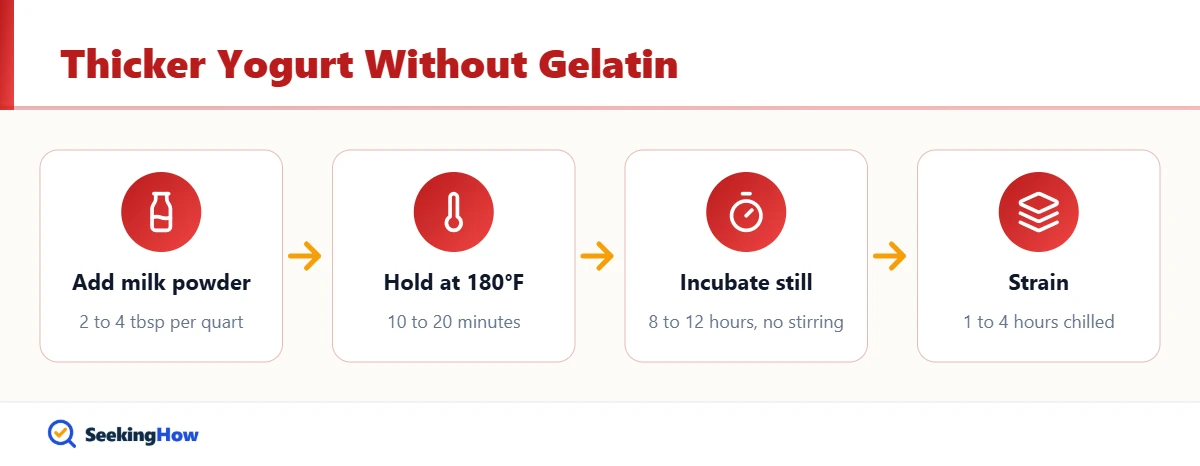
To make homemade yogurt thicker without gelatin, heat the milk to 180°F and hold it there for 10 to 20 minutes, stir in 2 to 4 tablespoons of nonfat dry milk powder per quart, incubate undisturbed at 105°F to 112°F for 8 to 12 hours, then strain it through cheesecloth for 1 to 4 hours. Never stir yogurt during incubation.
Key Takeaways
- Holding milk at 180°F for 10 to 20 minutes changes whey proteins so they set into a firmer gel.
- Adding nonfat dry milk powder raises milk solids and is the easiest thickener that keeps yogurt pure dairy.
- Straining for 1 to 4 hours turns regular yogurt into Greek-style yogurt; overnight straining makes labneh.
- Whole milk sets thicker and creamier than skim or 1 percent milk.
- Jostling or stirring during incubation breaks the curd and causes thin, runny yogurt.
- Ultra-pasteurized milk works, but many cooks find it sets softer than regular pasteurized milk.
Runny yogurt is usually a process problem, not a recipe problem. This guide shows how to make homemade yogurt thicker without gelatin using only heat, milk solids, time, and straining, so your yogurt stays plain dairy with no added stabilizers.
What You’ll Need
- 1 quart (4 cups) whole milk, pasteurized (not ultra-pasteurized if you can avoid it)
- 2 tablespoons plain yogurt with live and active cultures, or a freeze-dried starter
- 2 to 4 tablespoons nonfat dry milk powder
- Heavy-bottomed pot and whisk
- Instant-read or clip-on thermometer
- Yogurt maker, multicooker with a yogurt setting, or an oven with the light on
- Fine-mesh strainer lined with cheesecloth or a coffee filter
- Heavy cream, 2 to 4 tablespoons per quart (optional, for a richer set)
How To Make Homemade Yogurt Thicker Without Gelatin: Step-by-Step
Step 1: Choose Whole Milk
Start with whole milk, which has about 3.25 percent fat and more body than reduced-fat milk. Fat and protein both contribute to a firm set. If you prefer skim, plan to add more dry milk powder and strain longer.
Step 2: Whisk in Dry Milk Powder
Whisk 2 to 4 tablespoons of nonfat dry milk powder into the cold milk before heating. Extra milk solids give the cultures more protein to set into a thick gel. Adding powder to hot milk is the common mistake; it clumps and leaves gritty bits.
Step 3: Heat to 180°F and Hold
Heat the milk slowly to 180°F (82°C), stirring often, then hold it between 180°F and 185°F for 10 to 20 minutes. This step denatures whey proteins so they join the curd instead of staying in the liquid whey. Most runny homemade yogurt skips the hold and just heats to temperature.
Step 4: Cool to 110°F and Add Starter
Cool the milk to 110°F to 115°F, then whisk a cup of it into your starter yogurt before stirring the mix back into the pot. Temperatures above about 120°F can weaken or kill the cultures. A fresh, plain starter with live cultures sets far better than an old or sweetened one.
Step 5: Incubate Undisturbed for 8 to 12 Hours
Hold the yogurt at 105°F to 112°F for 8 to 12 hours without stirring or moving the container. Longer incubation makes yogurt both thicker and tangier. In practice, opening the lid to check it every hour is one of the most common causes of a weak set.
Step 6: Chill Before Judging
Refrigerate the yogurt for at least 6 hours before deciding it is too thin. Yogurt firms noticeably as it cools. Many batches that look loose when warm are spoonable the next morning.
Step 7: Strain to Your Preferred Thickness
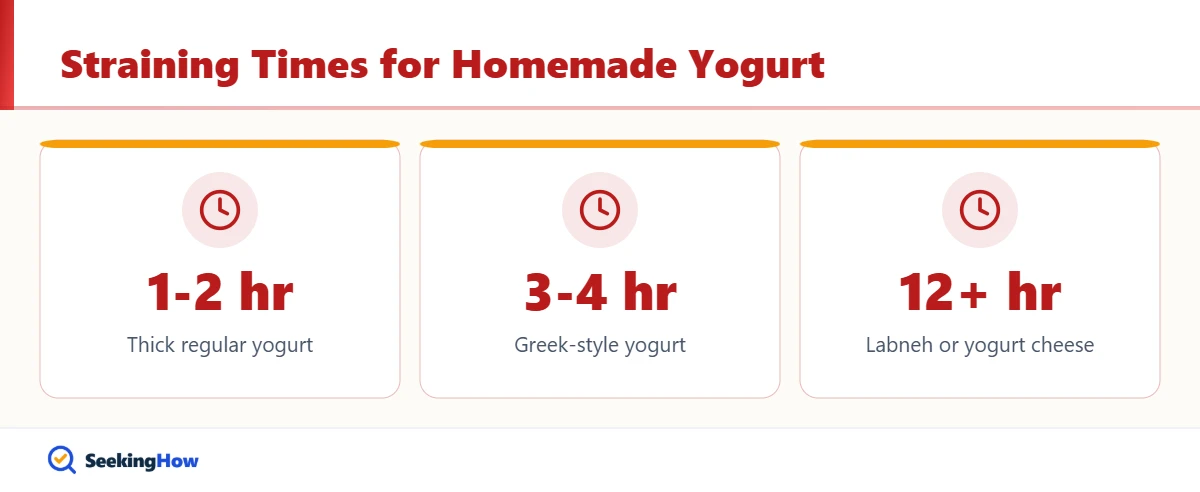
Spoon chilled yogurt into a cheesecloth-lined strainer set over a bowl and refrigerate. Strain 1 to 2 hours for a thick regular yogurt, 3 to 4 hours for Greek-style, and 12 hours or more for labneh. Save the drained whey for smoothies, baking, or bread dough.
Bottom line: the 180°F hold plus dry milk powder fixes most runny batches, and straining is the guaranteed backup.
If That Didn’t Work
Problem: Yogurt never set at all. Cause: Milk was too hot when the starter went in, or the starter had no live cultures. Fix: Use a fresh starter labeled “live and active cultures” and add it below 115°F.
Problem: Yogurt is thick on top with lots of liquid whey. Cause: Over-incubation or a container that was moved. Fix: Stir the whey back in or pour it off, and shorten incubation by 1 to 2 hours next time.
Problem: Yogurt is slimy or stringy. Cause: Some starter strains produce ropy textures. Fix: Switch to a different brand or a freeze-dried starter.
Problem: Yogurt is grainy. Cause: Milk powder added to hot milk, or milk overheated far above 185°F. Fix: Whisk powder into cold milk and keep the hold temperature steady.
Problem: Each batch gets thinner. Cause: Reusing your own yogurt as starter weakens cultures over many rounds. Fix: Buy a fresh starter every 4 to 6 batches.
Thickening Methods Compared
| Method | Extra time | Thickness gain | Best for |
|---|---|---|---|
| 180°F hold | 10 to 20 minutes | Moderate | Every batch, best first fix |
| Dry milk powder | 1 minute | Moderate | Skim or low-fat milk |
| Longer incubation | 2 to 4 hours | Small to moderate | People who like tangy yogurt |
| Straining | 1 to 12 hours | Large | Greek yogurt and labneh |
| Adding cream | 1 minute | Small, richer texture | Dessert-style yogurt |
Safety and When To Start Over
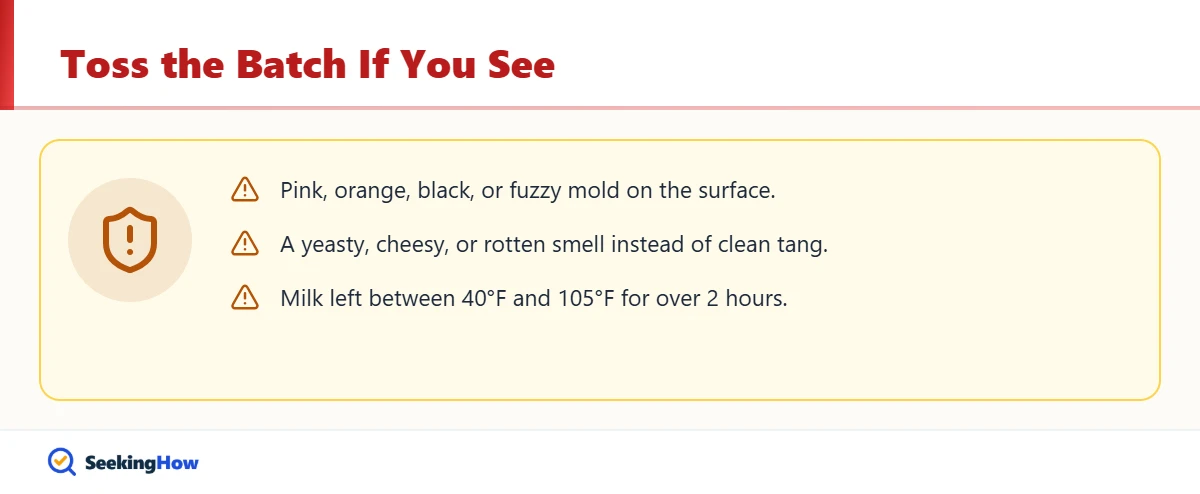
Homemade yogurt is safe when cultures acidify the milk quickly, so temperature control matters. Throw the batch out instead of trying to thicken it if:
- The milk sat between 40°F and 105°F for more than 2 hours before incubation.
- You see pink, orange, black, or fuzzy mold anywhere on the surface.
- It smells yeasty, cheesy, or rotten rather than clean and tangy.
- Bubbles or a fizzy taste appear, which suggests yeast contamination.
Keep finished yogurt in the fridge at 40°F or below and use it within 1 to 2 weeks.
Prevention Tips
- Use a thermometer every time; guessing temperatures is the top cause of thin yogurt.
- Place the incubating container where nobody will bump it.
- Wash all equipment in hot soapy water before each batch.
- Keep a little plain yogurt from a strong batch to start the next one.
Related Guides
- How to make buttermilk yogurt at home without a yogurt maker
- What is isolate protein and how it compares to concentrate
- How to hard boil eggs for high-protein breakfasts
Sources
- National Center for Home Food Preservation (University of Georgia): Making yogurt at home (nchfp.uga.edu)
- USDA Food Safety and Inspection Service: Dairy and refrigeration safety (fsis.usda.gov)
- U.S. Food and Drug Administration: Raw milk and pasteurization guidance (fda.gov)
Frequently Asked Questions
Why is my homemade yogurt so runny?
Homemade yogurt is usually runny because the milk was not held at 180°F, the starter was weak, or the container was moved during incubation. Low-fat milk and short incubation also produce thinner yogurt. Fix the heat hold first, use a fresh live-culture starter, and leave the yogurt completely undisturbed for at least 8 hours.
Can I thicken yogurt after it is already made?
Yes, you can thicken yogurt after it is made by straining it. Line a strainer with cheesecloth or a coffee filter, set it over a bowl, and refrigerate for 1 to 4 hours. Stirring in powdered milk after incubation does not work well because the powder stays gritty and does not set.
Does longer incubation make yogurt thicker?
Yes, longer incubation makes yogurt somewhat thicker, and it also makes it more sour. Going from 6 to 10 or 12 hours typically gives a firmer set. Past about 12 to 14 hours, the curd can tighten and push out more whey, so straining is a better way to add serious thickness.
How much powdered milk should I add to yogurt?
Add 2 to 4 tablespoons of nonfat dry milk powder per quart of milk. Start with 2 tablespoons for whole milk and use up to 4 for skim or low-fat milk. Whisk it into the cold milk before heating so it dissolves fully and does not leave grainy lumps.
Can I use ultra-pasteurized milk for thick yogurt?
You can use ultra-pasteurized milk, but it often sets softer. The very high heat of ultra-pasteurization already alters the proteins, so some cooks skip the 180°F hold with it. If your batches are thin, switch to regular pasteurized whole milk or add extra dry milk powder and strain.
Is cornstarch or pectin a good gelatin substitute for yogurt?
Cornstarch and pectin can thicken yogurt, but they change the texture and are rarely needed. Cornstarch must be cooked into the milk and can taste starchy. Commercial yogurt makers use pectin or tapioca starch for a smooth set. For homemade yogurt, milk powder and straining keep the result plain and clean-tasting.
What can I do with the whey from straining yogurt?
Use the whey from strained yogurt in smoothies, bread dough, pancakes, or as a soaking liquid for grains. It is tangy and contains some protein, calcium, and live cultures. Store it in a covered jar in the fridge and use it within about a week, or freeze it in ice cube trays.