Quick Answer
To flatten a warped board without a planer, shim it so it cannot rock, then surface it with a router sled and a 1-1/2 to 2-inch spoilboard bit, taking passes of 1/16 inch or less. Flip and repeat for the other face. Small boards can be hand planed instead. Expect 1 to 2 hours per board.
Key Takeaways
- A router sled is the most reliable way to flatten a warped board without a thickness planer or jointer.
- Shim the board under its high corners so it sits still; rocking during cuts ruins flatness.
- Take router passes of 1/16 inch or less to avoid tear-out and bit chatter.
- Flatten one face fully before flipping; the flat face becomes the reference for the second face.
- Ripping a badly cupped wide board into narrow strips and regluing wastes less wood than surfacing it flat.
- Moisture and clamping can reduce mild cupping but rarely fix twist.
Thickness planers cannot flatten a warped board on their own anyway; they only make the second face parallel to the first. Learning how to flatten a warped board without a planer means using a reference surface you create yourself, with a router sled, a hand plane, or a saw. This guide shows each method and when to use it.
What You’ll Need
- Router (1-1/2 HP or more) with a 1/2-inch collet
- Spoilboard or surfacing bit, 1-1/2 to 2-1/2 inches diameter
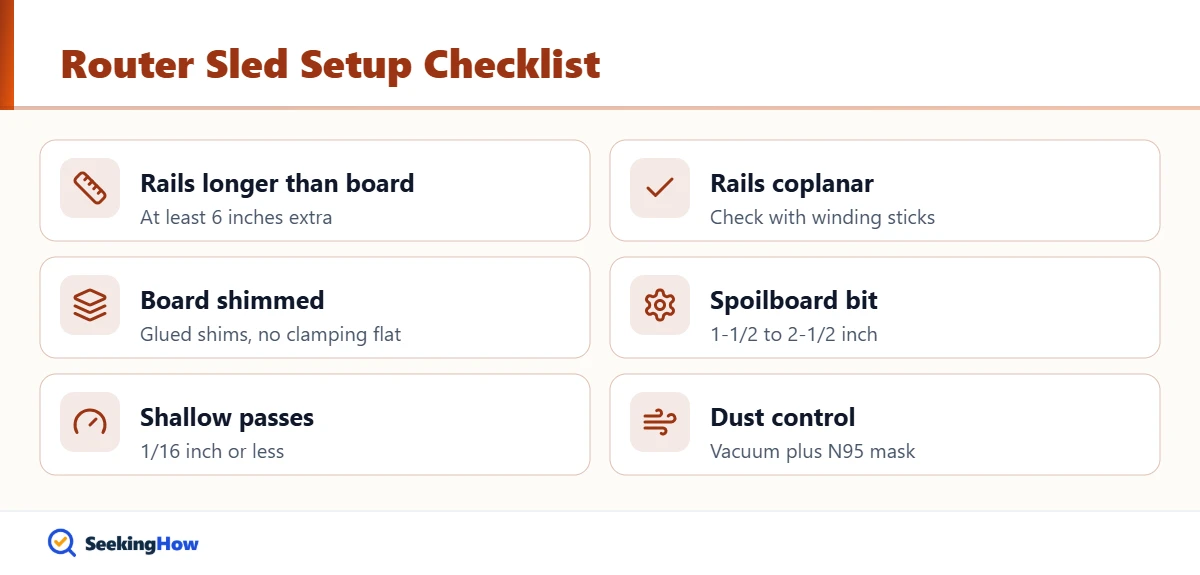
- Router sled: a 3/4-inch plywood or MDF base with two straight rails (aluminum angle or jointed hardwood) at least 6 inches longer than the board
- Flat work surface or torsion box to support the sled rails
- Wood shims or hot-melt glue to stabilize the board
- 4-foot straightedge and two winding sticks
- No. 5 jack plane or No. 7 jointer plane (alternative method)
- Pencil for scribbling high spots
- Dust mask (N95), safety glasses, and hearing protection
How To Flatten a Warped Board Without a Planer: Step-by-Step
Step 1: Identify the type of warp
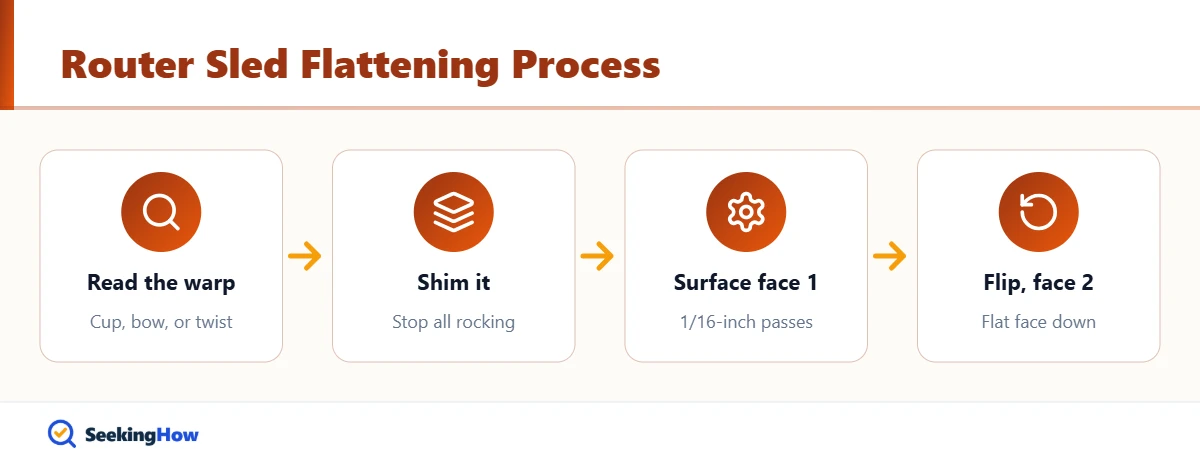
Lay a straightedge across and along the board and sight down winding sticks set at each end. Cup is a curve across the width, bow is a curve along the length, and twist makes opposite corners high. Twist is the hardest to fix and almost always needs material removed, while mild cup can sometimes be pulled back with moisture first.
Step 2: Shim the board so it cannot rock
Place the board cup-side down (hollow facing the table) and slide shims under any corner or edge that lifts. Fix the shims with hot-melt glue or double-sided tape so the board stays put. The most common mistake is clamping a warped board flat, which bends it temporarily; once released it springs back to its warped shape.
Step 3: Set up the router sled
Set the rails on both sides of the board so their tops sit just above the board’s highest point, and confirm both rails are level and coplanar with a straightedge. Mount the router on the sled base and set the bit to touch the highest point of the board. In practice, most people find twist in the rails is the hidden cause of uneven results, so check them with winding sticks too.
Step 4: Surface the first face
Lower the bit about 1/16 inch and move the router across the board in overlapping passes while sliding the sled along the rails. Climb cuts can grab, so feed against the bit’s rotation. Keep lowering in small steps until the bit touches every part of the face; pencil scribbles show where it has not reached yet.
Step 5: Flip and flatten the second face
Turn the board over so the newly flat face rests on the table; no shims are needed now. Surface the second face until it is clean and the board reaches your target thickness. Because both faces were cut from the same rail plane, they are now flat and parallel.
Step 6: Sand and stabilize
Sand away router ridges with a random-orbit sander, starting at 80 grit and finishing at 120 to 150 grit. Sticker the board (stack it with spacers) for a day or two before final use, since releasing internal stress can cause slight new movement. Then apply finish to both faces equally.
Method 2: Hand Plane a Small Board
For boards up to about 8 inches wide and 3 feet long, a hand plane is quicker than building a sled. Plane diagonally across the high corners first, check with winding sticks, then plane with the grain to smooth. Use a jack plane for removing material and a jointer plane for final flattening.
Method 3: Rip and Reglue a Cupped Board
A wide board with deep cupping loses a lot of thickness if surfaced flat. Rip it into strips 3 to 4 inches wide on a table saw, flatten each strip lightly with a hand plane or sander, and edge-glue them back together, alternating growth rings. Each strip has much less cup than the full width.
Method 4: Moisture and Clamping for Mild Cup
Cupped boards often curve because one face dried faster than the other. Wetting the concave side and placing the board in the sun or under weights can bring mild cup back, as explained in our guide on how to straighten wood with water. Treat this as a first step before machining, not a replacement for it.
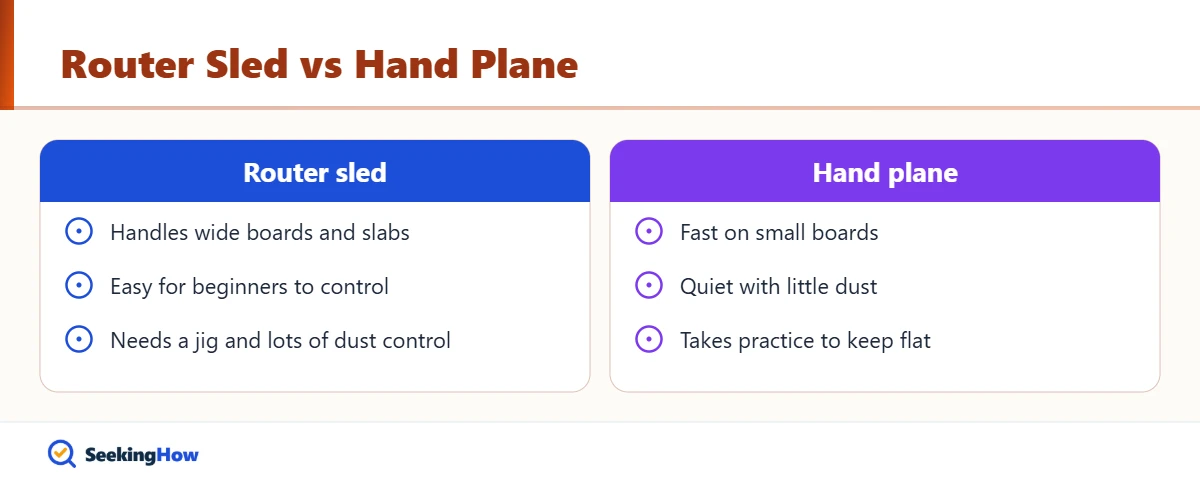
Bottom line: Use a router sled for wide boards and slabs, a hand plane for small boards, and rip-and-reglue when cupping is severe.
If That Didn’t Work
Problem: The board is still out of flat after surfacing. Cause: Board rocked during cuts or rails were not coplanar. Fix: Re-shim firmly and recheck rails with winding sticks.
Problem: Deep tear-out in figured grain. Cause: Heavy passes or a dull bit. Fix: Take 1/32-inch final passes and use a sharp carbide surfacing bit.
Problem: The board warped again a day later. Cause: Internal stress release or uneven moisture. Fix: Sticker it, let it acclimate, then take a final light pass.
Problem: Ran out of thickness before the face was flat. Cause: Warp too severe for the board. Fix: Rip into narrower strips and reglue, or use the board for shorter parts.
| Method | Time | Cost | Difficulty | Best for |
|---|---|---|---|---|
| Router sled | 1 to 2 hours | Low if you own a router | Moderate | Wide boards, slabs, twist |
| Hand plane | 30 to 60 minutes | Plane purchase | Moderate to hard | Small boards |
| Rip and reglue | 1 to 2 hours plus glue time | Low | Moderate | Severe cupping |
| Moisture and clamping | 1 to 3 days | Free | Easy | Mild cup only |
Safety and When To Call a Pro
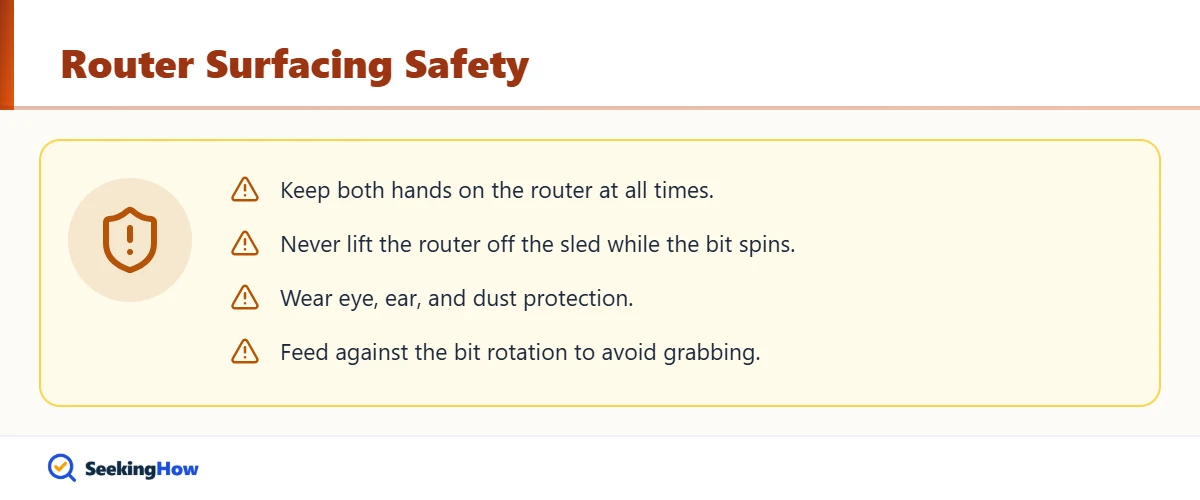
Surfacing bits are large and spin fast, so keep both hands on the router, wear eye and hearing protection, and never lift the router while the bit is spinning. Router surfacing creates fine dust; use dust collection and an N95 or better mask, especially with exotic species.
Many lumberyards and cabinet shops will run boards through a wide-belt or drum sander for a modest fee. Use that service if you need many boards flattened, have slabs wider than your sled, or the board is valuable enough that a mistake would be costly.
Prevention Tips
- Store lumber flat on evenly spaced stickers, not leaning against a wall.
- Let new boards acclimate in your shop for 1 to 2 weeks before milling.
- Finish both faces of a project equally so moisture moves evenly.
- Choose quartersawn boards when stability matters; they cup less than flatsawn.
Related Guides
- How to straighten wood with water
- How to remove polyurethane from wood
- How to make curved wood arches
- How to build free-standing wooden steps
Sources
- USDA Forest Products Laboratory: Wood Handbook, moisture and dimensional change in wood
- OSHA: wood dust and woodworking machinery safety
Frequently Asked Questions
Can you flatten a board without a jointer or planer?
Yes, you can flatten a board with a router sled, a hand plane, or a wide-belt sanding service. The router sled is the most beginner-friendly option because the rails create a flat reference plane. A hand plane works well on smaller boards once you learn to read winding sticks.
Will a planer alone flatten a warped board?
No, a thickness planer alone does not flatten a warped board. The feed rollers press the board flat as it passes, and it springs back afterward, leaving two parallel but still-warped faces. Woodworkers use a planer sled or jointer first to create one truly flat reference face.
How do you fix a cupped board without tools?
You can sometimes reduce mild cupping by wetting the concave face and setting it in sunlight or under weights for a day or two. The dry side absorbs moisture and swells, pulling the board flatter. Results are temporary unless the board is then sealed evenly on both faces.
What router bit is best for flattening wood?
A carbide spoilboard or surfacing bit 1-1/2 to 2-1/2 inches in diameter is best for flattening wood. Bits with replaceable inserts stay sharp longer. Use a 1/2-inch shank bit in a router of at least 1-1/2 horsepower for safety and a smoother cut.
How much thickness will I lose flattening a warped board?
You lose roughly the depth of the warp plus a little cleanup on each face. A board with 1/8 inch of cup typically loses a bit more than 1/8 inch overall. For severe cups, ripping into narrow strips first saves much more thickness.
Can twisted boards be flattened?
Yes, twisted boards can be flattened, but they lose more thickness than cupped boards. Shim the two low corners so the board sits still, then remove the two high corners with a router sled or plane until the face is flat. Very twisted boards are better cut into shorter pieces.
Why does wood keep warping after I flatten it?
Wood keeps warping after flattening because of moisture changes or stress released when material is removed. Let boards acclimate to your shop for 1 to 2 weeks, flatten in stages, and seal all faces equally so humidity cannot move one side faster than the other.