
Quick Answer
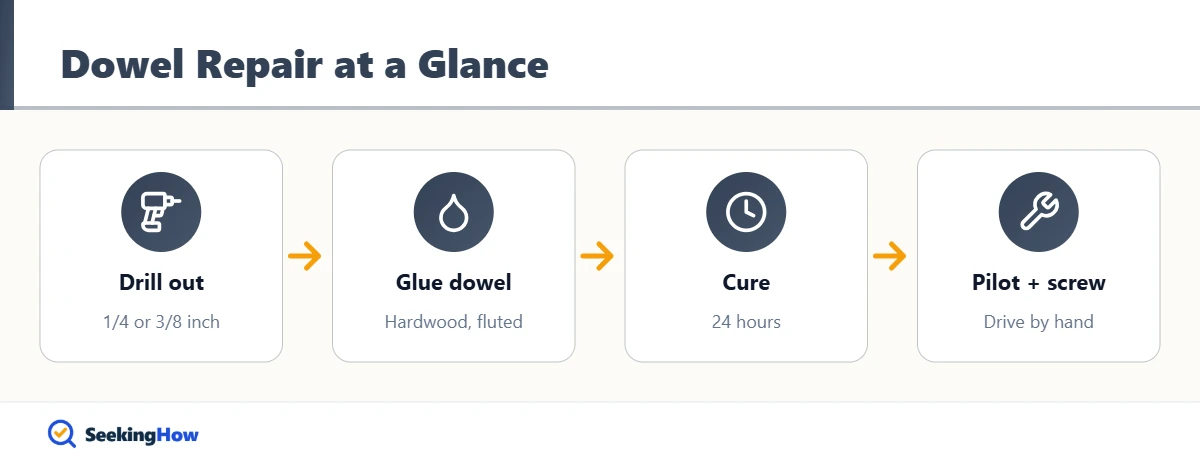
To fix a stripped screw hole in particle board, drill the hole out to 1/4 or 3/8 inch, glue in a hardwood dowel with wood glue, let it cure overnight, then drill a new pilot hole and reinstall the screw. The dowel gives threads solid wood to grip. For crumbled edges, use two-part epoxy putty instead.
Key Takeaways
- A glued hardwood dowel is the strongest DIY fix for a stripped screw hole in particle board.
- Toothpicks and glue work in solid wood but often fail in particle board because the fibers around them are already crushed.
- Two-part epoxy putty rebuilds holes near edges where particle board has crumbled.
- Threaded inserts made for particle board are best for parts you remove repeatedly.
- Drill a pilot hole about the size of the screw’s inner shank before driving a screw into a repair.
- Particle board that has swollen from water will not hold any repair and should be replaced.
Particle board is made from wood chips pressed with resin, so once a screw strips its threads, the hole is just loose crumbs. Cranking the screw tighter only makes it worse. This guide shows how to fix a stripped screw hole in particle board with three reliable methods, and how to choose the right one for hinges, drawer slides, and furniture joints.
What You’ll Need
- Drill/driver and brad-point bits: 1/4 inch and 3/8 inch, plus a pilot bit sized for your screw
- Hardwood dowels (birch or maple) in 1/4 or 3/8 inch diameter, or fluted furniture dowels
- PVA wood glue (Titebond II or similar)
- Two-part epoxy putty or epoxy wood filler (for crumbled edges)
- Threaded inserts for particle board (optional)
- Flush-cut saw or sharp utility knife
- Painter’s tape to mark drill depth
- Replacement screws: same length or slightly longer, with coarse threads
- Safety glasses
How To Fix a Stripped Screw Hole in Particle Board: Step-by-Step
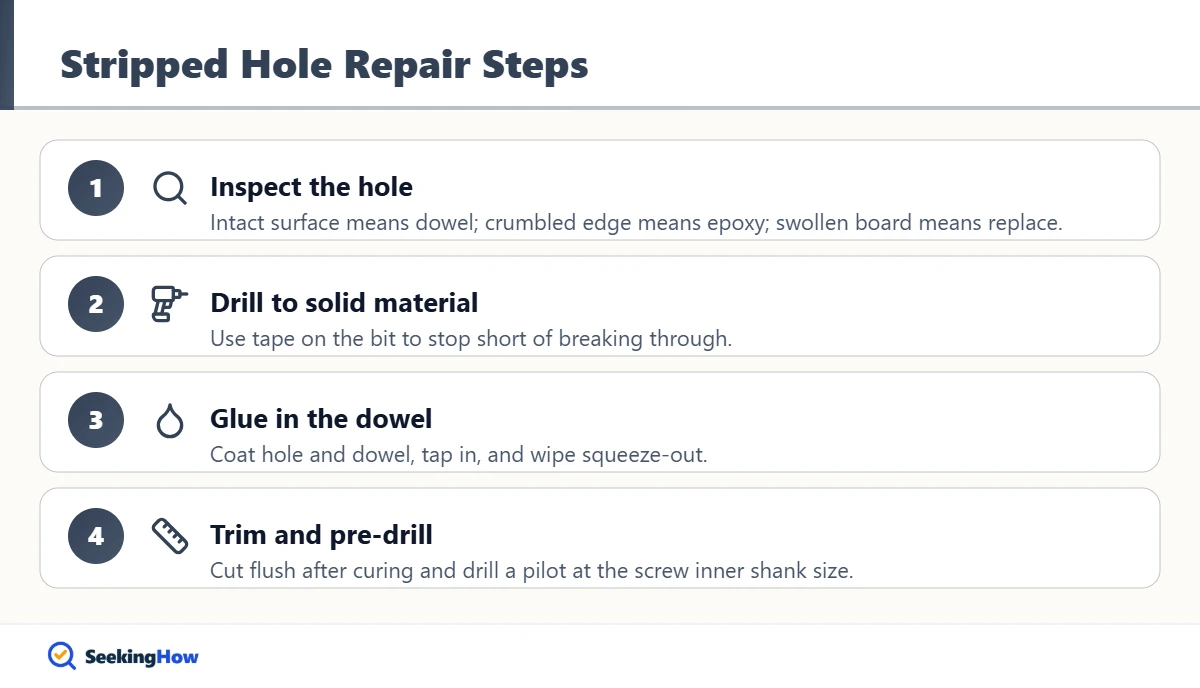
Step 1: Remove the screw and inspect the hole
Back out the screw and look at the hole. If the surface around it is intact but the threads are gone, the dowel method below will work. If chunks are missing or the hole is near a crumbling edge, skip to the epoxy method. If the board is swollen or soft from water, no screw repair will last.
Step 2: Drill out the damaged hole
Drill the hole out with a 1/4-inch bit for small screws (#6 to #8) or a 3/8-inch bit for larger screws and hinge locations. Wrap tape on the bit to mark a depth slightly deeper than the screw length, but never deep enough to break through the far side. Drilling to clean, solid material is what makes the dowel grip.
Step 3: Glue in a hardwood dowel
Coat the inside of the hole and the dowel with wood glue, then tap the dowel in until it bottoms out. Wipe away squeeze-out with a damp rag. Fluted dowels let excess glue escape and hold better than smooth dowel rod, which can trap glue and hydraulically push back out.
Step 4: Let the glue cure and trim flush
Let the glue cure for at least 24 hours before loading the joint. Cut the dowel flush with a flush-cut saw or utility knife. Rushing this step is the most common reason repaired holes strip again on the first use.
Step 5: Drill a new pilot hole
Mark the screw location in the center of the dowel and drill a pilot hole roughly the diameter of the screw’s inner shank, not its threads. Without a pilot, the screw can split the dowel. In practice, most people find a #8 screw needs about a 1/8-inch pilot in hardwood dowel.
Step 6: Reinstall the screw by hand
Drive the screw slowly with a hand screwdriver or a drill on its lowest clutch setting, stopping as soon as the screw head seats. Particle board and dowel repairs strip easily if overdriven, so snug is enough.
Method 2: Epoxy Putty for Crumbled Holes
When the hole is near an edge or chunks are missing, knead two-part epoxy putty until it is one uniform color, press it firmly into the cleaned-out hole, and smooth it flush. After it fully cures, typically several hours according to the package, drill a pilot hole and drive the screw. Epoxy bonds to the loose particles and rebuilds the surrounding area. For broader damage, see our guide on repairing particle board water damage.
Method 3: Threaded Inserts for Removable Parts
If you will remove the part again, such as a bed rail or a desk leg, install a threaded insert designed for particle board, then use a matching machine bolt. The insert spreads the load over a larger area and does not wear out with repeated assembly. Drill the exact hole size listed on the insert package.
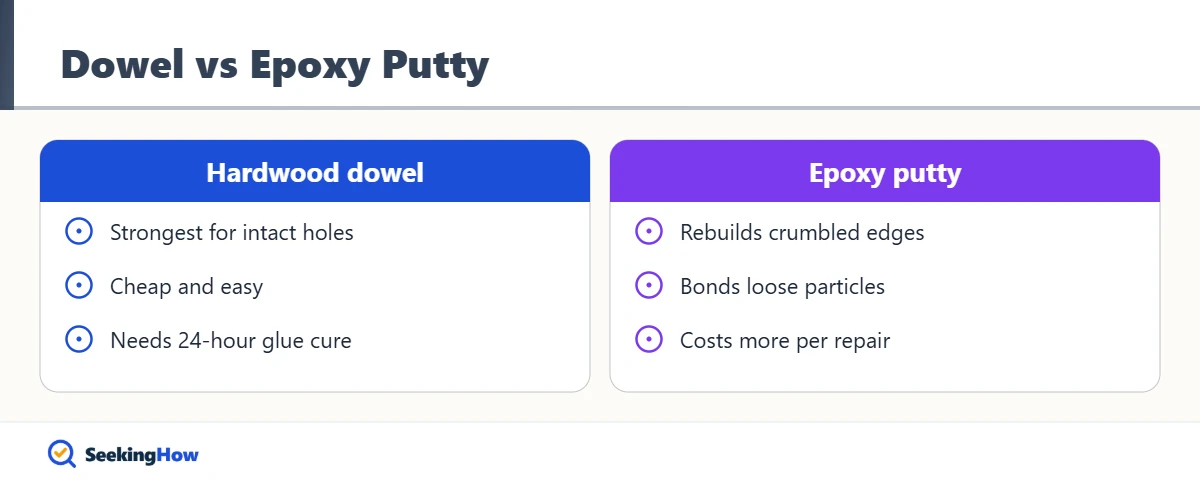
Bottom line: Use a glued dowel for most stripped holes, epoxy when the board has crumbled, and threaded inserts for joints you take apart.
If That Didn’t Work
Problem: The screw still spins after the dowel repair. Cause: Pilot hole too large or glue not cured. Fix: Wait the full 24 hours and use a smaller pilot bit.
Problem: The dowel split. Cause: No pilot hole or screw too thick. Fix: Drill out and redo with a 3/8-inch dowel and always pre-drill.
Problem: The hinge keeps loosening. Cause: Door weight levering on the screws. Fix: Repair all hinge holes, add a third hinge on tall doors, and adjust the hinge so the door does not bind.
Problem: The board crumbles around the repair. Cause: Water damage or a degraded panel. Fix: Replace the panel or reinforce it with a plywood backer.
Problem: The screw head is stripped too. Cause: Worn driver bit. Fix: Remove it using the methods in how to remove a stripped screw from wood.
| Method | Time | Strength | Best for |
|---|---|---|---|
| Glued hardwood dowel | 20 minutes plus 24-hour cure | High | Hinges, slides, cabinet joints |
| Epoxy putty | 15 minutes plus cure | High | Crumbled edges and blowouts |
| Threaded insert | 15 minutes | Very high | Parts you disassemble |
| Toothpicks and glue | 10 minutes plus cure | Low in particle board | Temporary, light loads only |
| Longer screw | 5 minutes | Variable | Only if there is solid material deeper |
Safety and When To Call a Pro
Wear safety glasses when drilling, since particle board throws fine chips, and work in a ventilated area with epoxy, wearing nitrile gloves to avoid skin sensitization. Support heavy doors or panels before removing their screws so they do not fall.
Call a handyman or cabinet installer if the stripped holes hold wall cabinets, a TV mount, or anything overhead, or if several mounting points have failed at once. Those loads need to be anchored into studs or a properly rebuilt panel, not a quick fix.
Prevention Tips
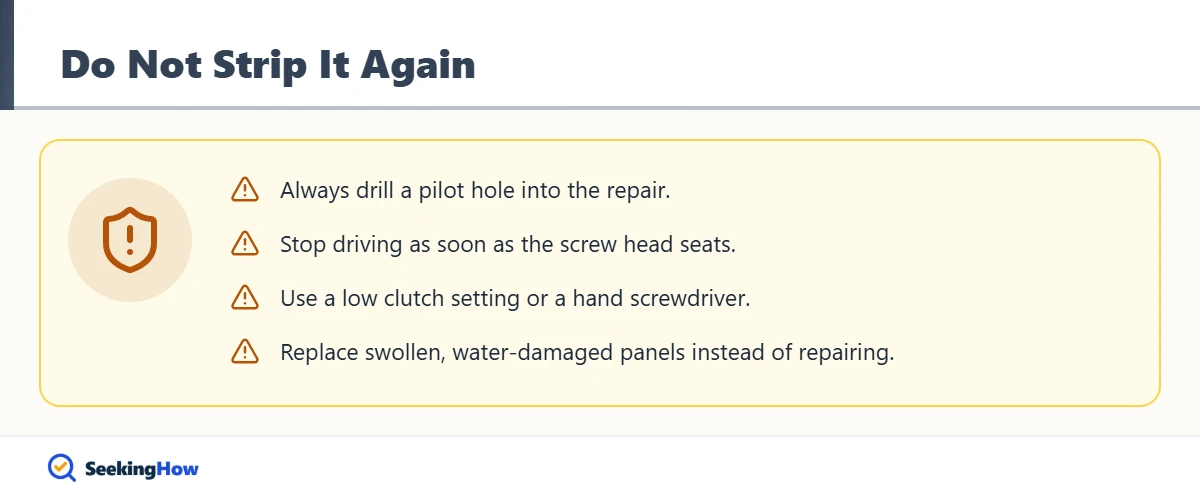
- Drive screws into particle board by hand or with a low clutch setting.
- Use screws made for particle board, with coarse threads.
- Do not reuse the same hole repeatedly; repair it when it first feels loose.
- Keep particle board furniture dry; even small spills weaken the core.
Related Guides
- How to repair particle board water damage
- How to remove a stripped screw from wood
- How to stabilize a wobbly cabinet
- How to fix a wobbly chair
Sources
- USDA Forest Products Laboratory: Wood Handbook, wood-based composite panels and fastener holding
- Composite Panel Association: particleboard and MDF basics
- OSHA: hand and power tool safety
Frequently Asked Questions
Do toothpicks work for stripped holes in particle board?
Toothpicks work poorly in particle board. They can fill the hole, but the crushed particles around them provide little grip, so the screw often strips again under load. A glued hardwood dowel or epoxy putty creates a much stronger base for the threads to bite into.
Can I use a bigger screw in a stripped particle board hole?
Sometimes, but it is a short-term fix. A slightly thicker or longer screw can bite fresh material, yet particle board crumbles easily and the larger screw may split thin panels or break through. Use it only when the hole is barely loose and there is extra depth.
What is the best glue for particle board screw holes?
Standard PVA wood glue is best when you are gluing in a hardwood dowel. For holes where the board has crumbled, two-part epoxy putty or epoxy wood filler works better because it fills gaps and bonds loose particles. Avoid relying on super glue alone.
How long should glue dry before putting a screw back in?
Let wood glue cure for at least 24 hours before driving a screw into a dowel repair. It may feel dry in an hour, but full strength takes longer. Epoxy putty cure times vary by product, so follow the package before drilling.
Can you use wood filler to fix a stripped screw hole?
Regular wood filler is not strong enough for screw threads in particle board. It works for cosmetic holes only. Use two-part epoxy wood filler or epoxy putty, which cures hard enough to hold threads, or a glued dowel for the strongest repair.
What are particle board threaded inserts?
Threaded inserts are metal sleeves with coarse outer threads that screw into a drilled hole in particle board and provide inner machine threads for a bolt. They spread load over a larger area and handle repeated assembly, making them ideal for bed rails, table legs, and desk parts.
How do I fix a stripped hinge screw on a particle board cabinet?
Remove the hinge, drill out the stripped hole, glue in a 1/4-inch hardwood dowel, and let it cure overnight. Then drill a pilot hole and reinstall the hinge screw by hand. Repair all loose hinge screws on that door at the same time.