Quick Answer
To fix a dresser drawer that falls out, add or repair a drawer stop at the back of the drawer, then fix the guide it rides on: reattach a loose center guide, replace worn runners, or re-engage bent metal slides. Most repairs take 20 to 45 minutes with a screwdriver and drill. Empty the drawer first, and anchor the dresser to the wall.
Key Takeaways
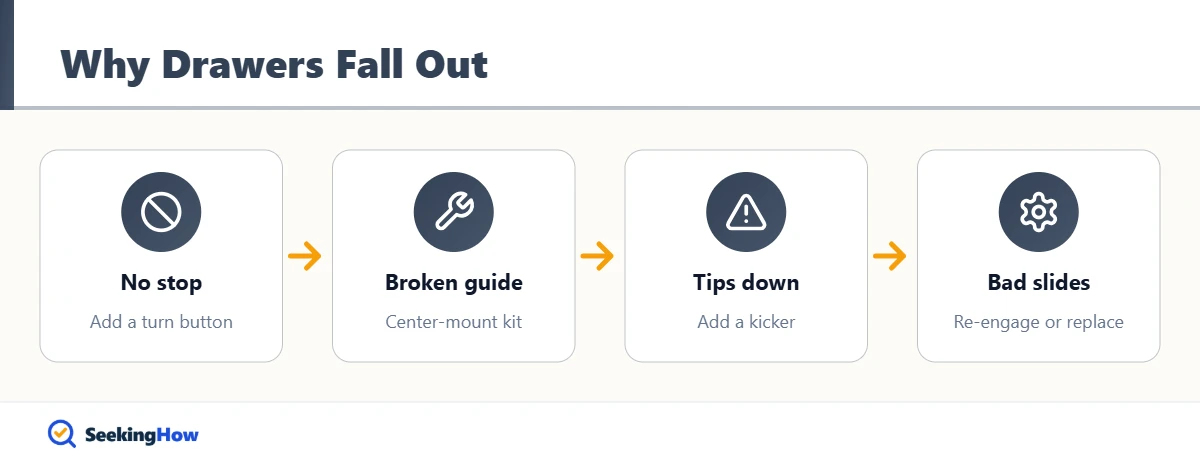
- A dresser drawer falls out when its stop is missing or broken, or when its guide no longer holds it level.
- A small wooden turn button or block screwed to the drawer back is the simplest drawer stop.
- Plastic center-mount guide kits replace broken wooden or plastic center guides in most older dressers.
- Drawers that tip downward when opened need a kicker strip above them to stop the tilt.
- Upgrading to full-extension ball-bearing slides gives built-in stops but needs side clearance.
- Dressers can tip over when drawers are opened; anchoring to the wall is essential in homes with children.
A drawer that drops onto your feet or tilts down the moment it opens is more than annoying; it can also strain the dresser and make tip-over more likely. This guide shows how to fix a dresser drawer that falls out by finding which part failed and installing the right fix, from a free scrap-wood stop to new slides.
What You’ll Need
- Phillips screwdriver and drill/driver with bits
- Scrap hardwood (1/2 x 1 inch strips) for stops and kickers
- #6 or #8 wood screws, 3/4 to 1-1/4 inch
- Wood glue
- Replacement center-mount drawer guide kit (optional)
- Replacement metal slides or ball-bearing slides, matched to drawer length (optional)
- Paraffin wax or a candle stub
- Tape measure, square, and pencil
- Flashlight
How To Fix a Dresser Drawer That Falls Out: Step-by-Step
Step 1: Empty and remove the drawer
Take everything out of the drawer and pull it free. Shine a flashlight into the opening and look at how the drawer is supposed to ride: side runners, a single center guide under the drawer, or metal slides on each side. You cannot fix the right part until you know the system.
Step 2: Find the failure
Check the back of the drawer for a stop (a block, turn button, or plastic tab) and the cabinet for a center rail, side runners, or slides. Look for broken plastic, loose screws, worn grooves, or a detached rail. Most people find that a broken plastic center guide or a missing stop is the culprit in older dressers.
Step 3: Repair or replace the guide
Reattach a loose center rail with glue and screws, keeping it square to the front. Replace a broken plastic center guide with a universal center-mount kit, which usually includes a track and a back bracket. For metal slides, re-engage the drawer member into the cabinet member and tighten every screw; replace any slide that is bent.
Step 4: Add a drawer stop
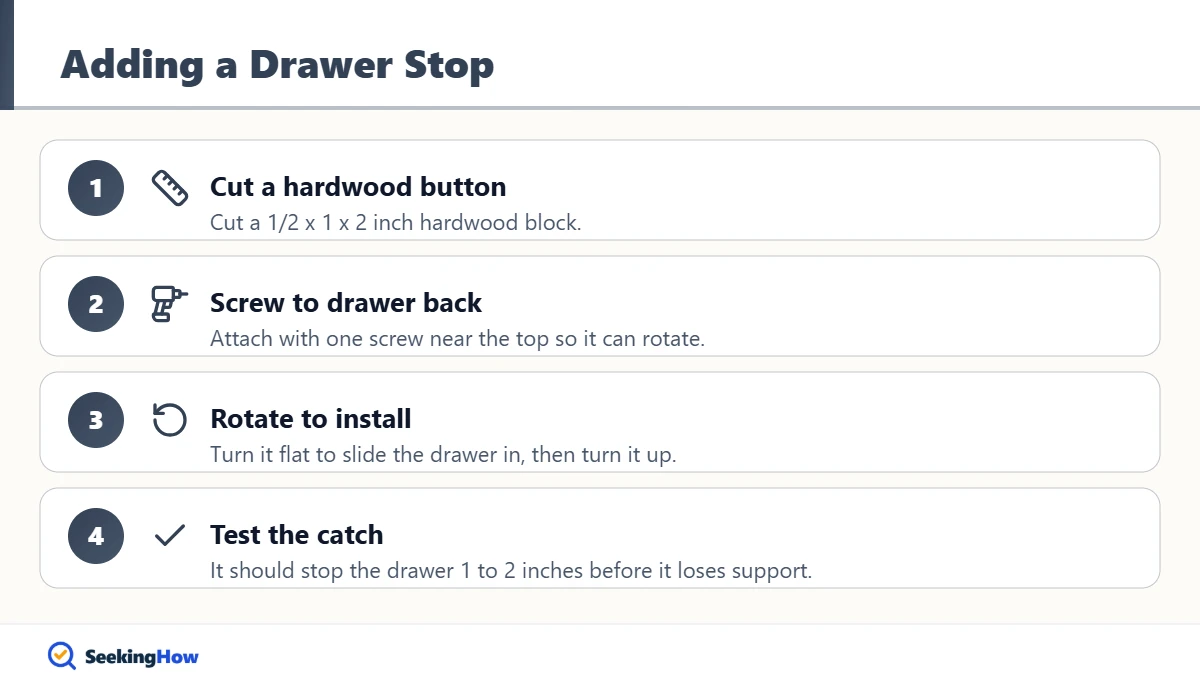
Screw a small hardwood turn button to the inside top of the drawer back so it can be rotated up to pass the face frame during installation and down to catch it during use. Alternatively, screw a block to the cabinet rail behind the drawer front. Test that the stop catches about 1 to 2 inches before the drawer would lose support.
Step 5: Add a kicker if the drawer tips
If the drawer tilts down when pulled out halfway, glue and screw a hardwood strip (a kicker) to the cabinet just above the drawer’s side, leaving about 1/16 inch of clearance. The kicker presses on the drawer side and stops the back from lifting. This is the most overlooked fix and often the real reason drawers drop out.
Step 6: Wax and test
Rub paraffin wax on wooden runners and drawer sides so the drawer slides smoothly without being forced, which can pop it past the stop. Reinstall, load it with a normal amount of clothing, and open it fully several times to confirm it stops and stays level.
Bottom line: Every drawer needs both a working guide and a stop; add a kicker if it tips.
Upgrade: Ball-Bearing Drawer Slides
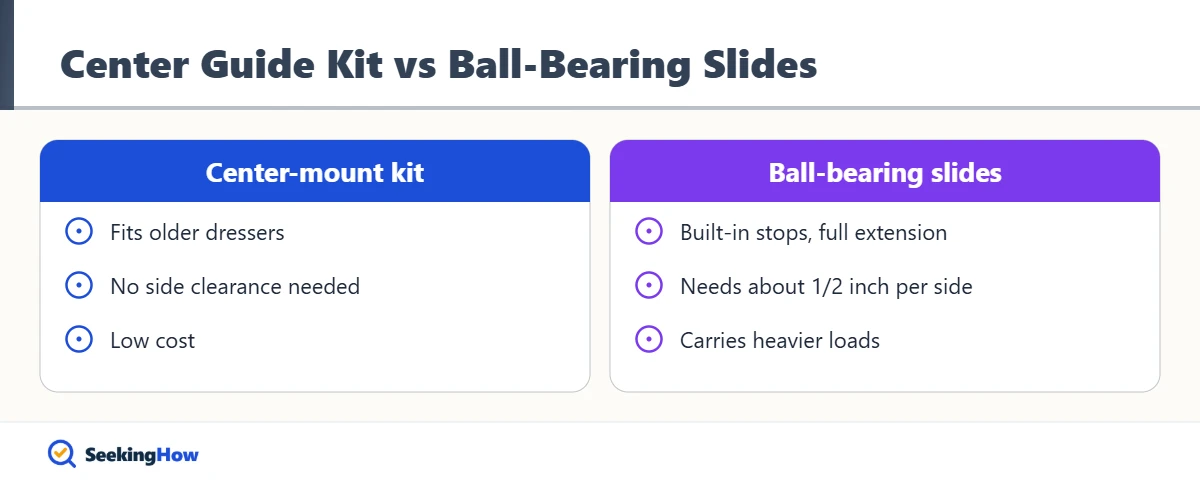
For a drawer that keeps failing, full-extension ball-bearing slides are the permanent fix. They have built-in stops and carry more weight than wooden runners. Most need 1/2 inch of clearance on each side between the drawer box and cabinet, so measure before buying; if the gap is smaller, stick with a center-mount kit. For cabinet boxes that rack or wobble, see how to stabilize a wobbly cabinet.
If That Didn’t Work
Problem: Screws will not hold in the dresser frame. Cause: Stripped particle board. Fix: Glue in a hardwood dowel and redrill, or move the guide slightly to fresh material.
Problem: The drawer box is coming apart. Cause: Failed corner joints or a broken bottom. Fix: Reglue and clamp the corners and reinforce with small corner blocks.
Problem: The drawer jams and then pops out. Cause: Swollen wood or particle board from humidity or spills. Fix: Wax the sides, plane or sand high spots, and repair swelling as described in repairing particle board water damage.
Problem: The new stop breaks. Cause: Drawer slammed open or stop too small. Fix: Use a hardwood stop with two screws and close drawers gently.
| Fix | Time | Cost | Best for |
|---|---|---|---|
| Add wooden stop | 15 minutes | Free to low | Missing or broken stops |
| Reattach center rail | 20 minutes | Free | Loose wooden guide |
| Center-mount guide kit | 30 minutes | Low | Broken plastic guides |
| Add kicker strip | 20 minutes | Free to low | Drawers that tip down |
| Ball-bearing slides | 1 hour per drawer | Moderate | Heavy use, repeated failures |
Safety and When To Call a Pro
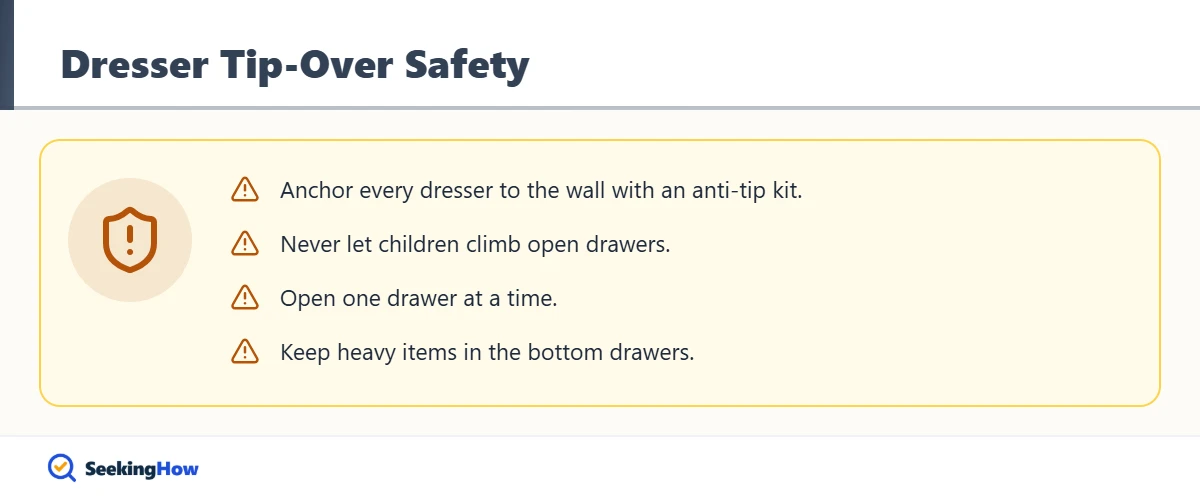
Dressers can tip forward when drawers are pulled out, especially with several open at once, and tip-overs have seriously injured and killed young children. Anchor every dresser to the wall with an anti-tip kit, never let children climb open drawers, and keep the TV off top of the dresser unless it is secured.
Call a furniture repair technician for antique dressers with dovetailed drawers and hand-cut runners, where the wrong screws can reduce value, or if the dresser carcass is cracked or racking badly.
Prevention Tips
- Do not overload drawers; heavy loads wear runners and break stops.
- Wax wooden runners once a year.
- Open and close drawers by the center pull, not one corner.
- Anchor the dresser to the wall before filling it.
Related Guides
- How to stabilize a wobbly cabinet
- How to repair particle board water damage
- How to remove a stripped screw from wood
- How to stabilize a bookshelf without drilling
Sources
- U.S. Consumer Product Safety Commission, Anchor It!: furniture tip-over prevention
- U.S. Consumer Product Safety Commission: clothing storage unit safety
- OSHA: hand and power tool safety
Frequently Asked Questions
Why does my dresser drawer keep falling out?
A dresser drawer keeps falling out because its stop is missing or broken, or because the guide it rides on is loose, worn, or broken. Drawers that tilt down when opened usually lack a kicker above them. Inspect the drawer back and the cabinet interior to find which part failed.
How do I make a drawer stop?
Make a drawer stop by screwing a small hardwood block, called a turn button, to the inside top of the drawer back with one screw. Rotate it flat to insert the drawer, then turn it upright so it catches the face frame when the drawer is pulled out.
What is a drawer kicker?
A drawer kicker is a wooden strip fastened inside the dresser just above a drawer side. When the drawer is pulled out, the kicker keeps the back of the drawer from lifting, so the front does not tip down. It is the standard fix for drawers that droop and fall.
Can I replace a wooden drawer guide with a plastic kit?
Yes, universal center-mount drawer guide kits replace most wooden or broken plastic center guides. They include a track that mounts to the dresser frame and a guide that attaches to the drawer bottom. Measure the drawer depth to choose a kit of the right length.
How much clearance do drawer slides need?
Most side-mount ball-bearing drawer slides need about 1/2 inch of clearance on each side of the drawer box. Check the slide package, since some models differ. If your dresser has less space, use a center-mount guide or undermount slides designed for tighter fits.
How do I fix drawer slides that came off the track?
Pull the drawer fully out, line up the drawer-side rails with the cabinet-side tracks, and push straight in until the slides click together. If they will not engage, look for a bent rail or loose screws, tighten the mounting screws, and replace any bent slide.
Should a dresser be anchored to the wall?
Yes, a dresser should be anchored to the wall, especially in homes with children. Open drawers shift weight forward and can tip the dresser over. The CPSC recommends anti-tip devices, and many new dressers include anchoring hardware in the box.