Quick Answer
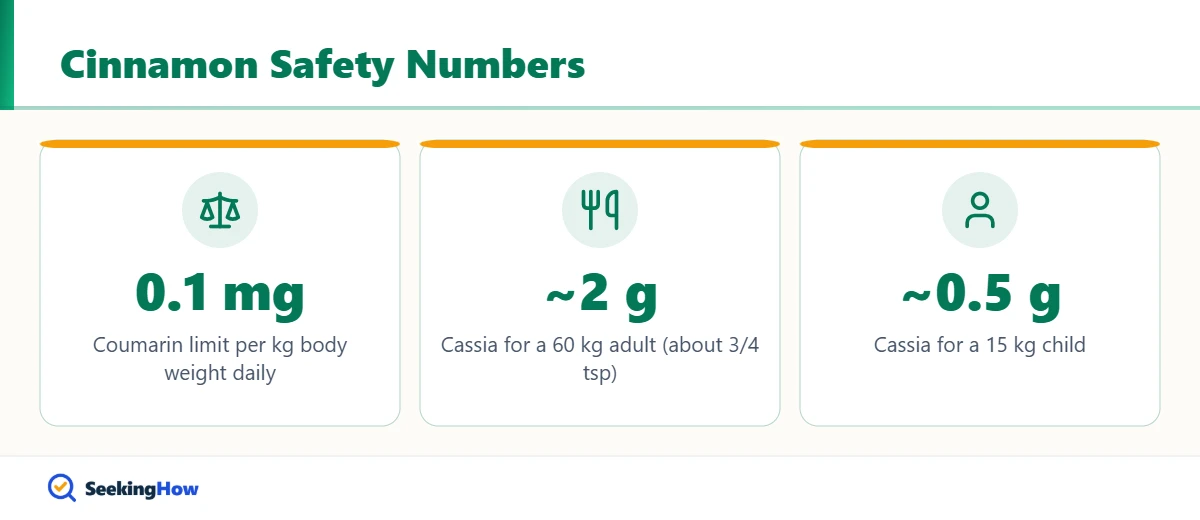
How much cinnamon is safe per day depends on the type. For common cassia cinnamon, a 132-pound (60 kg) adult reaches the European coumarin safety limit at about 2 grams a day, roughly 3/4 teaspoon, and a small child at about 0.5 grams. Ceylon cinnamon contains very little coumarin, so normal food amounts are generally considered safe. Ask a doctor before taking cinnamon supplements.
Key Takeaways
- The main safety concern with cinnamon is coumarin, a natural compound that can harm the liver in sensitive people at high intakes.
- Germany’s Federal Institute for Risk Assessment (BfR) sets a tolerable daily intake of 0.1 mg of coumarin per kg of body weight.
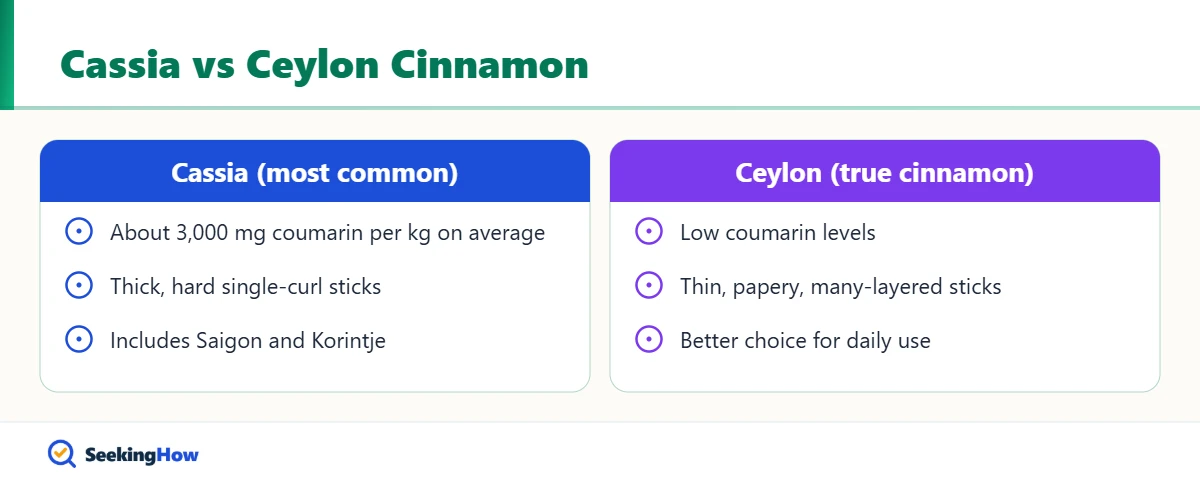
- Cassia cinnamon averages about 3,000 mg of coumarin per kg, with some samples far higher, while Ceylon cinnamon contains only low levels.
- About 2 g of cassia a day, roughly 3/4 teaspoon, can reach the limit for a 60 kg adult; about 0.5 g can for a 15 kg child.
- Most cinnamon sold in U.S. grocery stores is cassia unless the label says Ceylon or “true” cinnamon.
- People with liver disease, those taking diabetes medicines, and pregnant people should talk to a doctor before using cinnamon supplements.
Cinnamon is safe in the small amounts used for cooking, but daily spoonfuls in coffee, oatmeal, or “cinnamon water” add up fast. This guide explains how much cinnamon is safe per day, why the type matters, and how to calculate a sensible limit for your body weight.
What You’ll Need To Check Your Intake
- Your spice label (look for “Ceylon,” “true cinnamon,” “cassia,” “Saigon,” or “Korintje”)
- Measuring spoons (1/4, 1/2, and 1 teaspoon)
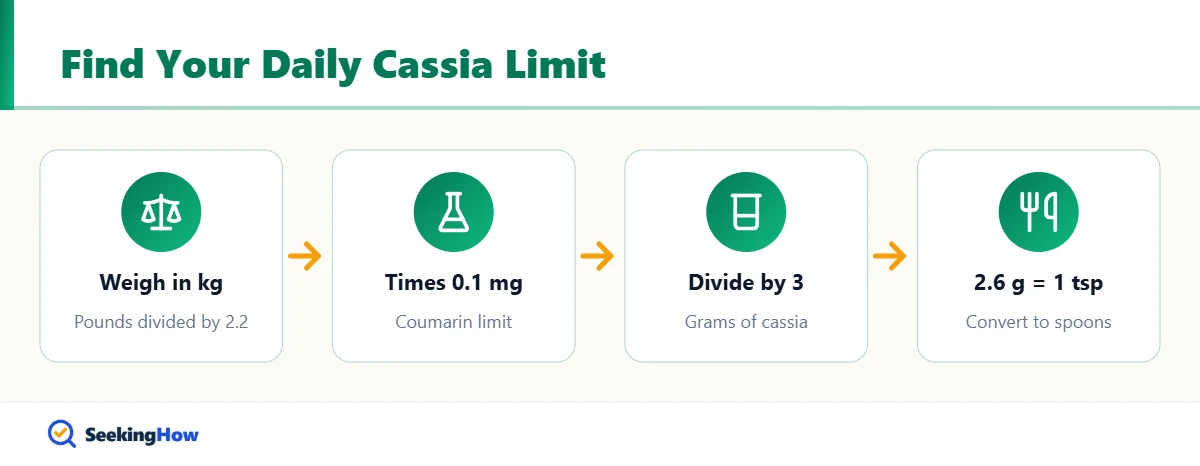
- Your body weight in kilograms (pounds divided by 2.2)
- A list of any supplements and medications you take
Cassia vs Ceylon: Why the Type of Cinnamon Matters
Cassia cinnamon, including Chinese, Saigon (Vietnamese), and Korintje (Indonesian) varieties, is the most common and least expensive type. According to BfR food monitoring data, cassia averages about 3,000 mg of coumarin per kilogram, with peaks up to 10,000 mg per kilogram. Ceylon cinnamon, from Sri Lanka, contains only low levels.
Most people find the label is the only reliable way to tell ground cinnamon apart. Ceylon sticks are thin, papery, and rolled in many layers, while cassia sticks are thick, hard, and usually a single curl.
How Much Cinnamon Is Safe Per Day: Step-by-Step
Step 1: Identify Your Cinnamon Type
Check the jar. If it says only “cinnamon” or “ground cinnamon” with no origin, assume it is cassia. If it says Ceylon or Cinnamomum verum, coumarin is unlikely to be a concern at normal food amounts.
Step 2: Find Your Coumarin Limit
Multiply your weight in kilograms by 0.1 mg. A 60 kg (132 lb) adult gets 6 mg of coumarin a day; an 80 kg (176 lb) adult gets 8 mg. This tolerable daily intake is set to protect even sensitive people over a lifetime.
Step 3: Convert to Teaspoons of Cassia
At an average of 3 mg of coumarin per gram of cassia, divide your limit by 3 to get grams per day. A level teaspoon of ground cinnamon weighs roughly 2.5 to 2.6 grams. That works out to about 3/4 teaspoon for a 60 kg adult and about 1 teaspoon for an 80 kg adult; because some cassia contains much more coumarin, staying around 1/2 teaspoon a day is a safer habit for regular use.
Step 4: Count Every Source
Add cinnamon from coffee drinks, cereal, baked goods, teas, and supplements. Cinnamon supplements often contain more than a gram per dose, and many do not state which type they use. In practice, people who exceed the limit are usually taking cinnamon daily for health reasons, not using it as a seasoning.
Step 5: Adjust for Children
A 15 kg (33 lb) child can reach the coumarin limit with about 0.5 g of cassia, roughly 1/5 teaspoon. Daily cinnamon toast or cinnamon cereal for young children is best made with Ceylon cinnamon or kept occasional.
Bottom line: keep cassia to about 1/2 teaspoon a day as a regular habit, switch to Ceylon if you use cinnamon daily, and check with a doctor before any supplement.
Safe Daily Amounts by Body Weight (Cassia)
| Body weight | Coumarin limit | Cassia at average coumarin | Approximate teaspoons |
|---|---|---|---|
| 15 kg (33 lb) child | 1.5 mg | About 0.5 g | About 1/5 tsp |
| 30 kg (66 lb) child | 3 mg | About 1 g | About 1/3 tsp |
| 60 kg (132 lb) adult | 6 mg | About 2 g | About 3/4 tsp |
| 80 kg (176 lb) adult | 8 mg | About 2.7 g | About 1 tsp |
| 100 kg (220 lb) adult | 10 mg | About 3.3 g | About 1 1/4 tsp |
These are estimates based on average coumarin content; actual levels vary widely between batches, brands, and harvest years.
If That Didn’t Work: Common Questions About Your Intake
Problem: You have been taking a teaspoon or more of cassia every day. Cause: Exceeding the coumarin limit regularly. Fix: Cut back or switch to Ceylon; short periods above the limit are not considered harmful for most healthy adults, but mention it to your doctor if you have liver concerns.
Problem: The label does not say which type. Cause: Generic labeling. Fix: Assume cassia and use the more cautious amounts.
Problem: Mouth sores or irritation after cinnamon gum or candy. Cause: Sensitivity to cinnamaldehyde, a flavor compound. Fix: Stop the product and see a dentist or doctor if sores persist.
Problem: Coughing or choking after trying to swallow a spoonful of dry cinnamon. Cause: Dry powder inhaled into the airway. Fix: Never eat cinnamon dry by the spoonful; seek urgent care for ongoing breathing trouble.
Safety and When To See a Doctor
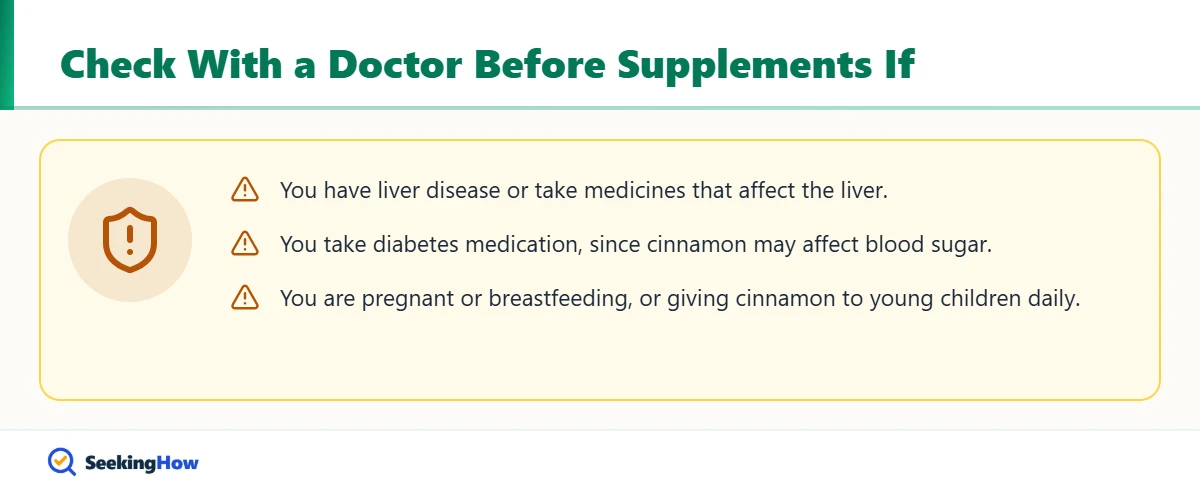
- Talk to a doctor before taking cinnamon supplements if you have liver disease, take diabetes medicines (cinnamon may affect blood sugar), take medications that can affect the liver, or are pregnant or breastfeeding.
- Seek care for signs of liver problems: yellowing skin or eyes, dark urine, pale stools, persistent nausea, or pain under the right ribs.
- Stop and get help for allergic symptoms such as hives, lip or tongue swelling, or wheezing.
- Cinnamon is not a substitute for prescribed diabetes treatment.
Related Guides
- How much rosemary is safe to eat: daily limits and risks
- How to reduce oxidative stress with diet and lifestyle
- How to make buttermilk yogurt to pair with cinnamon
Sources
- German Federal Institute for Risk Assessment (BfR): Frequently asked questions about coumarin in cinnamon and other foods (bfr.bund.de)
- NIH National Center for Complementary and Integrative Health: Cinnamon (nccih.nih.gov)
- European Food Safety Authority: Coumarin in flavourings and other food ingredients (efsa.europa.eu)
Frequently Asked Questions
Is 1 teaspoon of cinnamon a day too much?
One teaspoon of cassia cinnamon a day can exceed the coumarin safety limit for adults weighing under about 80 kg, and it is too much for children. One teaspoon of Ceylon cinnamon is generally considered fine for healthy adults. If you use cinnamon daily, choose Ceylon or keep cassia to about 1/2 teaspoon.
What happens if you eat too much cinnamon?
Eating too much cassia cinnamon over time can expose you to excess coumarin, which may cause liver irritation in sensitive people. Large amounts can also irritate the mouth and, if eaten dry, cause choking or lung irritation. Occasional higher amounts in baking are not considered a health risk for most healthy adults.
Is Ceylon cinnamon safer than cassia?
Yes, Ceylon cinnamon is safer than cassia for regular use because it contains only low levels of coumarin. Cassia averages around 3,000 mg of coumarin per kilogram. Ceylon is usually more expensive and is labeled Ceylon, true cinnamon, or Cinnamomum verum.
Is Saigon cinnamon cassia?
Yes, Saigon or Vietnamese cinnamon is a type of cassia, and it is often among the highest in coumarin. It has a strong, sweet flavor that makes it popular in baking. Use it in small amounts and avoid daily heaping spoonfuls.
Is it safe to take cinnamon supplements every day?
Daily cinnamon supplements are not right for everyone and should be discussed with a doctor first. Many capsules contain more than a gram per dose and do not say whether they use cassia or Ceylon. People with liver disease, those on diabetes medicines, and pregnant people should be especially cautious.
How much cinnamon is safe for kids?
For a 15 kg (33 lb) child, about 0.5 g of cassia cinnamon a day, roughly 1/5 teaspoon, reaches the coumarin limit. Occasional cinnamon treats are fine, but for daily use in oatmeal or toast choose Ceylon cinnamon. Never let children try to swallow spoonfuls of dry cinnamon.
Does cinnamon lower blood sugar?
Some studies suggest cinnamon may modestly affect blood sugar, but the results are mixed and it is not a replacement for diabetes treatment. People taking diabetes medicines should ask a doctor before using cinnamon supplements, because combining them could lower blood sugar more than expected.