Quick Answer
To cast a fly rod in tight spaces, use a roll cast: drag the line slowly back until the rod is just past vertical with a D-shaped loop of line hanging behind you, then snap the rod forward and stop sharply. A roll cast needs no backcast room. Add the side-arm cast for low branches and the bow-and-arrow cast for brushy banks; practice each for 15 minutes on grass first.
Key Takeaways
- The roll cast is the most useful tight-quarters fly cast because the line never goes fully behind you.
- Roll casts need the line on the water; surface tension loads the rod.
- A side-arm cast keeps the line under overhanging branches.
- The bow-and-arrow cast reaches 10 to 20 feet from inside thick brush.
- A shorter, softer rod such as a 7.5 to 8-foot 3 or 4 weight is easier on small brushy streams.
Small creeks and brushy banks hold trout that rarely see flies, because most anglers cannot get a cast through the trees. Knowing how to cast a fly rod in tight spaces turns those spots into your best water. Three casts cover nearly every situation, and the roll cast handles most of them.
What You’ll Need
- Fly rod, ideally 7.5 to 8.5 feet for small streams
- Weight-forward floating line matched to the rod
- Leader, 7.5 feet (shorten to 6 feet for very tight brush)
- A practice yarn fly for lawn sessions
- Polarized sunglasses and a hat for eye protection
- Hemostat or pliers for retrieving flies from branches
How To Cast a Fly Rod in Tight Spaces: Step-by-Step
Step 1: Read the Space Around You
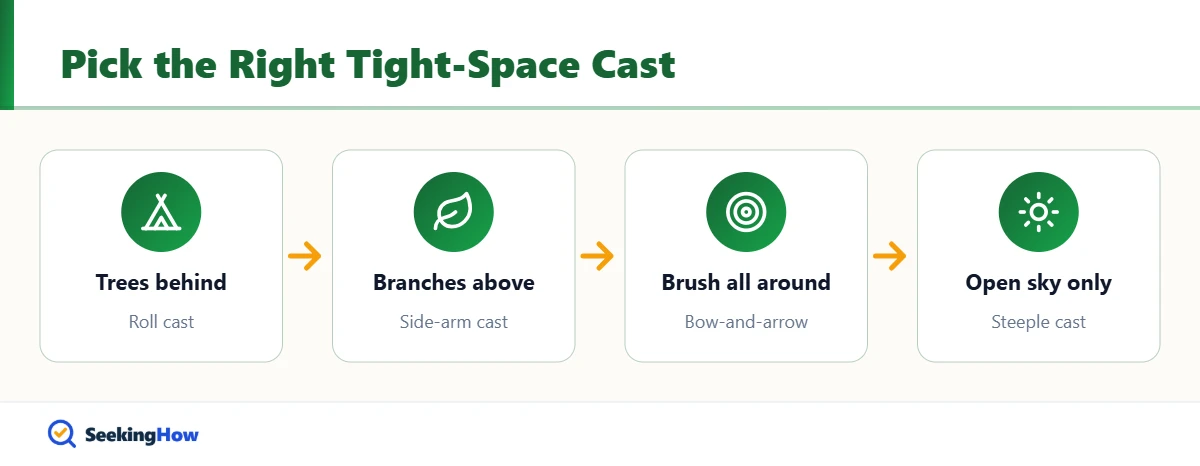
Before casting, look behind, above, and to both sides. If there is no room behind, use a roll cast; low branches overhead call for a side-arm cast; brush on all sides calls for the bow-and-arrow cast. Most people find that one glance saves several lost flies.
Step 2: Roll Cast: Set Up the D-Loop
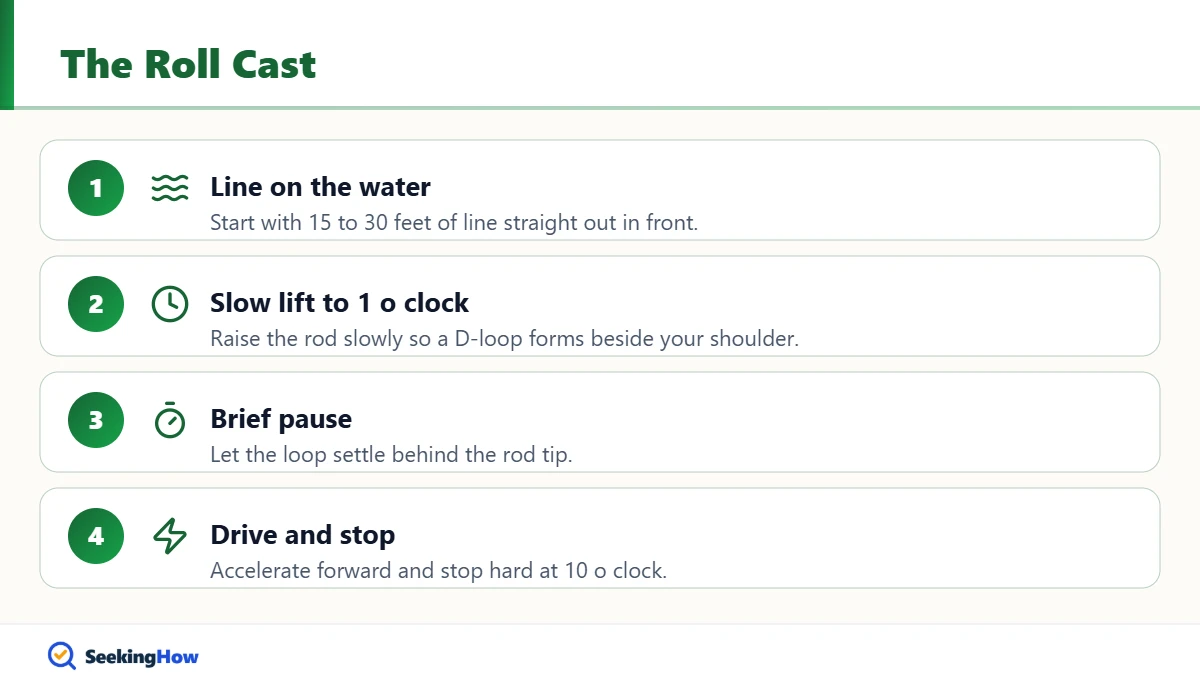
With 15 to 30 feet of line on the water in front of you, raise the rod slowly until the tip is just past vertical, around 1 o’clock, and the line forms a curved D-loop hanging beside and behind your shoulder. Keep the rod tip slightly tilted away from your body. Lifting too fast pulls the line off the water and kills the cast.
Step 3: Roll Cast: Drive Forward and Stop
Pause briefly, then accelerate the rod forward and down to about 10 o’clock and stop hard. The line rolls out along the water in a loop. The most common mistake is a soft stop; the crisp stop is what sends energy into the line.
Step 4: Side-Arm Cast Under Branches
Tilt the rod nearly horizontal and make a normal false cast parallel to the water. Keep the backcast short and tight. This keeps the loop below overhanging limbs and is also accurate for skipping flies under brush.
Step 5: Bow-and-Arrow Cast From the Brush
Hold the fly carefully by the bend of the hook with the point facing away from your fingers, pull back to bend the rod, aim the tip, and release the fly. The rod springs it forward 10 to 20 feet. This works best for short, precise drops into pockets.
Step 6: Practice on Grass
Practice side-arm and bow-and-arrow casts on a lawn with a yarn fly. Roll casts need water, so practice them on a pond or a pool. For a practice routine, see our guide to practicing fly fishing.
Bottom line: Learn the roll cast first, because it solves most tight-space problems; add the side-arm and bow-and-arrow casts as backup.
If That Didn’t Work
Problem: The roll cast piles up in front of you. Cause: No pause or a weak stop. Fix: Let the D-loop form fully and stop the rod firmly at 10 o’clock.
Problem: The line hits the rod or you. Cause: The D-loop is on the same side as the forward stroke. Fix: Tilt the rod slightly outward so the loop hangs off your shoulder.
Problem: The fly snags branches on the side-arm cast. Cause: The backcast is too long. Fix: Shorten line and keep strokes compact.
Problem: The bow-and-arrow fly falls short. Cause: Too little rod bend. Fix: Pull back farther and use a slightly longer leader.
| Cast | Room needed | Typical range | Best for |
|---|---|---|---|
| Roll cast | None behind you | 15 to 40 feet | High banks, trees behind (recommended) |
| Side-arm cast | Some side room | 15 to 40 feet | Low overhanging branches |
| Bow-and-arrow cast | Almost none | 10 to 20 feet | Thick brush, small pockets |
| Steeple cast | Clear space overhead | 15 to 30 feet | Wall of brush behind but open sky |
Safety Tips
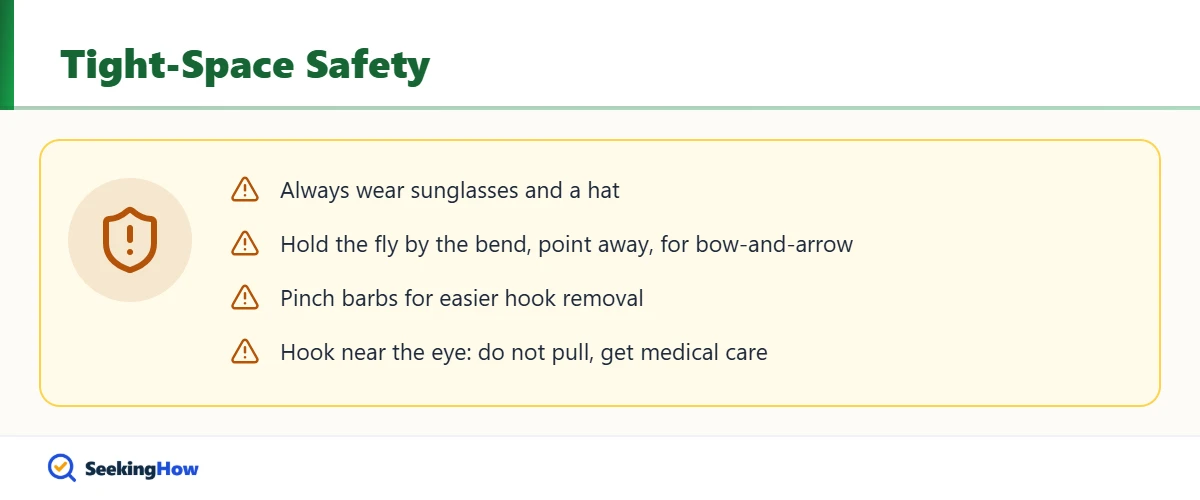
Always wear sunglasses and a hat; a fly moving at casting speed can cause serious eye injury. Keep the hook point away from your fingers on the bow-and-arrow cast, and pinch barbs to make removal easier. If a hook embeds in or near the eye, do not pull it out; cover the eye loosely and get emergency medical care.
Prevention Tips
- Shorten your leader on brushy streams for better control.
- Approach from downstream and stay low to avoid spooking fish at close range.
- Carry spare flies; tight-water fishing loses more of them.
Related Guides
- How to practice fly fishing
- How to fish a wacky rig
- How to hang fishing line from the ceiling
- Does a tent footprint go inside or outside the tent?
Sources
- Take Me Fishing (Recreational Boating and Fishing Foundation): fly fishing basics
- U.S. Fish and Wildlife Service: fishing resources and regulations
- American Academy of Ophthalmology: eye injury prevention
Frequently Asked Questions
What is the best fly cast for tight spaces?
The roll cast. It needs no backcast room because the line stays in front of you on the water, and the D-loop beside your shoulder loads the rod. It handles trees, high banks, and walls behind you, and it is the foundation of Spey and switch casting.
Can you roll cast on grass?
Not well. A roll cast relies on the water surface gripping the line to load the rod. On grass the line slides instead of anchoring. Practice side-arm and bow-and-arrow casts on a lawn and roll casts on a pond or pool.
What length fly rod is best for small brushy streams?
A rod around 7 to 8.5 feet in a 2 to 4 weight is easiest under trees. Shorter rods move through brush more easily and make accurate short casts. Very short rods can make roll casts harder, so many anglers settle near 8 feet.
How far can you roll cast?
Most anglers roll cast comfortably to about 30 to 40 feet with a floating weight-forward line. Skilled casters go farther. In tight brushy streams, most fish are within 20 to 30 feet anyway, so accuracy matters more than distance.
What is a steeple cast?
A steeple cast sends the backcast straight up over your head instead of behind you. It works when there is brush directly behind but open sky above. It is harder to control than a roll cast, so most anglers reserve it for dry flies where they want to avoid disturbing the water.
How do I keep from snagging trees when fly fishing?
Look behind and above before every cast, choose a roll or side-arm cast when space is tight, shorten your line and leader, and keep casting strokes compact. Wading to a spot with an open lane behind you often solves the problem entirely.