Quick Answer
To stop water coming in under a garage door, replace a worn or flattened bottom seal, then add a rubber garage door threshold seal glued to the floor so the door closes against a raised barrier. Check that the door closes fully and that downspouts and the driveway do not send water toward the opening. Seal and threshold together take about 2 hours. Severe runoff needs a trench drain.
Key Takeaways
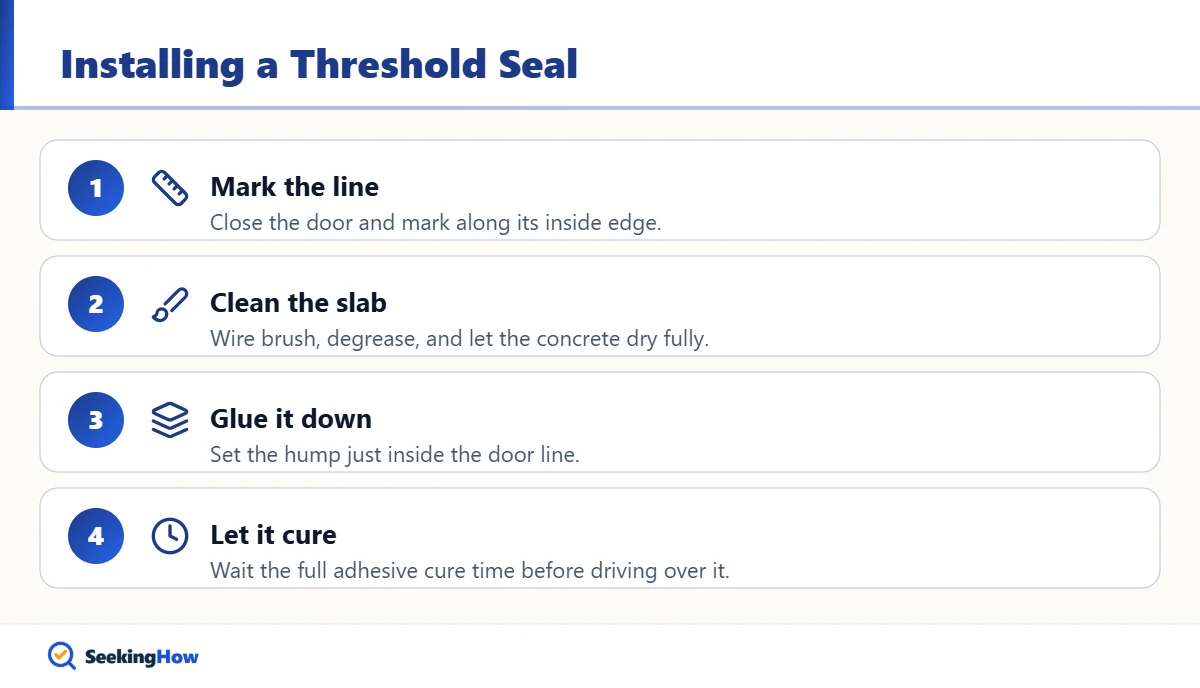
- Most leaks under a garage door come from a worn bottom seal, an uneven slab, or water running toward the door.
- A rubber threshold seal glued to the floor blocks wind-driven rain and shallow runoff.
- The bottom seal and the threshold work best together; neither alone stops heavy runoff.
- A driveway that slopes toward the garage often needs a trench drain or regrading.
- Downspouts that dump near the driveway are a common, easily fixed source of water.
Water seeping under a garage door ruins stored items, stains the slab, and invites mold. If you want to stop water coming in under a garage door, start by figuring out whether it is blowing in, seeping through a worn seal, or flowing down the driveway. Each problem has a different fix, and many garages need two of them.
What You’ll Need
- Replacement bottom seal matched to your door retainer (T-style, bulb, or J-type), measured to door width
- Garage door threshold seal kit with adhesive, usually 1/2 to 3/4 inch tall
- Silicone spray lubricant or dish soap (to slide the seal into the retainer)
- Wire brush, degreaser, and a shop vacuum to prep the floor
- Utility knife, tape measure, and chalk line
- Concrete crack filler or polyurethane sealant (optional)
- Downspout extensions (optional)
- Trench drain kit (optional, for driveways sloping toward the garage)
How To Stop Water Coming In Under a Garage Door: Step-by-Step
Step 1: Find Where the Water Enters
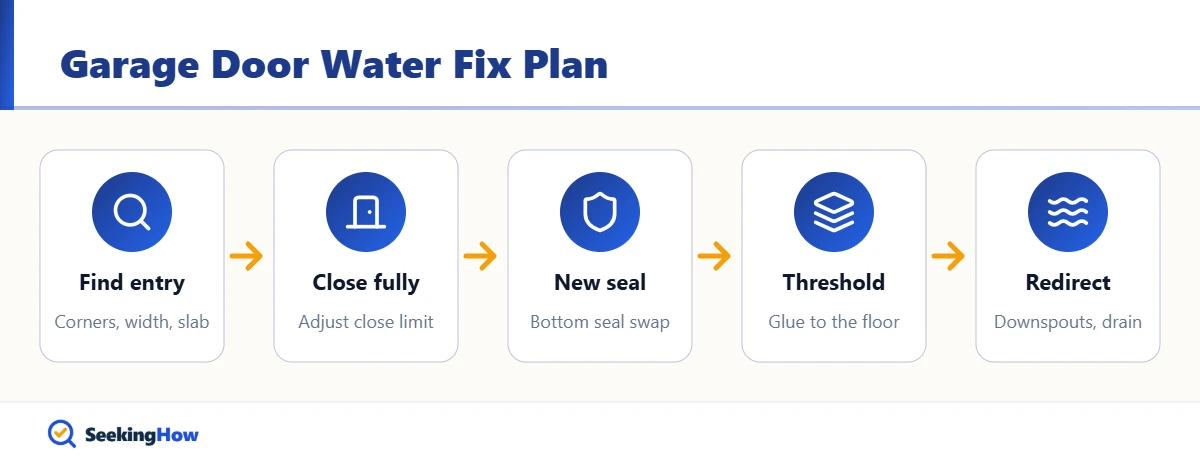
Close the door and run a hose on the driveway, or watch during the next rain. Note whether water enters at the corners, across the whole width, or only at low spots, and whether it flows down the driveway. In practice, most leaks are at the corners or at a dip in the slab.
Step 2: Check That the Door Closes Fully
Close the door and look for daylight along the bottom. If the seal barely touches the floor, the opener close limit may be set too high; adjust it according to the opener manual. Do not overadjust; the door should compress the seal gently, not strain against the floor.
Step 3: Replace the Bottom Seal
Slide the old seal out of the aluminum retainer at the bottom of the door. Spray the new seal and the track with silicone or soapy water, feed it in from one end, and trim it about 1/4 inch longer than the door. A cracked, stiff, or flattened seal cannot conform to an uneven floor.
Step 4: Install a Threshold Seal
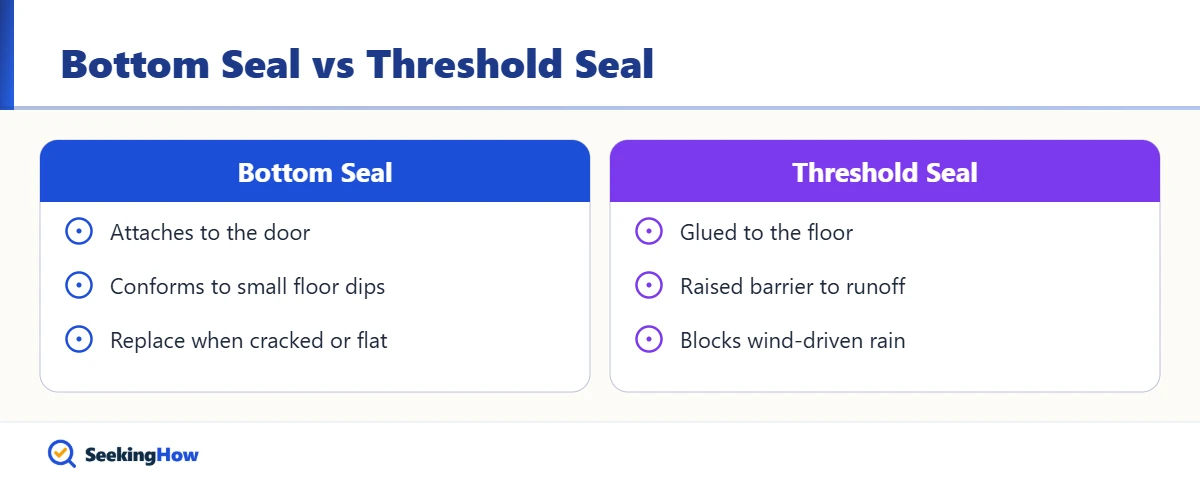
Close the door, mark the floor along the inside edge, then open it. Clean the concrete with a wire brush and degreaser, let it dry completely, and glue the threshold with its hump just inside the door line so the door closes on the outside slope. Let the adhesive cure for the time on the package before driving over it.
Step 5: Seal Cracks and Gaps at the Slab
Fill cracks in the slab near the door and the joint where the driveway meets the garage floor with a concrete crack sealant. Water often enters through that joint even with good door seals. See how to repair foundation cracks for wall cracks that leak too.
Step 6: Redirect Downspouts and Runoff
Extend downspouts at least several feet away from the driveway and the garage opening. If underground downspout lines back up, clear them using our guide on how to unclog an underground gutter drain pipe. Most people find this simple fix cuts the water at the door noticeably.
Step 7: Add a Trench Drain for Sloped Driveways
If the driveway slopes toward the garage, a trench drain across the driveway in front of the door catches runoff before it reaches the seal. It must drain to daylight, a dry well, or a pump, following local rules. This is often a job for a concrete contractor.
Bottom line: replace the bottom seal and add a threshold first; if water still flows down the driveway, a trench drain is the permanent fix.
Fixes Compared
| Fix | Time | Cost | Best for |
|---|---|---|---|
| Adjust close limit | 15 min | Free | Daylight under a closed door |
| New bottom seal | 30 to 60 min | Low | Cracked or flattened seal |
| Threshold seal | 1 hr plus cure time | Low | Wind-driven rain, uneven slab |
| Downspout extensions | 30 min | Low | Roof water near the door |
| Trench drain | 1 to 2 days | Moderate to high | Driveway sloping toward the garage |
If That Didn’t Work
Problem: Water still enters at the corners. Cause: Gaps between the seal ends and the door jambs. Fix: Add corner seals or extend the threshold to the jambs.
Problem: The threshold peels up. Cause: Dusty or damp concrete. Fix: Remove it, grind or brush the floor clean, dry it, and reglue.
Problem: Water rises through the slab, not under the door. Cause: High groundwater. Fix: Consider perimeter drainage; see how to install a sump pump outside.
Problem: The door reverses after adjusting the limit. Cause: Safety reverse sensing the floor too early. Fix: Back off the adjustment and test the reverse feature.
Safety and When To Call a Pro
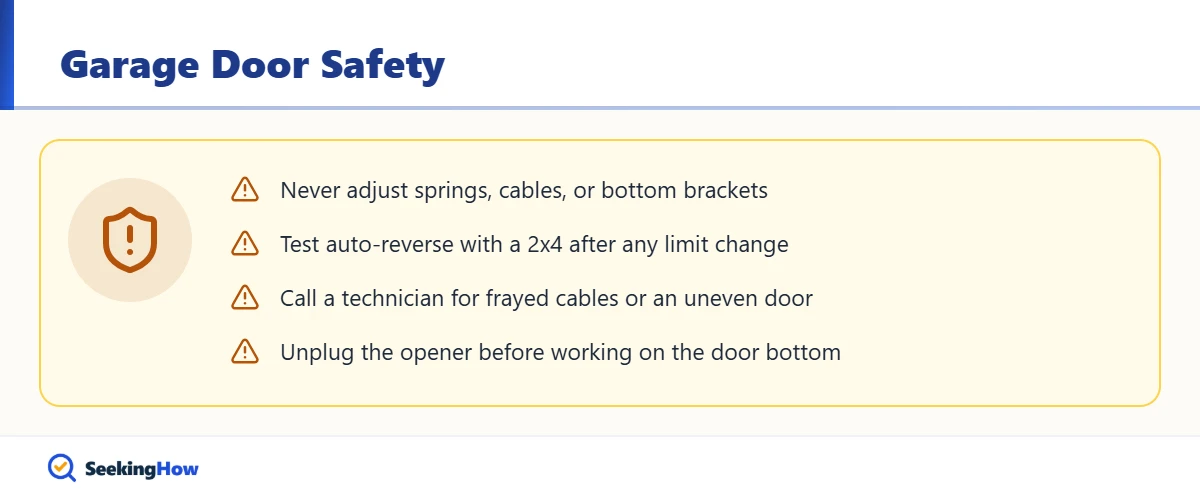
Never adjust or loosen garage door springs, cables, or bottom brackets yourself; they are under high tension and can cause serious injury. After any limit adjustment, test the auto-reverse by placing a 2×4 flat under the door; it must reverse on contact. Call a garage door technician if the door is uneven, the cables are frayed, or the bottom bracket is rusted, and a drainage contractor for driveway regrading.
Prevention Tips
- Inspect the bottom seal every fall and replace it when it cracks or stiffens.
- Keep gutters clean so they do not overflow onto the driveway.
- Sweep debris from the threshold so it seals tightly.
- Keep a few sandbags for extreme storms.
Related Guides
- How To Unclog an Underground Gutter Drain Pipe
- How To Install a Sump Pump Outside
- How To Repair Foundation Cracks in Concrete Walls
Sources
- U.S. Consumer Product Safety Commission, garage door opener safety and auto-reverse testing (cpsc.gov)
- Federal Emergency Management Agency, protecting your home from flooding (fema.gov)
- U.S. Environmental Protection Agency, mold and moisture in homes (epa.gov)
Frequently Asked Questions
Why is water coming in under my garage door?
Water comes in under a garage door when the bottom seal is worn, the slab is uneven, or rain and runoff flow toward the opening. Wind-driven rain can also push past a good seal. Watching during rain or with a hose shows which cause applies.
Do garage door threshold seals work?
Yes, garage door threshold seals work well against wind-driven rain and shallow runoff when glued to clean, dry concrete. They do not stop heavy flows from a driveway that slopes toward the garage, which need a trench drain or regrading.
How do I know which garage door bottom seal to buy?
Slide out a short section of the old seal and match its shape to the retainer type, usually T-style, bulb, or J-type, and the track width. Measure the door width and buy a seal at least that long. Wood doors may use nail-on seals instead.
Can I drive over a garage door threshold?
Yes, garage door thresholds are designed to be driven over once the adhesive has fully cured. Driving on it too soon can shift it. Rubber thresholds about 1/2 to 3/4 inch tall work for most cars and lawn equipment.
How much does it cost to stop water under a garage door?
A new bottom seal and threshold kit usually cost a modest amount and take an afternoon to install, as of 2026. Trench drains or driveway regrading cost much more and vary by region and length. Get quotes if runoff is the main problem.
Will a garage door threshold affect the door safety reverse?
A threshold raises the floor slightly, so test the auto-reverse feature afterward. Place a 2×4 flat on the floor under the door; the door must reverse on contact. Adjust the opener settings according to its manual if it does not.