
Quick Answer
To unclog an underground gutter drain pipe, disconnect the downspout, flush the pipe from the top with a hose to locate the blockage, then feed a 25-50 ft drain auger or a pressure-washer sewer jetter through it. Flush again until water runs freely out the pop-up emitter. Clear the gutters too, and add a downspout filter to prevent repeat clogs.
Key Takeaways
- Most underground downspout clogs are leaves, shingle grit, and silt packed at elbows or at the outlet.
- Try the gentlest fix first: hose flush, then auger, then jetter. Stop before anything that could tear corrugated pipe.
- Work from both ends when possible; the outlet or pop-up emitter is often where debris jams.
- Repeated clogs or a pipe that will not hold water usually mean roots, a crushed section, or a sag that needs digging up.
- Call 811 before you dig, and call a drain pro if the line ties into a storm sewer or runs under a driveway.
Underground gutter drains carry roof water away from your foundation. When one clogs, water backs up the downspout, overflows the gutters, and soaks the soil right where you least want it. This guide shows how to find the clog, clear it with common tools, and keep it from coming back.

How Do You Know an Underground Gutter Drain Is Clogged?
- Water spills over the gutter edge during rain, especially near the downspout.
- The downspout fills with water or gurgles and drains slowly after a storm.
- Water pools or erodes soil around the downspout connection.
- The pop-up emitter at the end of the line never opens, even in heavy rain.
- You notice damp basement walls or new foundation cracks near that downspout.
Persistent wet spots can also point to a leaking line underground. Our guide to spotting an underground water leak covers other warning signs.
What Causes Underground Downspout Pipes To Clog?
Gutters send everything on your roof into the pipe: leaves, pine needles, seed pods, roofing granules, and dirt. Debris settles where water slows down, which happens at 90-degree elbows, low spots, and at the outlet. Tree roots can also invade joints, and corrugated plastic pipe can crush under vehicles or settle into sags that hold silt.
| Cause | Clue | Best fix |
|---|---|---|
| Leaves and debris | Clog near the top or first elbow | Hose flush or drain auger |
| Silt and shingle grit | Slow drainage, muddy flush water | Sewer jetter |
| Blocked outlet or emitter | Pipe full, outlet dry | Clear the emitter, flush back |
| Tree roots | Clogs return quickly; fibrous debris on auger | Root-cutting head on smooth pipe or replace section |
| Crushed or sagging pipe | Auger stops at the same spot; standing water | Excavate and replace |
What Tools Do You Need?
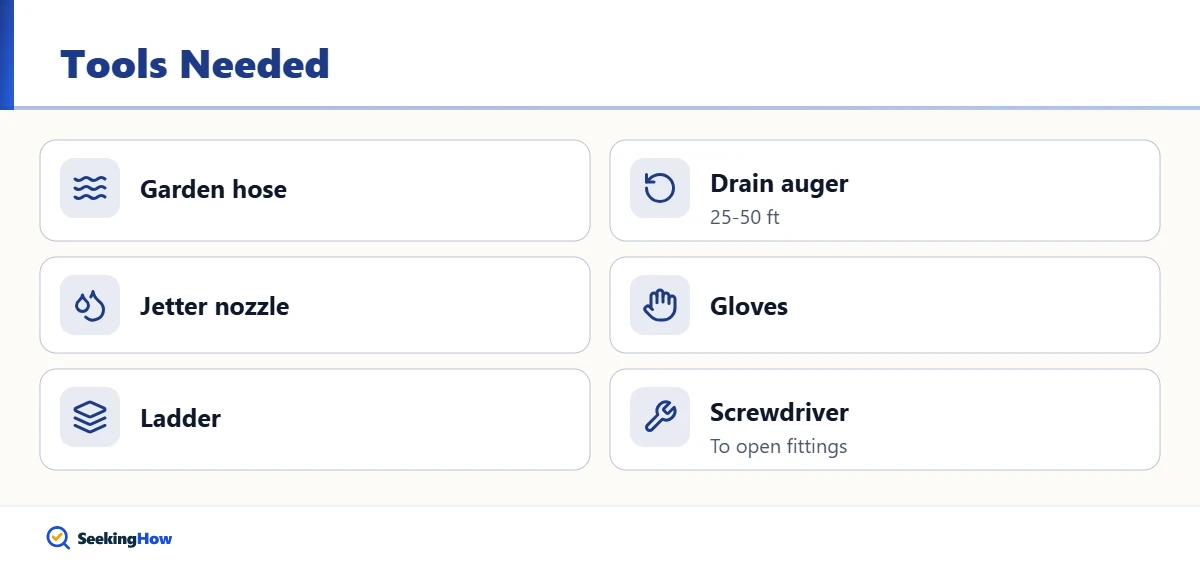
- Garden hose with a jet nozzle
- Drain auger (plumber’s snake), 1/4 to 3/8 inch cable, 25-50 ft long
- Sewer jetter hose for a pressure washer (optional but very effective)
- Wet/dry shop vacuum
- Screwdriver or nut driver to remove the downspout
- Work gloves and safety glasses
- Tape measure or marked cable to estimate clog distance
How To Unclog an Underground Gutter Drain Step by Step
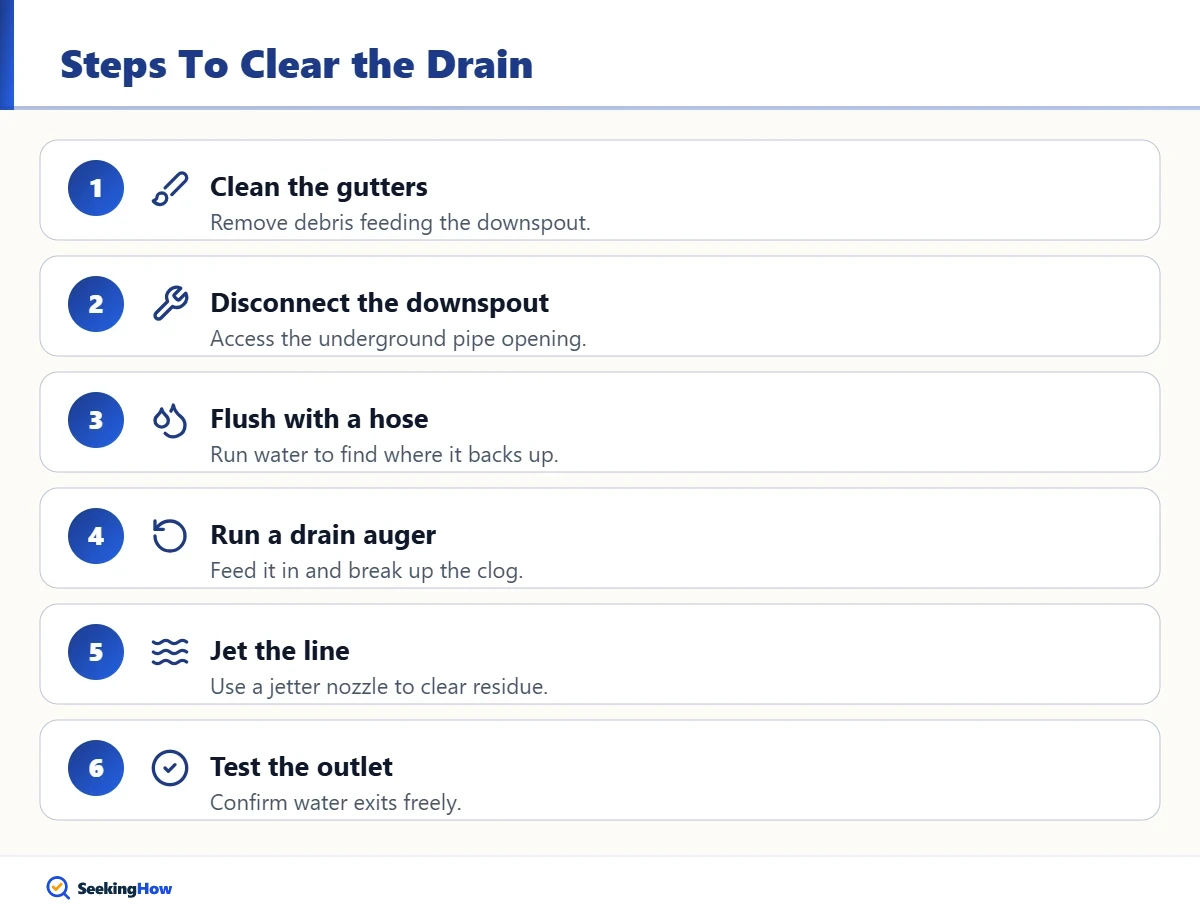
Step 1: Clean the gutters and check the downspout
Clear the gutters first so you are not adding debris to the pipe as you work. Use a sturdy ladder and a scoop, and run water through the gutter to confirm the downspout itself is open. Tap the downspout; a dull sound can mean it is packed.
Step 2: Disconnect the downspout from the underground pipe
Remove the screws at the bottom of the downspout or lift it out of the adapter so you can see the opening of the buried pipe. Pull out any visible debris by hand or with a shop vac.
Step 3: Clear the outlet end
Find where the pipe exits, often a pop-up emitter in the lawn or an open pipe at a slope or curb. Unscrew or lift the emitter cap, remove packed debris, and shop-vac what you can reach. Many clogs live right here.
Step 4: Flush with a hose to find the blockage
Feed a garden hose with a jet nozzle into the pipe and push it forward while running water. Note how far it goes before resistance. If water rises and does not drain, the clog is beyond where the hose stops.
Step 5: Run a drain auger through the clog
Feed the auger cable into the pipe until it reaches the blockage, then crank while pushing gently to break it up. Pull the cable out periodically to remove debris. On corrugated pipe, use a standard spring head, not an aggressive blade cutter, to avoid tearing the pipe.
Step 6: Jet the line clean
For silt and compacted grit, a sewer jetter hose on a pressure washer works best. Its rear-facing jets pull the hose along and scour the pipe walls. Start from the outlet if possible so debris flushes out the open end instead of packing tighter.
Step 7: Test and reconnect
Run a hose at full flow into the top for several minutes. Water should exit freely at the outlet with no backup. Reconnect the downspout securely, reinstall the emitter, and check again during the next rain.
Safety: Wear gloves; drain debris can contain sharp roofing fragments and bacteria. Keep pressure-washer jets away from skin and never pull a running jetter hose out of the pipe toward you. Use ladders on level ground and keep three points of contact.
What If the Pipe Is Still Clogged?
If the auger stops at the same point every time and nothing comes back, you may have a crushed pipe, a collapsed joint, or a root mass. A drain contractor can run an inspection camera to see the problem and mark its location and depth.
Repair usually means digging up and replacing the damaged section. Before you dig anywhere, call 811 (in the U.S.) at least a few business days ahead so utility lines can be marked for free. When replacing pipe, many homeowners upgrade from corrugated to smooth-wall PVC, which resists crushing, holds fewer deposits, and is easier to clean.
Make sure the new section slopes continuously toward the outlet, commonly at least 1/8 inch per foot, with no low spots that collect water. Water that sits against a foundation over time can contribute to cracking; see our guide on repairing foundation cracks in concrete walls if you already see damage.
Common Mistakes To Avoid
- Using harsh drain chemicals: They do little against leaves and silt and can harm soil and plants at the outlet.
- Blasting only from the top: This can pack debris tighter against a blocked outlet.
- Using bladed cutters on corrugated pipe: They can shred thin plastic walls.
- Forgetting the gutters: A clean pipe will clog again quickly under dirty gutters.
- Digging without locates: Gas, electric, and fiber lines are often shallow.
How Do You Prevent Underground Gutter Drain Clogs?
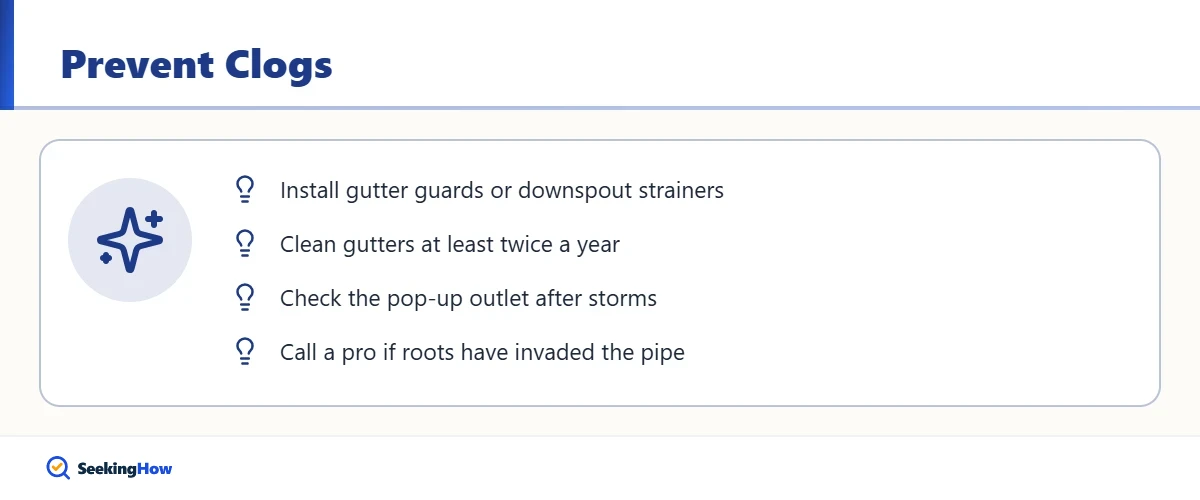
- Install gutter guards: Mesh or screen guards keep most leaves out of the system.
- Add a downspout filter or leaf catcher: A filter box above the ground connection traps debris where you can empty it.
- Clean gutters at least twice a year: Late spring and late fall are typical; more often under heavy tree cover.
- Flush the line yearly: A quick hose flush in fall finds slow clogs before winter.
- Keep the outlet clear: Trim grass around pop-up emitters and do not mulch over them.
- Use a cleanout: Adding a cleanout tee near the downspout makes future auger or jetter access easy.
If you have an auger already, the same tool basics apply indoors; see our guide on using a drain snake on a toilet.
When Should You Call a Professional?
Call a drain or gutter professional if the line runs under a driveway or patio, connects to a municipal storm sewer, is longer than your auger, or keeps clogging after cleaning. Pros have camera equipment and powered jetters that can diagnose and clear long runs quickly, and they can tell you whether replacement is the better value.
Frequently Asked Questions
Can I use a pressure washer to unclog an underground gutter drain?
Yes, with a sewer jetter hose attachment designed for drains. Its rear-facing jets pull the hose through the pipe and scour silt from the walls. Do not just point a standard wand into the pipe, and start from the outlet when possible so debris flushes out the open end.
How do I find where my underground downspout drain ends?
Look downhill from the downspout for a pop-up emitter, an open pipe at a slope, ditch or curb, or a connection to a storm drain. Running water into the pipe and watching where it exits is the easiest way. A drain pro can also trace it with a camera locator.
Will drain cleaner unclog a gutter drain pipe?
Chemical drain cleaners are designed for grease and hair, not leaves, silt and roofing grit, so they rarely clear gutter drains. They can also harm soil and plants at the outlet. Mechanical methods like a hose, auger or jetter work far better.
How much does it cost to have an underground gutter drain cleaned?
Costs vary widely by region, pipe length and access. Simple flushing or augering is usually a modest service call, while camera inspection, hydro-jetting or excavation and pipe replacement cost considerably more. Get a written quote that specifies the method and length cleaned.
Should underground gutter drains be corrugated or PVC?
Smooth-wall PVC is generally preferred because it resists crushing, keeps a consistent slope, holds fewer deposits and is easier to clean with an auger or jetter. Corrugated pipe is cheaper and flexible but clogs and crushes more easily.