
Quick Answer
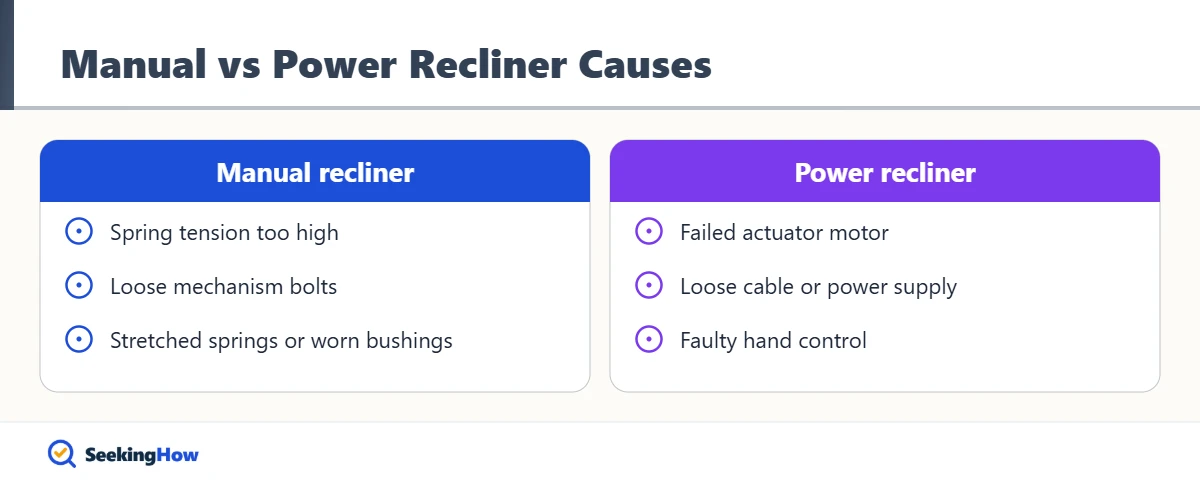
To fix a recliner that won’t stay reclined, tip the recliner forward, tighten every bolt on the reclining mechanism, and reduce the spring tension by moving the tension springs to a looser hole or backing off the tension nuts. Lubricate the pivots with white lithium grease. Most fixes take 30 to 60 minutes; unplug power recliners first and watch for pinch points.
Key Takeaways
- A manual recliner that springs back upright usually has spring tension set too high for the user’s weight.
- Loose mechanism bolts let the linkage slip out of its locked reclined position.
- Stretched or broken springs cause the footrest to droop or the back to creep forward.
- Power recliners that drift usually have an actuator, power supply, or hand-control problem.
- White lithium grease on pivot points reduces binding that prevents the mechanism from locking.
- A bent mechanism arm cannot be adjusted back and needs replacing.
A recliner that slowly pushes you back upright, or whose footrest will not stay out, is almost always a mechanism problem you can see and fix. This guide explains how to fix a recliner that won’t stay reclined, starting with the quick adjustments and moving to parts replacement, for both manual and power models.
What You’ll Need
- Socket set (7/16 and 1/2 inch are common on recliner mechanisms) and adjustable wrench
- Phillips screwdriver and pliers
- Spring puller tool or a loop of strong cord (for moving tension springs)
- White lithium grease (spray or tube)
- Flashlight
- Thread-locking compound, medium strength (optional)
- Replacement tension springs or mechanism matched to your model (if needed)
- Work gloves and safety glasses
- Old blanket to protect the chair and floor
How To Fix a Recliner That Won’t Stay Reclined: Step-by-Step
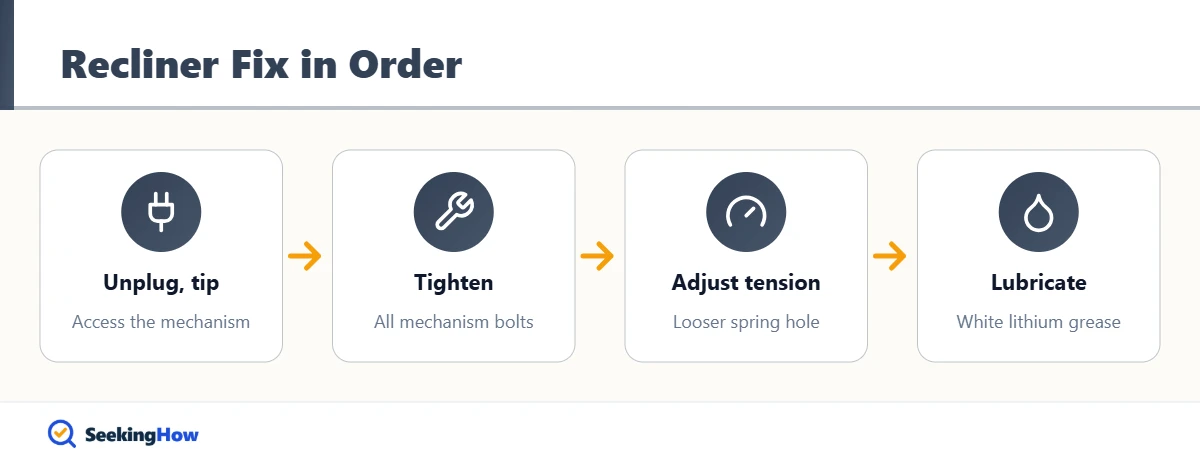
Step 1: Unplug and tip the chair over
Unplug power recliners and disconnect any battery pack. With a helper, tip the recliner forward onto a blanket so the underside faces you, or lay it on its back, depending on how your model opens. Keep hands out of the mechanism while moving the chair, since the linkage can snap shut.
Step 2: Inspect the mechanism
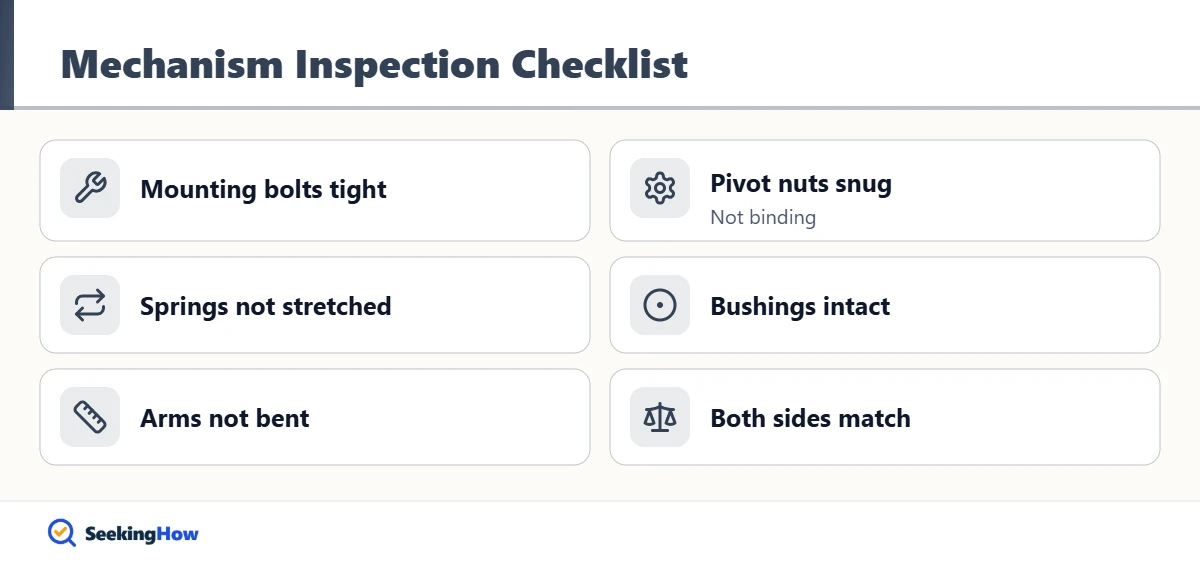
Use a flashlight to check both sides of the mechanism for loose or missing bolts, worn plastic bushings, stretched springs, and bent arms. Compare the left and right sides; they should look identical. A mismatch usually points straight to the problem part.
Step 3: Tighten all mechanism bolts
Snug every nut and bolt on the mechanism and where it attaches to the wooden frame. Loose mounting bolts let the whole mechanism shift so it never reaches its locked-open position. Do not crank pivot nuts so tight that the arms bind; they need to move freely. A drop of medium thread locker helps nuts that keep backing off.
Step 4: Adjust spring tension
Many manual recliners have tension springs hooked into a row of holes, or tension bolts with nuts. If the chair pushes you upright, move each spring to a hole that gives less stretch, or back off the tension nuts a few turns, adjusting both sides equally. In practice, most people find a lighter user needs less tension than the factory setting.
Step 5: Lubricate the pivots
Spray or dab white lithium grease on every pivot point, rivet, and sliding surface, then cycle the mechanism by hand several times. Dry, binding joints can stop the linkage from passing its over-center lock point. Wipe off excess so it does not reach the upholstery.
Step 6: Test and replace worn parts
Set the chair upright and test it while seated. If it still will not stay reclined, replace stretched springs with exact matches from the manufacturer or a recliner parts supplier, measured by length, coil diameter, and hook style. If an arm is bent, replace the whole mechanism side; bent steel will not hold its geometry.
Bottom line: Tighten first, then lower spring tension; replace springs or the mechanism only if those two steps fail.
Power Recliner That Won’t Stay Reclined
Power recliners hold position with an electric actuator, not springs. If the chair drifts or moves on its own, check that the power supply light is on, inspect the cable connections under the chair, and try the hand control or a known-good spare. An actuator whose motor runs but does not hold usually needs replacing; many manufacturers sell actuators by model number, and some cover them under a separate parts warranty.
If That Didn’t Work
Problem: The footrest droops when extended. Cause: Stretched footrest spring or worn bushings. Fix: Replace the spring and any cracked plastic bushings on both sides.
Problem: One side reclines farther than the other. Cause: Loose bolt or bent arm on one side. Fix: Tighten the loose side; replace the bent side of the mechanism.
Problem: The back creeps forward slowly. Cause: Too much tension or a worn lock point. Fix: Reduce tension; if that fails, replace the mechanism.
Problem: The handle feels loose and the chair will not lock. Cause: Stretched release cable or loose handle set screw. Fix: Tighten the handle screw (often an Allen screw; see removing a stripped Allen screw if it is damaged) or replace the cable.
Problem: The whole chair rocks or wobbles. Cause: Loose frame joints. Fix: Glue and reinforce joints, as in how to fix a wobbly chair.
| Fix | Time | Cost | Solves |
|---|---|---|---|
| Tighten bolts | 15 minutes | Free | Slipping linkage |
| Adjust tension | 20 minutes | Free | Chair pushes you upright |
| Lubricate pivots | 10 minutes | Low | Binding, incomplete lock |
| Replace springs | 30 to 60 minutes | Low to moderate | Drooping footrest, weak hold |
| Replace mechanism or actuator | 1 to 2 hours | Moderate to high | Bent arms, failed motor |
Safety and When To Call a Pro
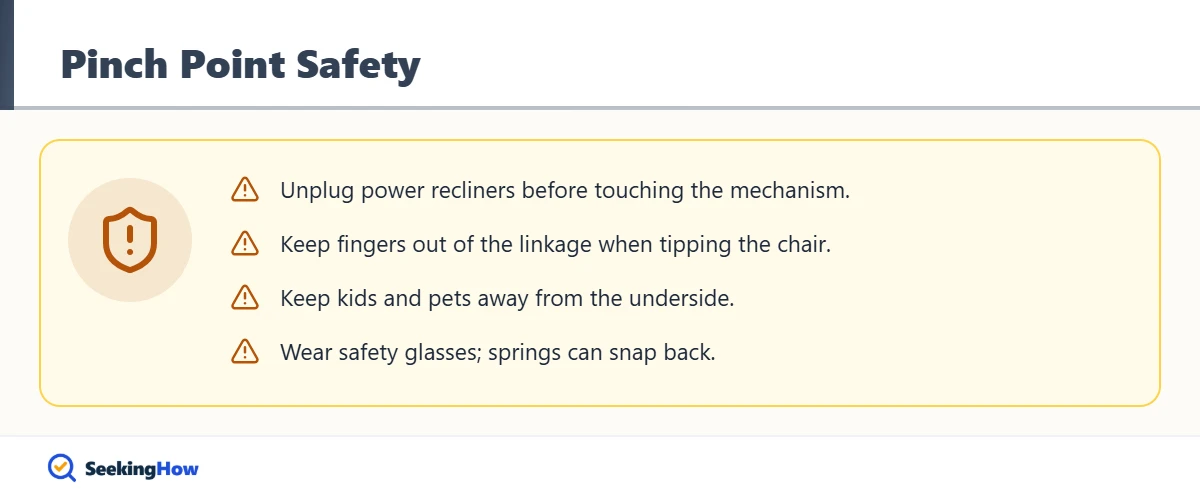
Recliner mechanisms have strong scissor-like pinch points. Keep fingers clear when the chair is tipped over, never work under a power recliner while it is plugged in, and keep children and pets away, since the CPSC has warned about entrapment hazards under reclining furniture. Springs under tension can snap back, so wear safety glasses.
Contact the manufacturer or a furniture repair technician if the chair is under warranty (opening the mechanism yourself may affect coverage), if a power recliner has burning smells or exposed wiring, or if the frame wood around the mechanism mounts is cracked.
Prevention Tips
- Lubricate the mechanism pivots once a year.
- Check and snug mechanism bolts every 6 to 12 months.
- Do not sit or stand on the extended footrest.
- Close the footrest fully before getting up.
Related Guides
- How to fix a wobbly chair
- How to remove a stripped Allen screw
- How to stop couch cushions from sliding
Sources
- U.S. Consumer Product Safety Commission: recliner and furniture entrapment safety
- La-Z-Boy: manufacturer care and warranty information for recliners
Frequently Asked Questions
Why does my recliner keep pushing me forward?
A recliner pushes you forward when its spring tension is too high for your weight or when mechanism bolts are loose. Lowering tension by moving springs to a looser hole or backing off tension nuts usually fixes it. Worn lock points on older mechanisms can also cause it.
How do you adjust the tension on a recliner?
Tip the chair to reach the mechanism and find the tension springs or tension bolts on each side. Move springs to a different hole or turn the nuts to loosen or tighten, adjusting both sides equally. Not every recliner is adjustable; check your manufacturer instructions.
Why won’t my recliner footrest stay up?
A recliner footrest usually will not stay up because a footrest spring is stretched or broken, or because worn bushings let the linkage slip. Inspect both sides with the chair tipped over, replace damaged springs with exact matches, and lubricate the pivots.
Can you replace a recliner mechanism yourself?
Yes, many recliner mechanisms can be replaced at home with basic tools. Order the exact mechanism by brand and model number, photograph the old one before removal, and transfer springs and the handle cable in the same positions. Expect one to two hours with a helper.
What lubricant is best for a recliner mechanism?
White lithium grease is the best general lubricant for recliner mechanisms. It clings to metal pivots and does not drip onto upholstery as easily as thin oils. Avoid heavy wheel-bearing grease, which attracts dust, and wipe away any excess after cycling the chair.
Why does my power recliner slowly go back down?
A power recliner that slowly lowers usually has a worn actuator that no longer holds position, or a loose connection interrupting power. Check the power supply light and all cable plugs first. If connections are fine, the actuator likely needs replacing.
Is a recliner worth fixing or should I replace it?
A recliner is usually worth fixing if the frame is solid and the problem is bolts, tension, springs, or a single mechanism side. Replacement parts are often far cheaper than a new chair. If the frame is cracked or upholstery is worn out too, replacing the chair may make more sense.