Quick Answer
To vacuum an above-ground pool without a skimmer, use a cordless battery-powered pool vacuum, which collects debris in its own filter bag and needs no hose to the pump. Alternatives are a garden-hose venturi vacuum, connecting the vac hose directly to the filter pump intake, or siphoning debris to waste. Expect 20 to 45 minutes; vacuum slowly so silt does not cloud the water.
Key Takeaways
- Cordless pool vacuums are the simplest choice for skimmerless pools because they need no suction from the filter.
- Garden-hose venturi vacuums push dirt into a mesh bag; fine silt can pass through.
- A vac hose must be completely filled with water before it connects to a pump intake, or the pump loses prime.
- Vacuuming to waste with a siphon removes fine dirt but also lowers the water level.
- Slow, overlapping strokes keep sediment from swirling back into the water.
Many soft-sided and frame pools from Intex, Bestway, and Coleman come without a wall skimmer, so standard vacuum heads have nowhere to plug in. You can still vacuum an above-ground pool without a skimmer using one of four methods. The right one depends on how much debris you have and what equipment came with the pool.
What You’ll Need
- Cordless rechargeable pool vacuum with a fine filter bag (recommended)
- Or a garden-hose venturi vacuum head with debris bag
- Or a manual vacuum head, vac hose sized to your pump fittings, and any needed hose adapter
- Telescoping pole
- Garden hose for siphoning to waste (optional)
- Pool brush
How To Vacuum an Above-Ground Pool Without a Skimmer: Step-by-Step
Step 1: Let the Debris Settle and Brush Walls
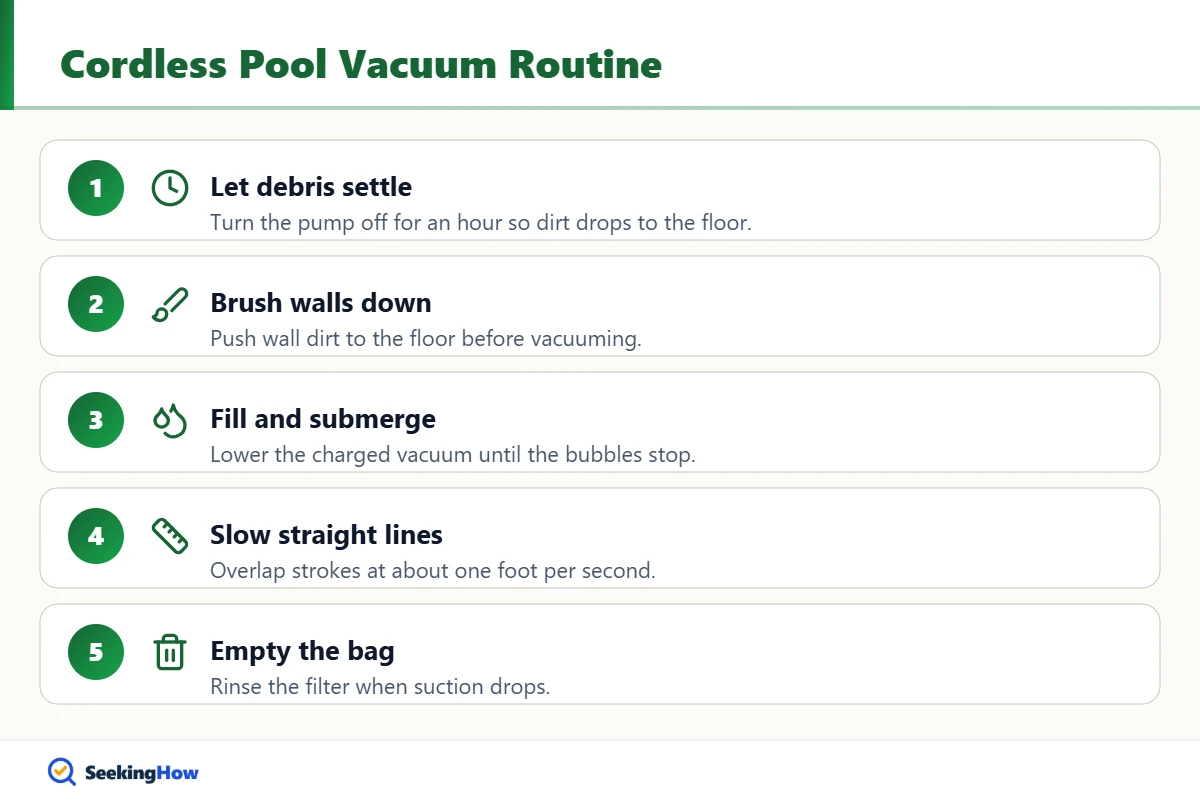
Turn off the filter pump and let the water sit for an hour or more so debris drops to the floor. Brush the walls downward first. Vacuuming while particles are still floating only chases them around.
Step 2: Choose the Method
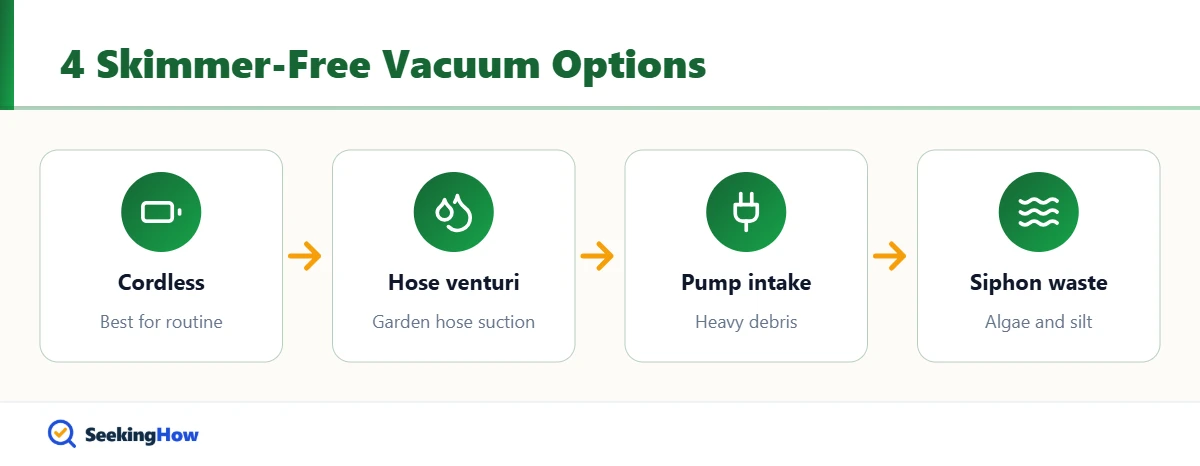
Use a cordless vacuum for routine cleaning, a venturi vacuum if you only have a garden hose, the pump-intake method for heavy leaves with a sand or larger cartridge filter, and siphon-to-waste for algae or fine silt. Most people find a cordless unit saves the most time on small pools.
Step 3: Vacuum With a Cordless Unit
Charge it fully, attach the pole, and lower it in until it fills and the air bubbles stop. Work in slow, overlapping straight lines from the shallow side toward the center. Empty and rinse the filter bag when suction drops, usually once or twice per session.
Step 4: Or Use a Garden-Hose Venturi Vacuum
Connect the head to a garden hose, attach the debris bag, and turn the water on full. The water jet creates suction that lifts dirt into the bag. Expect the pool level to rise a bit, and check the bag often since fine dust can slip through.
Step 5: Or Connect the Vac Hose to the Pump Intake
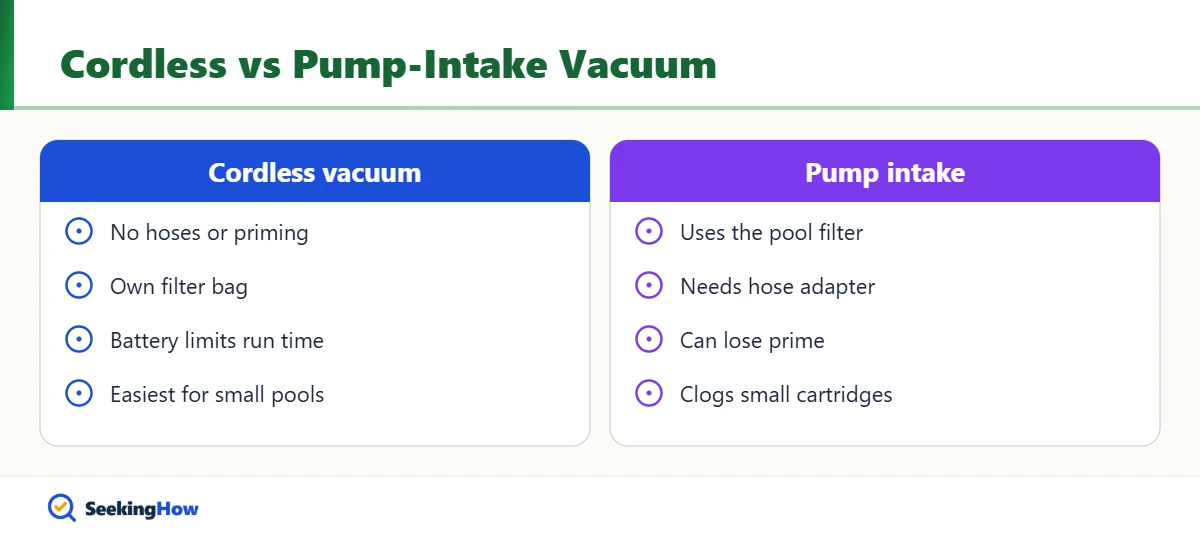
Turn the pump off, close or plug the pool-side inlet, and attach the vac hose to the pump intake connection with the correct adapter. Fill the vac hose by holding it against the return jet or submerging it until no bubbles appear, then connect the vacuum head and restart the pump. Clean the cartridge right after, since it clogs quickly.
Step 6: Or Siphon Debris to Waste
For green-pool sludge, attach a vacuum head to a garden hose, fill the hose with water, and run the open end downhill like a siphon. Dirty water goes out to the lawn instead of through the filter. Top the pool back up afterward; see our guide to lowering pool water without a pump for siphon tips.
Bottom line: Buy a cordless pool vacuum for routine cleaning and save siphon-to-waste for algae or heavy silt.
If That Didn’t Work
Problem: The water clouds while vacuuming. Cause: Moving too fast. Fix: Slow down to about one foot per second and let the water settle again.
Problem: The pump loses prime. Cause: Air in the vac hose. Fix: Fully refill the hose before connecting and keep the head underwater.
Problem: Fine dirt passes through the bag. Cause: Coarse mesh. Fix: Use a fine-mesh bag or vacuum to waste.
Problem: The cordless vacuum stops early. Cause: A full filter or low battery. Fix: Empty the bag and recharge; do not charge while wet.
| Method | Time | Cost | Best for |
|---|---|---|---|
| Cordless vacuum | 20 to 30 min | Moderate | Routine cleaning (recommended) |
| Garden-hose venturi | 30 to 45 min | Low | Leaves, sand, budget setups |
| Pump intake hookup | 30 min | Low | Heavy debris with a capable filter |
| Siphon to waste | 30 to 60 min | Free | Algae, fine silt |
Safety and When To Call a Pro
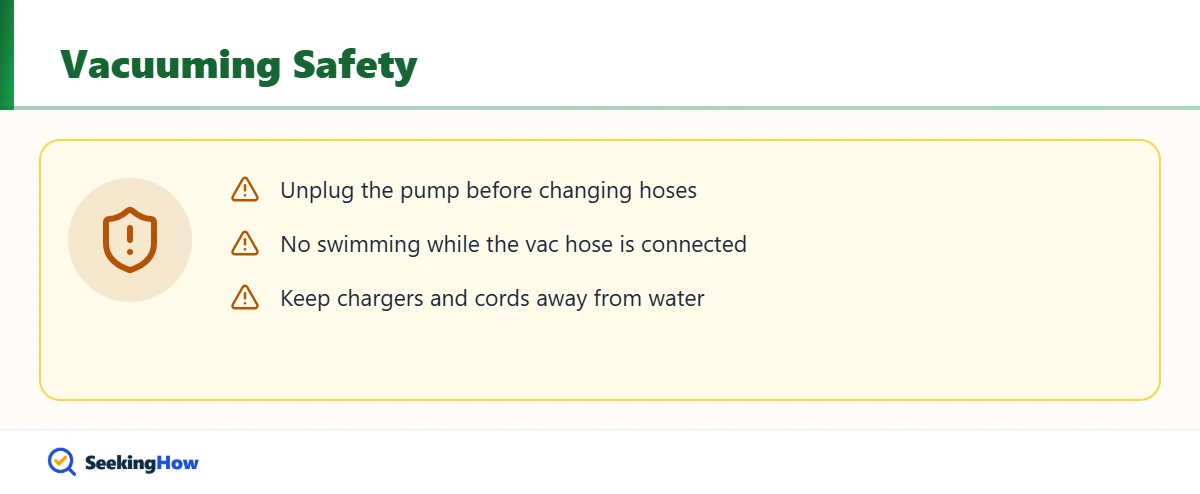
Unplug the filter pump before changing hose connections, and keep extension cords and chargers away from the water. Never swim while a vac hose is connected to the pump intake; suction fittings can trap hair or limbs.
Call a pool professional if you have a green pool with a black or slimy floor that keeps returning, a pump that will not hold prime even with tight connections, or visible liner damage under the debris. Check the floor for holes while you vacuum, and use our guide to finding a leak in an above-ground pool liner if the level drops.
Prevention Tips
- Cover the pool when not in use to block leaves and dust.
- Keep a foot-rinse tub by the ladder to keep sand out.
- Use a leaf net daily before debris sinks.
- Run the filter for enough hours each day to turn the water over.
Related Guides
- How to drain a pool using the pool pump
- How to lower pool water without a pump
- How to find a leak in an above-ground pool liner
- How to fix a pool light
Sources
- CDC Healthy Swimming: keeping pool water clean and safe
- U.S. Consumer Product Safety Commission: pool drain and suction entrapment safety
- Intex: above-ground pool maintenance products and manuals
Frequently Asked Questions
Can you vacuum an Intex pool without a skimmer?
Yes. Most small Intex pools have no skimmer, so owners use a cordless pool vacuum, the garden-hose vacuum in Intex maintenance kits, or a vac hose connected to the filter pump intake. Cordless vacuums are the easiest because they need no priming or hose adapters.
Do garden-hose pool vacuums really work?
Yes, for leaves, sand, and bugs. The water jet creates suction that pushes debris into a mesh bag. Fine silt and dust can pass through the mesh and settle again, so pair it with a fine bag or vacuum to waste for very fine dirt.
How do I vacuum my pool to waste without a multiport valve?
Use a siphon. Connect a vacuum head to a garden hose, fill the hose completely with water, and run the open end to a spot lower than the pool. Debris and water drain out to the lawn, so refill the pool afterward.
Why does my pump lose prime when I vacuum?
Air is getting into the line. The vac hose must be completely full of water before you connect it to the intake, and the vacuum head must stay underwater the whole time. A loose hose clamp or cracked adapter can also suck air.
How often should I vacuum an above-ground pool?
Vacuum about once a week for most backyard pools, and more often after storms, heavy use, or an algae treatment. A daily leaf-net skim and a pool cover cut down how often you need to vacuum.
Are cordless pool vacuums worth it for small pools?
For most skimmerless pools, yes. They need no hoses, no pump connection, and no priming, and they trap debris in their own bag. The tradeoffs are limited battery run time and smaller bags that need emptying during a session.