Quick Answer
To stop overthinking at night, write down every worry and next step 1 to 2 hours before bed, then use a calming technique in bed such as slow breathing with a longer exhale or the cognitive shuffle. If you are still awake after about 20 minutes, get up, do something dull in dim light, and return when sleepy. Persistent nightly rumination is worth discussing with a doctor.
Key Takeaways
- Racing thoughts at night are common because bedtime is often the first quiet moment of the day.
- A short “worry window” in the early evening moves problem-solving out of the bedroom.
- Writing a to-do list or brain dump before bed offloads unfinished tasks your mind keeps rehearsing.
- Slow breathing with a longer exhale than inhale activates the body’s calming response.
- Lying awake for long stretches trains the brain to link the bed with thinking; getting up after about 20 minutes breaks that link.
- Cognitive behavioral therapy for insomnia (CBT-I) is the recommended first treatment for chronic insomnia.
The mind often waits until the lights go out to replay conversations, plan tomorrow, and spin through what-ifs. This guide explains how to stop overthinking at night with an evening routine and in-bed techniques drawn from CBT-I and stress management, plus signs that it is time to get help.
What You’ll Need
- Notebook and pen kept outside the bedroom or on the nightstand
- Dim lamp or warm, low light for the last hour of the evening
- Alarm clock to replace your phone at the bedside (optional)
- A dull book or puzzle for out-of-bed time
- White noise machine or fan (optional)
How To Stop Overthinking at Night: Step-by-Step
Step 1: Schedule a 15-Minute Worry Window
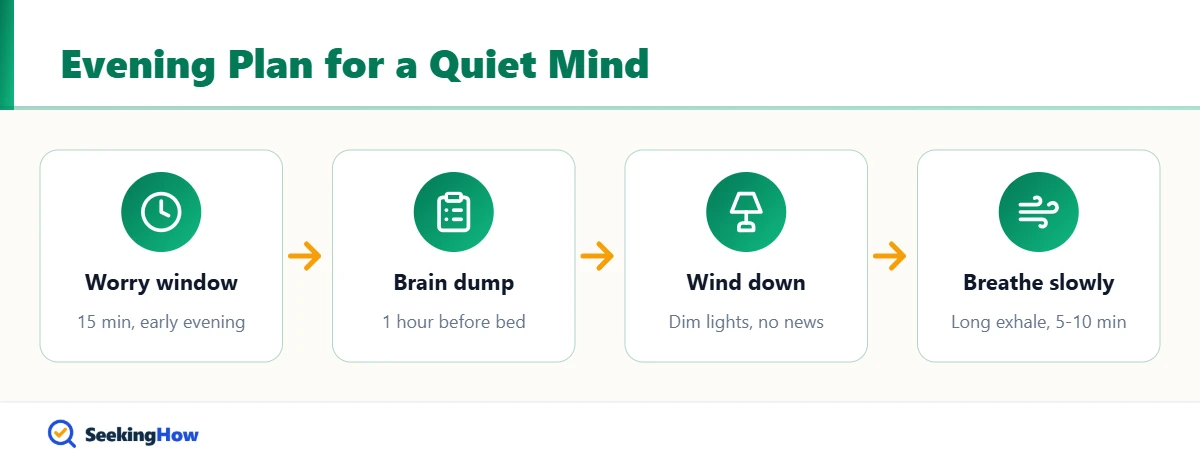
Set aside 15 minutes in the early evening, at least 2 hours before bed, to think through what is bothering you on purpose. Write each worry and one concrete next step, even if the step is “ask Sam on Monday.” When worries show up later, remind yourself they already have a time and a plan.
Step 2: Do a Brain Dump Before Bed
About an hour before bed, write tomorrow’s to-do list and anything still on your mind. Getting tasks onto paper reduces the mental effort of remembering them. Most people find a specific list works better than vague journaling, which can turn into more rumination.
Step 3: Wind Down for 30 to 60 Minutes
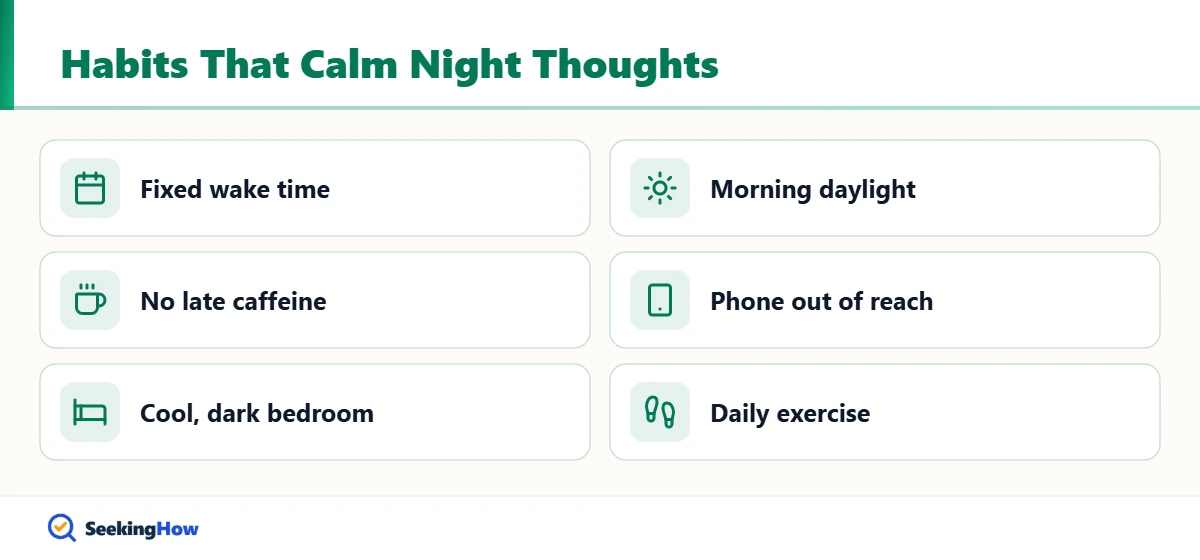
Dim the lights, put work and news away, and switch to quiet activities like reading fiction, stretching, or a warm shower. Bright screens and emotionally charged content keep the brain alert. Keep the phone out of reach of the bed if you tend to check it.
Step 4: Slow Your Breathing in Bed
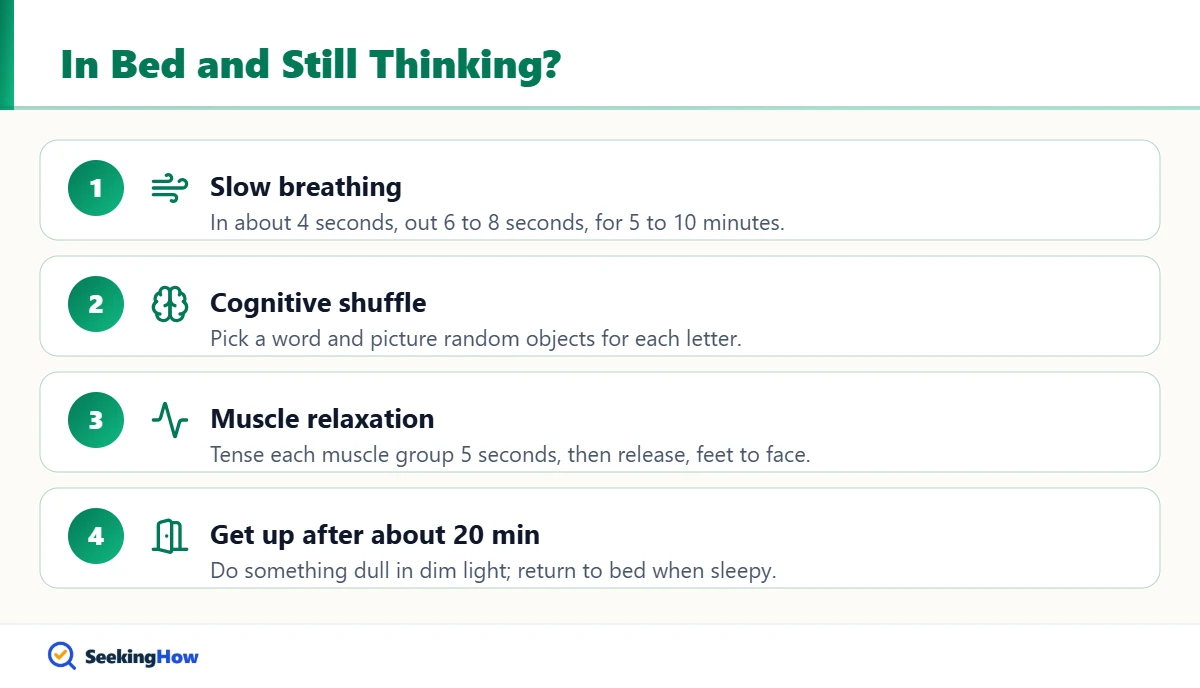
Breathe in through your nose for about 4 seconds and out slowly for about 6 to 8 seconds, for 5 to 10 minutes. A longer exhale shifts the nervous system toward a calmer state. Do not force deep breaths; slow and gentle is the goal.
Step 5: Use the Cognitive Shuffle
Pick a random word such as “garden,” then for each letter imagine as many unrelated objects as you can: g for goat, guitar, glove; then a for apple, anchor. These random images are too boring to worry about and too absorbing to leave room for problem-solving. In practice, many people fall asleep before finishing the word.
Step 6: Get Up if You Are Still Awake After About 20 Minutes
If you feel wide awake or frustrated, go to another room, keep the lights dim, and do something calm and dull until you feel sleepy. Do not watch the clock; estimate. This step, called stimulus control, is a core part of CBT-I and keeps the bed linked with sleep rather than worry.
Step 7: Keep a Fixed Wake Time
Get up at the same time every morning, including weekends, even after a bad night. A consistent wake time builds sleep drive for the next night. Long naps and sleeping in tend to make the next bedtime more restless.
Bottom line: deal with worries on paper in the evening, use breathing or the cognitive shuffle in bed, and get up instead of lying awake and thinking.
If That Didn’t Work
Problem: The same worry loops all night. Cause: An unresolved problem with no plan. Fix: Write the worry, the worst case, the most likely case, and one action; then tell yourself “this is scheduled for tomorrow.”
Problem: You wake at 3 a.m. and cannot shut off. Cause: Lighter sleep in the second half of the night plus stress. Fix: Use the same breathing and shuffle techniques, avoid checking your phone, and get up if awake after about 20 minutes.
Problem: Your body feels tense even when thoughts slow down. Cause: Physical stress response. Fix: Try progressive muscle relaxation: tense each muscle group for 5 seconds, then release, from feet to face.
Problem: Overthinking happens all day too. Cause: A broader rumination habit or anxiety. Fix: See our guide on how to reduce overthinking and consider talking with a professional.
Nighttime Techniques Compared
| Technique | When | Time | Best for |
|---|---|---|---|
| Worry window | Early evening | 15 minutes | Recurring problems, best overall habit |
| Brain dump or to-do list | 1 hour before bed | 5 to 10 minutes | Busy minds planning tomorrow |
| Slow breathing | In bed | 5 to 10 minutes | Physical tension and a racing heart |
| Cognitive shuffle | In bed | Until asleep | Looping thoughts |
| Getting out of bed | After about 20 minutes awake | As needed | Frustration and clock-watching |
Safety and When To See a Doctor
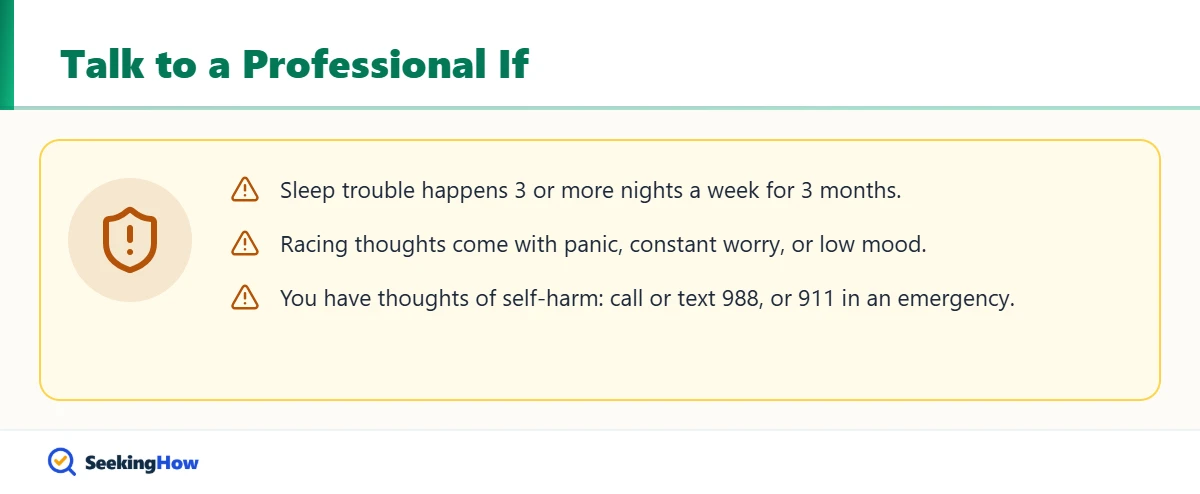
Occasional nights of overthinking are normal. Talk to a doctor or mental health professional if:
- You have trouble falling or staying asleep at least 3 nights a week for 3 months or more.
- Racing thoughts come with ongoing worry, panic attacks, low mood, or loss of interest in things you enjoy.
- Daytime sleepiness affects driving, work, or safety.
- You rely on alcohol, cannabis, or sleep aids most nights to switch off.
- You snore loudly, gasp at night, or wake with headaches, which can point to sleep apnea.
If you have thoughts of harming yourself, call or text 988 in the U.S. to reach the Suicide and Crisis Lifeline, or call 911 in an emergency.
Prevention Tips
- Limit caffeine after early afternoon and alcohol in the evening.
- Get bright daylight in the morning and some physical activity most days.
- Keep the bedroom cool, dark, and quiet, and use the bed only for sleep and intimacy.
- Address physical discomfort that keeps you awake; see how to reduce back pain.
Related Guides
- How to reduce overthinking: 10 techniques to quiet your mind
- How to reduce blood pressure, including stress management
- How to reduce back pain for better sleep
Sources
- National Institute of Mental Health: Generalized anxiety disorder (nimh.nih.gov)
- American Academy of Sleep Medicine: Sleep Education, insomnia and healthy sleep habits (sleepeducation.org)
- Mayo Clinic: Insomnia diagnosis and treatment (mayoclinic.org)
- 988 Suicide and Crisis Lifeline (988lifeline.org)
Frequently Asked Questions
Why do I overthink more at night?
You overthink more at night because bedtime is often the first quiet moment without tasks or distractions. Fatigue also makes it harder to put problems in perspective, so worries feel bigger. Unfinished tasks, stress, and screen use before bed all make racing thoughts more likely.
What is the cognitive shuffle?
The cognitive shuffle is a sleep technique where you pick a random word and imagine unrelated objects that start with each of its letters. The random images keep your mind busy without engaging in problem-solving or worry, similar to the drifting thoughts that come naturally as you fall asleep.
Does writing things down before bed help you sleep?
Yes, writing things down before bed helps many people fall asleep faster. A specific to-do list for the next day or a brief brain dump of worries offloads tasks your mind is trying to remember. Keep it short and practical so it does not turn into more rumination.
Should I get out of bed if I cannot stop thinking?
Yes, if you have been awake for about 20 minutes and feel alert or frustrated, get out of bed. Go to another room, keep lights dim, and do something calm until you feel sleepy. This keeps your bed associated with sleep rather than worrying.
Can overthinking at night be a sign of anxiety?
Yes, frequent overthinking at night can be a sign of an anxiety disorder, especially if worry is hard to control and happens on most days. Other signs include restlessness, muscle tension, irritability, and trouble concentrating. A doctor or therapist can assess it and recommend effective treatment.
What is CBT-I and does it help with racing thoughts?
CBT-I, or cognitive behavioral therapy for insomnia, is a structured program that changes sleep habits and thoughts that keep you awake. It is the recommended first treatment for chronic insomnia and directly addresses nighttime worry. It is available through therapists, sleep clinics, and some digital programs.
Are sleep aids a good way to stop overthinking at night?
Sleep aids are not a good long-term way to stop overthinking at night. Some can cause next-day grogginess, dependence, or side effects, and they do not address the cause of racing thoughts. Talk to a doctor before using any sleep medication or supplement regularly.